

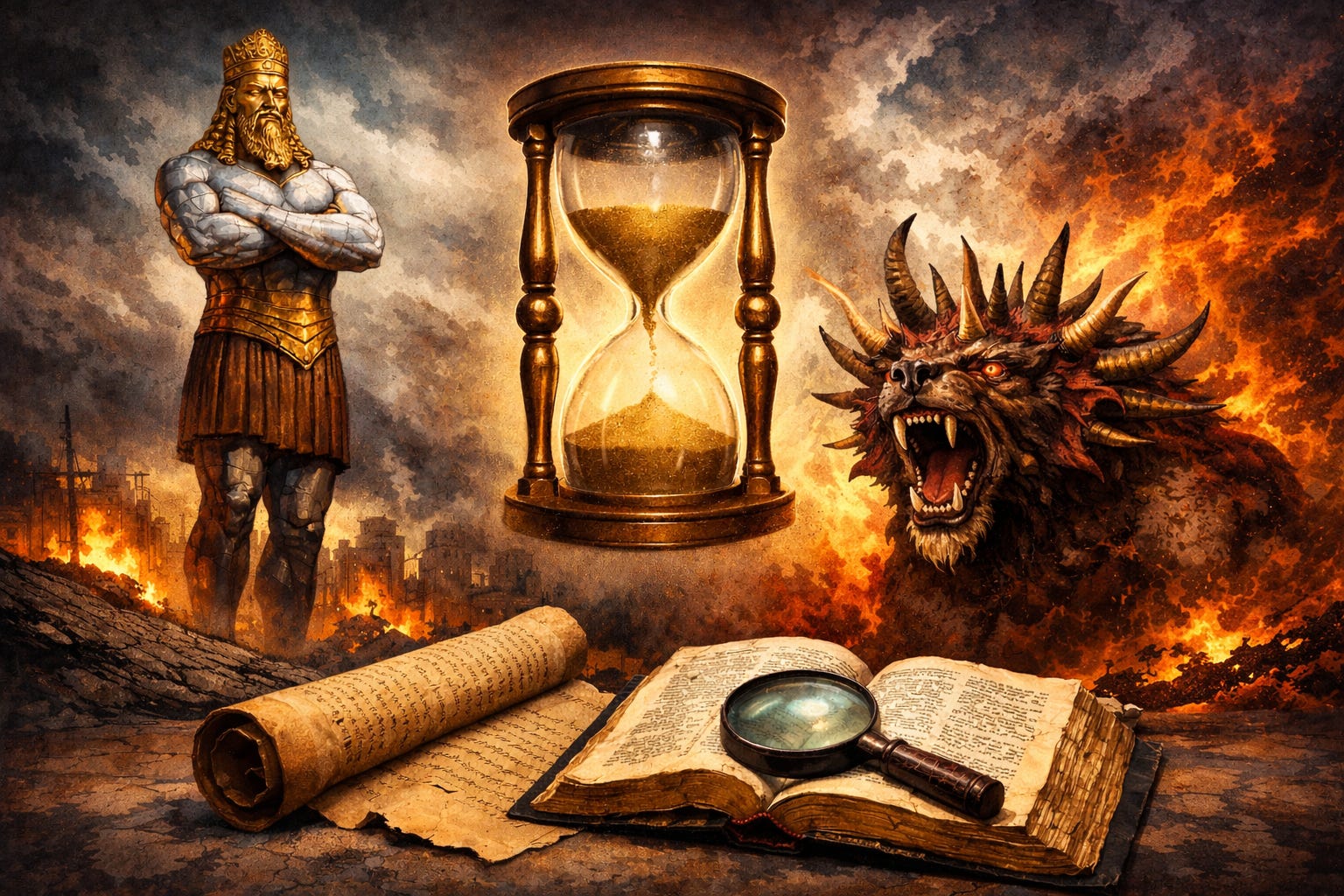
The book of Daniel is one of the best starting points for learning about end-time prophecy. It is cited frequently by Jesus in his discourse on the end of the age (Matt. 24-25). Furthermore, it has a disproportionate influence on the book of Revelation, especially relative to its size.1
A big question people often have is if we are to interpret prophecy literally, figuratively, or somewhere in between. Thankfully, the book of Daniel shows us how to interpret end time prophecy with a very strong degree of precision.
In addition to end time predictions, Daniel also contains prophecies that have already been fulfilled. For example, Daniel predicted Alexander the Great’s defeat of Persia and the dynasties that succeeded his empire after his death (Dan. 8; 11). Daniel also predicted the coming of Antiochus IV Epiphanes, who was a horrible persecutor of the Jews (Dan. 8; 11).2
All these prophecies were written in the book of Daniel over 500 years before the time of Christ.3 The Daniel prophecies about Alexander the Great, Antiochus IV Epiphanes and others were fulfilled hundreds of years later.4 5 Yet these fulfillments still preceded Jesus’ earthly ministry by centuries.
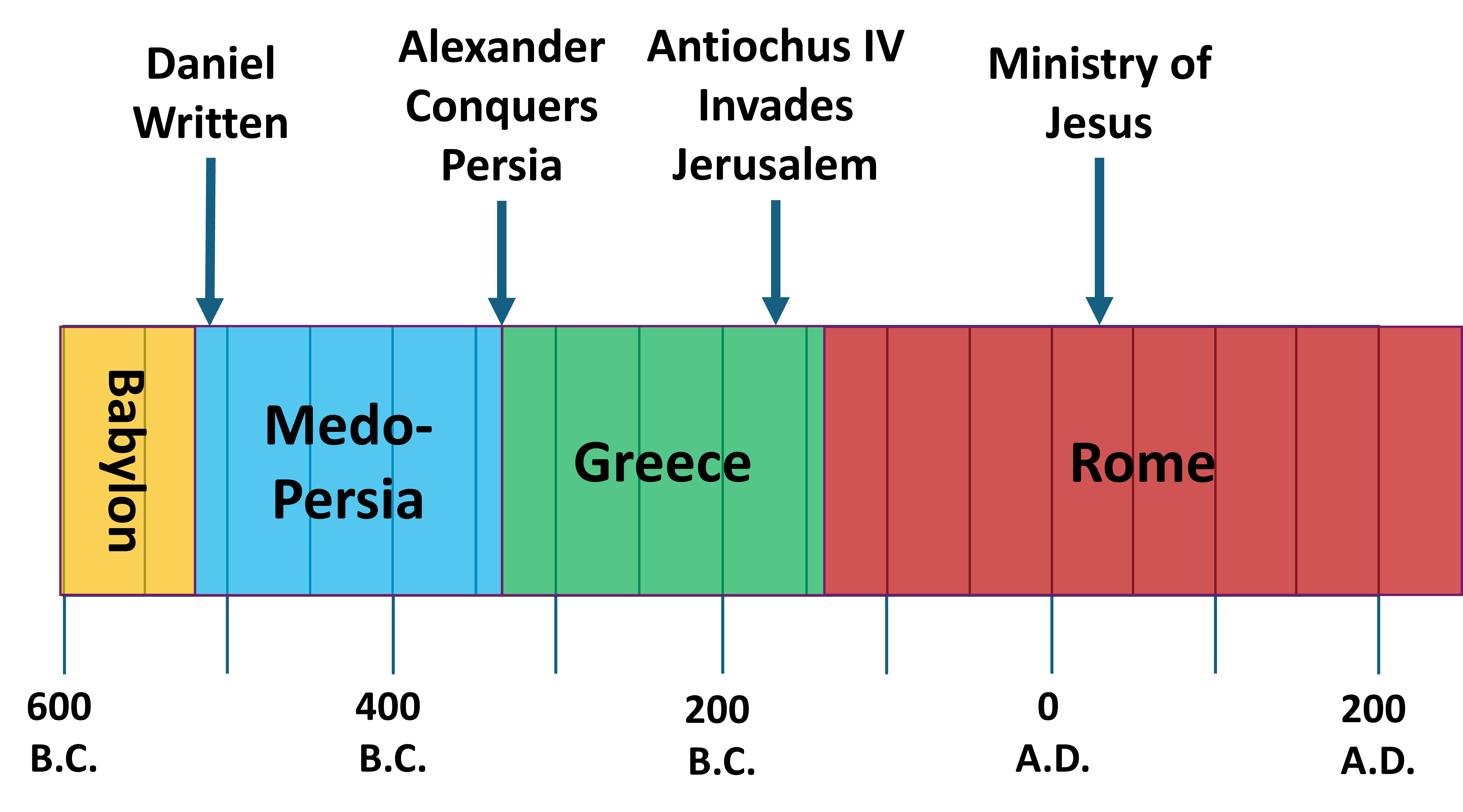
By studying how these prophecies actually turned out in history, we can determine if Daniel intended these prophecies to be taken literally, figuratively, or somewhere in between. As we will see, prophecies about Alexander the Great, Antiochus IV, and others were, for the most part, literally fulfilled in history.
The Prophetic Storyline of Daniel 11
One major example of this is Daniel chapter 11, which is the most detailed and precise prophecy in the entire Bible. The first five verses of the chapter predict Persian king Xerxes’ antagonism against Greece, the rise of Alexander the Great, as well as the four successors who replaced him. 6
Verses 6-20 go on to give an incredibly detailed account of wars back and forth between the “king of the South” and the “king of the North.” These refer to the Syrian Wars, which took place between the Seleucid Empire north of Israel and the Ptolemaic Empire, which was south of Israel. 7
Verses 21-35 describe that wicked persecutor of the Jews, Antiochus IV Epiphanes. It goes into great detail about his military campaigns and his attempts to lure the Jews into idolatry. He ultimately set up an altar to Zeus on the altar of the Jewish temple, in an event known as the “abomination of desolation.” After a successful Jewish revolt, the temple was rededicated. Today, this is celebrated as Hanukkah.8

All these prophecies came true in a literal fashion. As a result, the remaining 10 verses in the chapter ought to be interpreted in a relatively literal fashion as well.
Verses 35-39 suddenly shift to a figure who exalts himself above every god. The text emphasizes that he won’t even honor the gods of his ancestors but will boast against them all. Furthermore, he honors a “god of fortresses” (military might) with financial means and promotes people based on their willingness to support his cause.9
His battles in verses 40-45 are much more sweeping and grandiose than those of Antiochus IV or his predecessors. After being attacked, this self-exalting figure goes on a rampage through many countries, ultimately invading Israel and taking control over northern Africa. While preoccupied in Egypt, he responds to bad reports north and east of Israel. On the way north, he sets up shop in Israel and is ultimately defeated there.10
Yet this poses a problem. The battles in verses 40-45 do not correspond well to history. This man’s defeat does not correspond to Antiochus IV, since Antiochus did not meet his end in the Holy Land.11
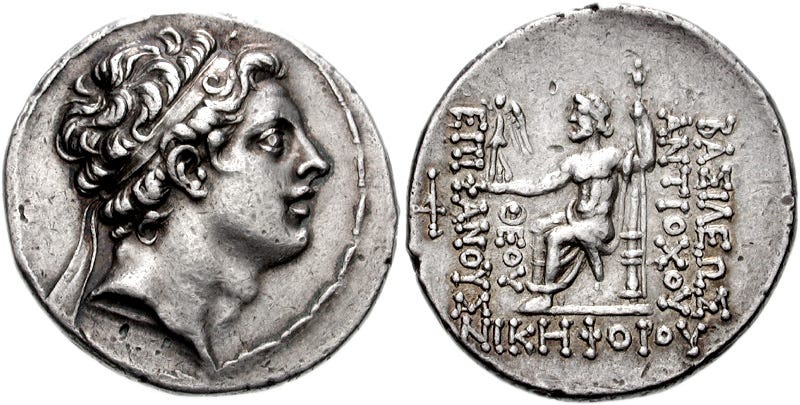
Furthermore, the arrogance of this figure goes above and beyond even Antiochus IV Epiphanes. Antiochus IV made coins that called himself “god manifest.” 12 However, he clearly honored the gods of his ancestors, since he tried to get people to worship Zeus. Though Antiochus IV probably was perhaps claiming to be Zeus “manifest,” he still honored the gods of the Greek pantheon.
To try to make these verses fit into history, we could consider giving them more interpretive leeway than the preceding verses. Yet this immediately raises the question as to why we would change our method of interpretation two thirds into a chapter, when no change in literary genre is indicated. To “change horses midstream” is a rather unsatisfying and ultimately, inadmissible solution.
The rest of the book of Daniel, and even the apostle Paul, can give us clues to the interpretation of this figure. Paul alludes to Daniel 11:36 and speaks of an extremely boastful figure who exalts himself above every god, even to the point of sitting in the temple of God (2 Thess. 2:4). Paul goes on to say that he will be personally destroyed by Jesus Christ at His Second Coming (2 Thess. 2:8).
This end time interpretation fits well with the rest of the book of Daniel, which speaks of the general resurrection of the dead which happens around the time that this wicked figure is operating (Dan. 12:2). Furthermore, just before the mentioning of this terrible monarch, the text pivots to the “end time” (Dan. 11:35).
We can thus conclude that the end of Daniel 11 describes a literal wicked king who will be defeated by God in the end times. If prophecies of Antiochus IV and Alexander are literal, then so too are the prophecies of this particular villain.
Historical Fulfillment in Daniel 8
All this is fine and dandy when it comes to prophecies which are presented literally. But Daniel contains visions of beasts and horns, representing empires and kings. So how are we supposed to interpret these symbols, which are clearly not literal in nature?
As it turns out, we can use the same process to interpret Daniel’s visions. We can take the imagery and the angel’s interpretation of the vision and compare how these actually turned out in history. Daniel 8 is an excellent case study for this.
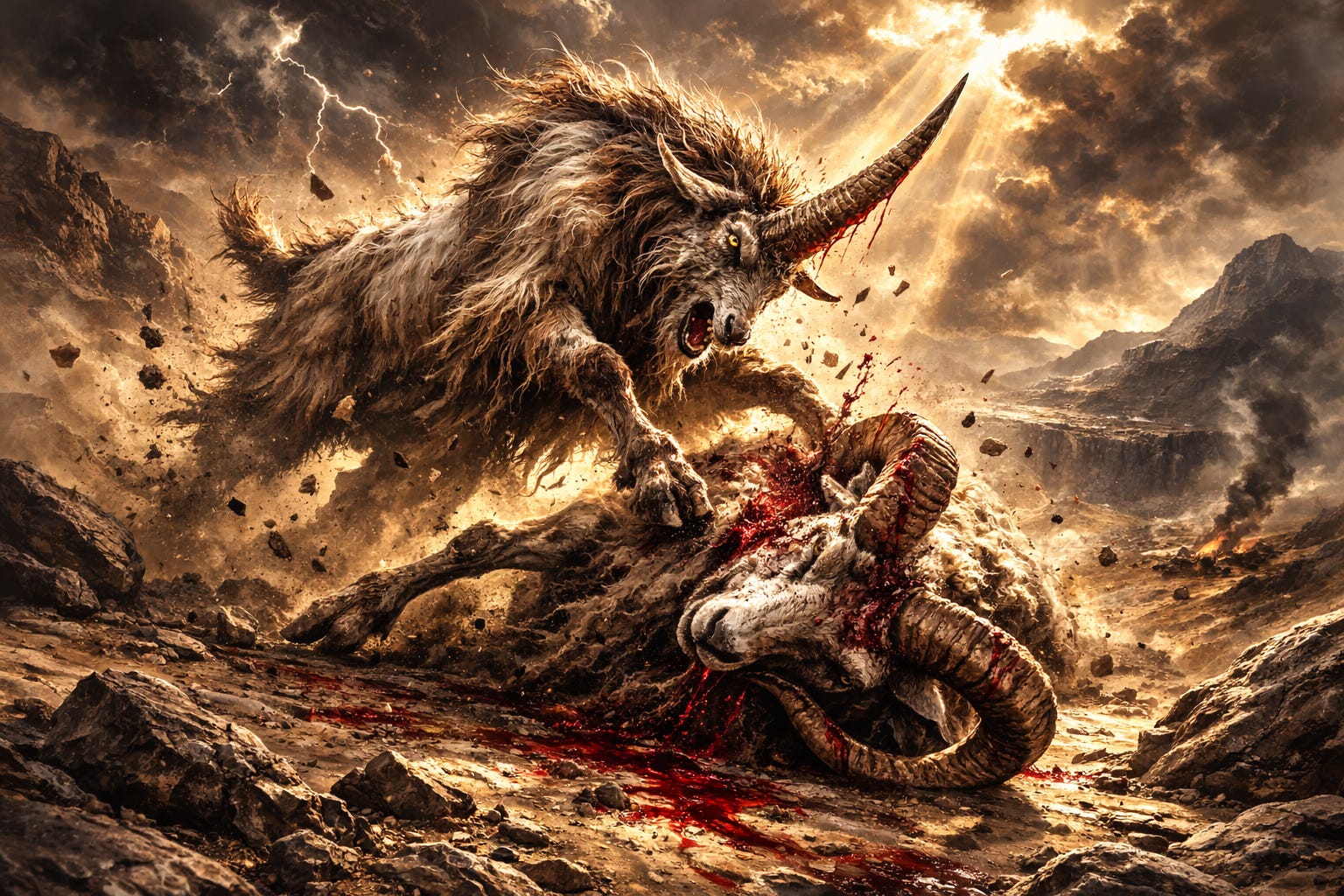
In his vision, Daniel sees a ram with two horns charging around in an undefeated manner (Dan. 8:4). Then, a goat with a big horn on its head charges the ram and violently defeats it (Dan. 8:5-7). However, the big horn on the goat’s head is broken, causing four horns to rise up in its place (Dan. 8:8).
A little horn then arises from one of the four horns, growing very great in multiple directions. This horn opposes God and desecrates the Jewish temple. However, the sanctuary is properly restored after a set period of time (Dan. 8:9-14).

The angel interprets this for Daniel, saying that the ram with two horns represent the “kings of Media and Persia” (Dan. 8:20). Therefore, the ram represents the Medo-Persian empire. However, the shaggy goat attacks the Medo-Persian ram, totally defeating it. The big horn on the goat’s head represents the “first king” in the Greek empire, corresponding to Alexander the Great (Dan. 8:21).
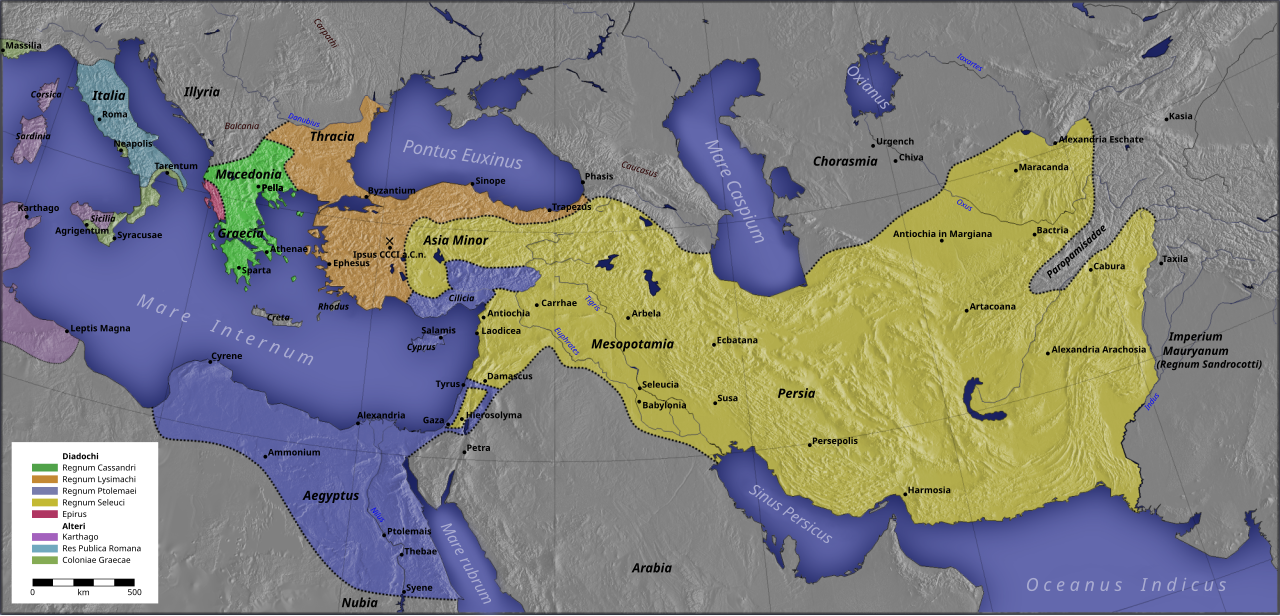
Nevertheless, the big horn on the head of the goat is broken, representing the death of Alexander. The four horns represent his four successors who came up in his place during the Hellenistic period. (Dan. 8:22; 11:3-4)
Finally, the little horn represents a cunning king that opposes God and hurls truth to the ground. Despite opposing God, he is defeated without human intervention (Dan. 8:23-26). This last king corresponds to Antiochus IV Epiphanes. Though he opposed God and persecuted the Jews, he died from an illness outside of Israel.13
Just like how the prophecies of Alexander and Antiochus IV literally came true in Daniel 11, so too, the angel’s interpretation of these events literally came true. Furthermore, the imagery corresponds to what happened in history.
For example the ram, representing Medo-Persia, had two horns, with the longer horn coming up last. This corresponds to the lop-sided nature of the Medo-Persian empire, which came to be dominated by the Persian side during its heyday.14 Furthermore, the broken horn on the goat represents the death of Alexander. Finally, the little horn that came up out of one of the four horns represents how Antiochus IV came from one of the four kingdoms that succeeded Alexander.15
End Time Prophecy in Daniel 7
Daniel 7 describes one of Daniel’s visions which contain a lot of the same themes as Daniel 8. Both involve a series of animals leading up to a final antagonist. Furthermore, the last animal has a little horn coming up from among other horns, similar to Daniel 8. Both of these little horns represent a villain who persecutes God’s people for approximately 3 years until they are ultimately defeated.
Despite their thematic similarities, they have several important differences. Daniel 8 only describes two animals in a series, a ram and a goat. However, Daniel 7 describes four beasts in a series. In Daniel 8, the last beast has a little horn that comes up out of one of the four horns. Yet in Daniel 7, a little horn arises from among ten horns, not out of one of the four horns as in Daniel 8.
The identities of these four empires are relatively uncontroversial. Daniel 2 also presents the same four kingdoms, from a different angle. In that passage, the first kingdom in the sequence is Babylon. Furthermore, Daniel 5 tells us that the Medo-Persian empire succeeded the Babylonian empire. As we saw before, Daniel 8 tells us that Alexander’s Greek empire succeeded Medo-Persia. This leaves the fourth and last kingdom, which is the Roman Empire. It defeated the Greek empire and was terrifying and violent, just like Daniel 7 describes.

Just like in Daniel 8, there is a direct historical correspondence between the characteristics of the animals in Daniel 7 and the empires they represent. This, among other reasons, is why commentators are in wide agreement that the fourth beast represents the Roman Empire.16
Daniel 8 and Daniel 7 are very similar types of literature that have similar themes. Therefore, it would be inappropriate to interpret Daniel 8 with one method of interpretation, only to abandon that method in the previous chapter. This is particularly true, given that the beasts in Daniel 7 correspond to history in the same way that the animals in Daniel 8 do.
But just like in Daniel 11, we run into a situation where the last part of the vision in chapter 7 has not been literally fulfilled. Daniel 7 states that ten horns, representing ten kings, will come from the fourth beast, which is the Roman Empire (Daniel 7:23). Then a little horn rises up among the ten, uprooting three in the process (Dan. 7:7-8). The angel interprets this for Daniel, saying that this king will “humble” three of the original ten in his rise to power (Dan. 7:23-24). We can already see that this does not correspond to Roman history.

The text of Daniel 7 says that this little horn goes on to boast against God and persecute God’s people. Yet he is violently destroyed when God sets up an eternal kingdom, led by the Messiah (Dan. 7:11-14). In this new kingdom, all empires and rulers are in submission to God and his people (Dan. 7:27). Once again, this cannot apply to the fall of the Roman Empire, since it gradually disintegrated.17
Just like with the wicked figure in Daniel 11, we can find clues in the New Testament about the nature of this wicked man. In context, this final ruler is defeated when the “son of man” comes “on the clouds of heaven” as Daniel 7:13 says. He goes on to receive a kingdom where all nations worship him (Dan. 7:24).
“Son of man” is probably the most common title that Jesus used for Himself throughout the four Gospels. Furthermore, Jesus uses the language of the son of man coming on the clouds of heaven to describe his Second Coming in Matthew 24:30. Finally, the beast with ten horns reemerges in Revelation 13 and 17, only to be defeated by Jesus Christ during the battle of Armageddon (Rev. 19). These would lead us to believe that the final ruler of the Roman Empire in Daniel 7 is defeated in the end times, not during the historical Roman Empire.
Focus on Outcomes, Not Gaps or Processes
Though prophecies in Daniel are fulfilled in a consistently literal manner, there are some nuances to keep in mind. For example, Bible prophecies Daniel tend to only describe political outcomes. The prophecies deliberately leave out large gaps of time and the messy historical processes that led up to those outcomes. There are several examples of this within Daniel.
First, Daniel 8 seems to describe Alexander’s fight against Persia as a violent and climactic defeat. However, Alexander actually spent over three years fighting three separate battles before finally defeating the Persians.18 This supports the idea that the vision is emphasizing the outcome of Alexander’s battles, not the drawn-out military campaigns that led to the defeat of the Persians.
Second, both Daniel 8 and Daniel 11 make it seem like Alexander’s four successors replaced him immediately after he died. Yet his potential successors battled for over 20 years before finally landing in the Hellenistic world’s four-part division after the Battle of Ipsus in 301 B.C. 19
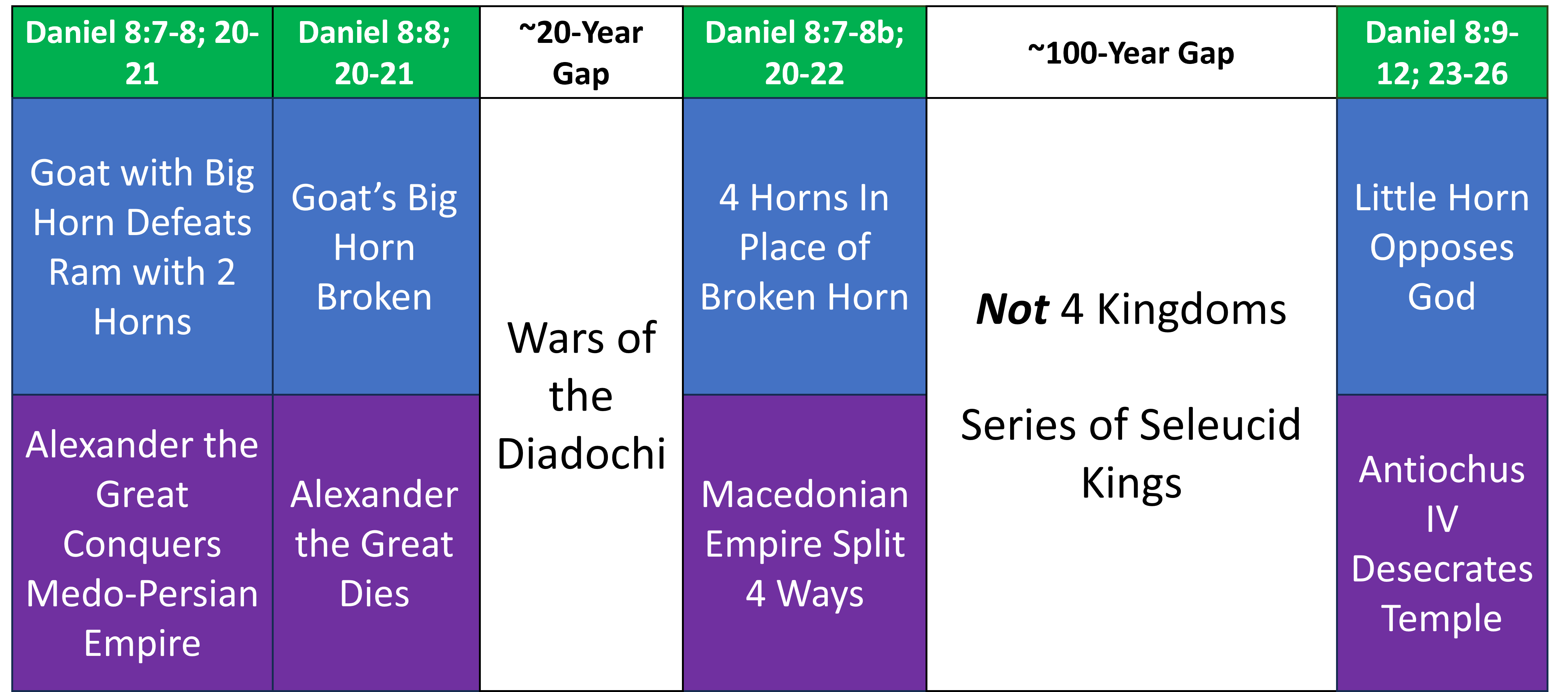
Third, Antiochus IV is said to come up out of one of the four horns. This is true, since he came up from the Seleucid Empire, which was one of the four kingdoms that succeeded Alexander. But the four-part configuration of the Hellenistic world had long ended by that point.20
In the same vein, prophecies often skip large gaps of time that are irrelevant to the final historical outcome. For example, Daniel 11:2-5 talks about the first four kings after Darius the Mede, ending with Xerxes, who would be far richer than the previous three and would provoke Greece. Then, it starts talking about a “mighty king” who we know to be Alexander the Great.
However, the prophecy skipped about 6 kings between Xerxes and Alexander, since it wasn’t part of the author’s literary goals.21 Yet this is not misleading, since the text never says that Alexander came immediately after Xerxes.
All these show a focus on the outcome, not the intervening political processes leading up to the outcome. The author skips irrelevant time gaps and historical details in order to focus on how things will turn out at the end of each process.
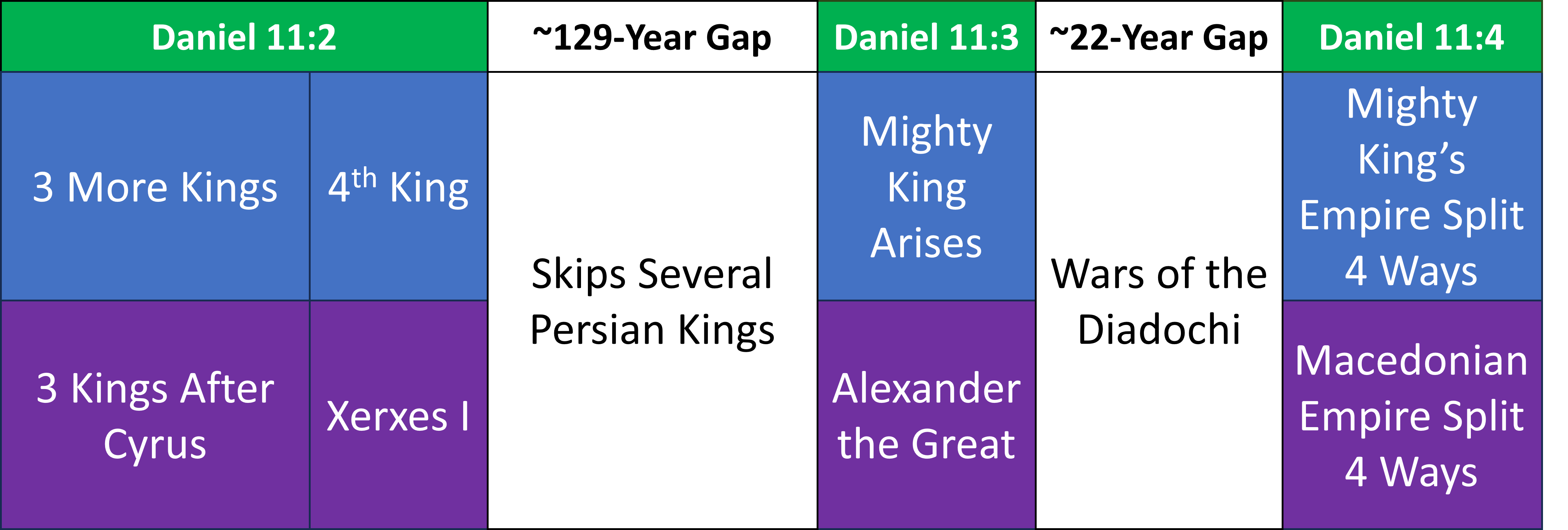
This nuance helps inform our literal understanding of end-time prophecy in Daniel. For example, it helps us understand why there is a huge gap of time between the historical Roman Empire and the defeat of its final villain in Daniel 7. The prophecy did not mention this gap of time. However, this does not mean a gap is absent, as Daniel 11:2-4 indicates.
Furthermore, the rise to power of the little horn in Daniel 7 may not be as smooth and seamless as some theologians portray. On the contrary, it will involve messy historical processes, the historical outcome of which will involve a relatively insignificant king rising to power, humbling and (possibly replacing) three of the original ten kings in the process.
Conclusion
We have seen how a consistent method of interpretation leads us to believe in literal end time prophecies about a terrible villain who will emerge in the end times, only to be defeated by Christ at the Second Coming. This rules out interpretations such as preterism, which see these as having already been fulfilled in the events surrounding the destruction of the Jewish temple in 70 A.D. It also rules out allegorical interpretations which see these as descriptions of the history of the church.
This has large implications for our interpretation of other passages, such as those found in Matthew 24, 1 & 2 Thessalonians, and Revelation. As it turns out, the use of Daniel by Jesus, Paul, and John in the book of Revelation does not diminish the idea that these are literal future events. On the contrary, it greatly amplifies that notion.
Use of Old Testament in Revelation. Arnold Fruchtenbaum | CTS Journal https://www.chafer.edu/CTS-Journal-The-Use-of-the-Old-Testament-in-the-Book-of-Revelation-by-Arnold-G-Fruchtenbaum
A Commentary on the Book of Daniel: A Man of Faith, Integrity, and Insight https://paultanner.org/English%20Docs/Daniel/Commentary/Dan%20Comm%20for%20BEE_P%20Tanner_Ver%201.15_8.4.2017.pdf (page 63)
Who Wrote the Book of Daniel? Part 4: Five Positive Evidences for an Early Daniel - The Good Book Blog - Biola University https://www.biola.edu/blogs/good-book-blog/2022/who-wrote-the-book-of-daniel-part-4-five-positive-evidences-for-an-early-daniel1
Alexander the Great | Empire, Death, Map, & Facts | Britannica https://www.britannica.com/biography/Alexander-the-Great
Antiochus IV Epiphanes | Biography, Reign, Jerusalem, Revolt, & Death | Britannica https://www.britannica.com/biography/Antiochus-IV-Epiphanes
A Commentary on the Book of Daniel: A Man of Faith, Integrity, and Insight https://paultanner.org/English%20Docs/Daniel/Commentary/Dan%20Comm%20for%20BEE_P%20Tanner_Ver%201.15_8.4.2017.pdf (page 91-93)
A Commentary on the Book of Daniel: A Man of Faith, Integrity, and Insight https://paultanner.org/English%20Docs/Daniel/Commentary/Dan%20Comm%20for%20BEE_P%20Tanner_Ver%201.15_8.4.2017.pdf (page 94-98)
A Commentary on the Book of Daniel: A Man of Faith, Integrity, and Insight https://paultanner.org/English%20Docs/Daniel/Commentary/Dan%20Comm%20for%20BEE_P%20Tanner_Ver%201.15_8.4.2017.pdf (page 99-104)
Preaching and Teaching the Last Things: Old Testament Eschatology for the Life of the Church https://www.google.com/books/edition/Preaching_and_Teaching_the_Last_Things/h7JJPu6XlhsC?hl=en&gbpv=0 (p. 126-132)
Preaching and Teaching the Last Things: Old Testament Eschatology for the Life of the Church https://www.google.com/books/edition/Preaching_and_Teaching_the_Last_Things/h7JJPu6XlhsC?hl=en&gbpv=0 (p. 126-132)
Antiochus IV Epiphanes | Biography, Reign, Jerusalem, Revolt, & Death | Britannica https://www.britannica.com/biography/Antiochus-IV-Epiphanes
Antiochos IV Epiphanes - Antiochus IV Epiphanes - Wikipedia https://en.wikipedia.org/wiki/Antiochus_IV_Epiphanes#/media/File:Antiochos_IV_Epiphanes.jpg

A Commentary on the Book of Daniel: A Man of Faith, Integrity, and Insight https://paultanner.org/English%20Docs/Daniel/Commentary/Dan%20Comm%20for%20BEE_P%20Tanner_Ver%201.15_8.4.2017.pdf (page 70)
Achaemenid Empire - Wikipedia https://en.wikipedia.org/wiki/Achaemenid_Empire
A Commentary on the Book of Daniel: A Man of Faith, Integrity, and Insight https://paultanner.org/English%20Docs/Daniel/Commentary/Dan%20Comm%20for%20BEE_P%20Tanner_Ver%201.15_8.4.2017.pdf (page 93)
Theologian Quotes: The Fourth Kingdom in Daniel 7 is the Roman Empire https://www.christwillreturn.com/p/theologian-quotes-the-fourth-kingdom
Fall of the Western Roman Empire - Wikipedia https://en.wikipedia.org/wiki/Fall_of_the_Western_Roman_Empire
Chronology of the expedition of Alexander the Great into Asia - Wikipedia https://en.wikipedia.org/wiki/Chronology_of_the_expedition_of_Alexander_the_Great_into_Asia
A Commentary on the Book of Daniel: A Man of Faith, Integrity, and Insight https://paultanner.org/English%20Docs/Daniel/Commentary/Dan%20Comm%20for%20BEE_P%20Tanner_Ver%201.15_8.4.2017.pdf (page 93)
World in 200 BCE - Hellenistic period - Wikipedia https://en.wikipedia.org/wiki/Hellenistic_period#/media/File:World_in_200_BCE.png
