

(NOTE: A small section was added on Dec. 4, 2025, to increase the strength of the argument. You can jump straight to the new section by clicking here. Furthermore, this article received minor updates for clarity and grammar on that same day).
Where will the Antichrist come from?
Will the Antichrist come from a revived Roman Empire from Europe as most futurist scholars say? Or will he be a Muslim from a revived Ottoman Empire based in Turkey, as author Joel Richardson thinks?
In this article, I am going to make a positive case that the Antichrist will come from a revived Roman Empire. I will also provide a response Joel Richardson’s book, where he argues that the Antichrist will come from a revived Ottoman Empire. (He has kindly provided his book for free. You can read it here.)
Nothing in this article should be considered as an attack on Joel’s character. I do not know him personally, so I can’t vouch for him on that level. Nevertheless, I hear positive things about what he is doing for the kingdom.
Theological Assumptions
For purposes of our discussion, I am going to assume the “futurist” view, that a literal, blasphemous king will persecute God’s people in the end times. This wicked man will be personally defeated by Jesus Christ at His Second Coming.
This is in contrast to the preterist view, where those Antichrist passages are seen as referring to someone in the past (like Nero Caesar). I plan to evaluate and critique preterism in another post.
I also believe in Biblical inerrancy, namely, that everything God says is true. I realize this is not a given for some. I plan to write an article defending the authenticity of the prophecies in Daniel. But for purposes of this article, I am assuming that the Bible is completely true.
I will be using the NASB2020 Bible translation. The New American Standard Bible is well known for being one of the best word-for-word translations available. Regarding the Bible quotes, bear in mind the use of italics. As the Lockman Foundation website states:
In the NASB, italics are used to communicate to the reader words that are not found in the original language, but are implied in the original language or are needed for a complete thought in English.1
To be clear, I do not know Hebrew, Aramaic, or Greek. Where definitions are required, I will try to use a scholarly lexicon like The Hebrew and Aramaic Lexicon of the Old Testament (HALOT) or A Greek-English Lexicon of the New Testament and Other Early Christian Literature (BDAG). These lexicons incorporate word usage from other texts from the time period, both within and outside the Bible. I will use these when possible. Otherwise, I will use Hebrew/Greek interlinear.
Overview of Arguments in Favor of a Roman Antichrist
My positive case for a Roman Antichrist revolves around the following claims:
1) Rome is the Fourth Kingdom in an Ordinal Succession
The Roman Empire is the only political entity that qualifies as the “fourth” kingdom in Daniel’s four kingdom sequence of chapter 2 & 7. On the contrary, the Ottoman Empire cannot be considered the “fourth” kingdom on any system of counting, especially when ordinal succession is in view.
2) The Roman Empire Fits the Description of the Fourth Kingdom
The Roman Empire fits well with the description of the fourth kingdom in both Daniel 2 and 7. It’s terrifying strength, destructive nature, location on the Mediterranean Sea, and persecution of Israel fit with the symbols provided in those texts, as well as their interpretations. Comparisons to the Ottoman Empire are a moot point, as the Roman empire adequately fulfills the descriptions in Daniel 2 and 7.
3) The Antichrist Will Have Global Authority at the Peak of His Reign
The beginning of the Antichrist’s reign will be regional, centered around the Euro-Mediterranean area. Nevertheless, he gains authority over the entire planet at the height of his reign, due to military conquest and religious deception. This two-stage reign, among other things, provides the best explanation for the seven-kingdom sequence in Revelation 17. On the contrary, Richardson’s seven kingdom sequence is not the best explanation of the passage.
4) The “People of the Prince” Is Best Understood to be the Romans
Daniel 9:26-27 indicates that the Antichrist will come from the same people that would destroy the temple and Jerusalem. Most commentators believe this refers to the Romans, since they did this very thing in the year 70 A.D. Richardson contends that the Hebrew word for “people” always means an ethnic group, arguing that most of the soldiers at that siege were of Syrian, Arab or Middle Eastern descent. On the contrary, Hebrew usage of this word most naturally reads in a non-ethnic sense in Daniel 9:26.
5) The Antichrist Will Be Self-Deifying, Not Islamic
The Bible consistently shows that the Antichrist will exalt himself above every god or deity, including the true God. He will do this to such an extent that he will display himself as God in a rebuilt Jerusalem temple. Richardson argues that the Islamic Antichrist will stop short of actually deifying himself. On the contrary, the Bible overwhelmingly points to the self-deification of the Antichrist. In context, his service to the “god of fortresses” in Daniel 11:38 is best explained by the worship of military might rather than regard for a traditional deity like Allah.
6) The Northern Foe in the Bible is Distinct from the Antichrist
The Bible repeatedly speaks of a northern antagonist(s) who will be defeated in the end times. Richardson’s arguments attempting to equate this northern foe with the Antichrist are ultimately unsuccessful. Furthermore, equating Daniel’s “king of the North” with the Antichrist does not ultimately undermine the Roman thesis, as Rome occupied the areas directly north of Israel at the height of its reign. Finally, there is good reason to believe that the “king of the north” is distinct from the Antichrist.
1. Rome is the Fourth Kingdom
Daniel 2 and 7 describe four empires that rise up in world history, one after another. In chapter 2, Babylonian king Nebuchadnezzar has a dream of a giant statue, with four parts of its body each made of different metals. Then a rock hits the feet of the statue, causing the whole thing to come tumbling down. In chapter 7, Daniel sees a vision of four beasts that rise up out of the “great sea,” one after another. The final beast is violently destroyed by God when he sets up a global kingdom, led by the Messiah.
Daniel 2 identifies the first empire as Babylon. Daniel 5 tells us that the Medo-Persian empire came after the Babylonian Empire. Furthermore, Daniel 8 says that Greece came after the Medo-Persian Empire. This leaves the fourth empire, which came after Greece. It was terrifying and violent, just like Daniel 7 describes.
Scholarly Consensus
A wide consensus of scholars, starting from the early church all the way to the present, identify the fourth empire as Rome. You can check out quotes from those scholars here.
Preterists say the prophecy of the fourth kingdom has been completely fulfilled in the historical Roman Empire. Others believe Roman Empire will revive in the end times, to be led by the Antichrist (as I do). Others (such as Lutherans) associate the fourth kingdom with the Papacy and the Roman Catholic church. Yet despite these differences, they all agree that Rome is the final kingdom in the four-kingdom sequence.
Richardson should be commended for his willingness to challenge the consensus on these issues where he thinks they are mistaken. Scholarly consensus does not make something true. However, the truth is often a reason why there is a scholarly consensus. I hope to demonstrate that the latter is true in this case.
Rome is the “fourth” kingdom in ordinal succession in both Daniel 2 & 7. To make sense of this, we first have to explore the two passages that discuss this sequence of four empires.
The Fourth Kingdom in Daniel 2
Let us take Daniel 2 for example:
31 “You, O king, were watching and behold, there was a single great statue; that statue, which was large and of extraordinary radiance, was standing in front of you, and its appearance was awesome. 32 The head of that statue was made of fine gold, its chest and its arms of silver, its belly and its thighs of bronze, 33 its legs of iron, and its feet partly of iron and partly of clay. 34 You continued watching until a stone was broken off without hands, and it struck the statue on its feet of iron and clay, and crushed them. 35 Then the iron, the clay, the bronze, the silver, and the gold were crushed to pieces all at the same time, and they were like chaff from the summer threshing floors; and the wind carried them away so that not a trace of them was found. But the stone that struck the statue became a great mountain and filled the entire earth. (Daniel 2:31-35)
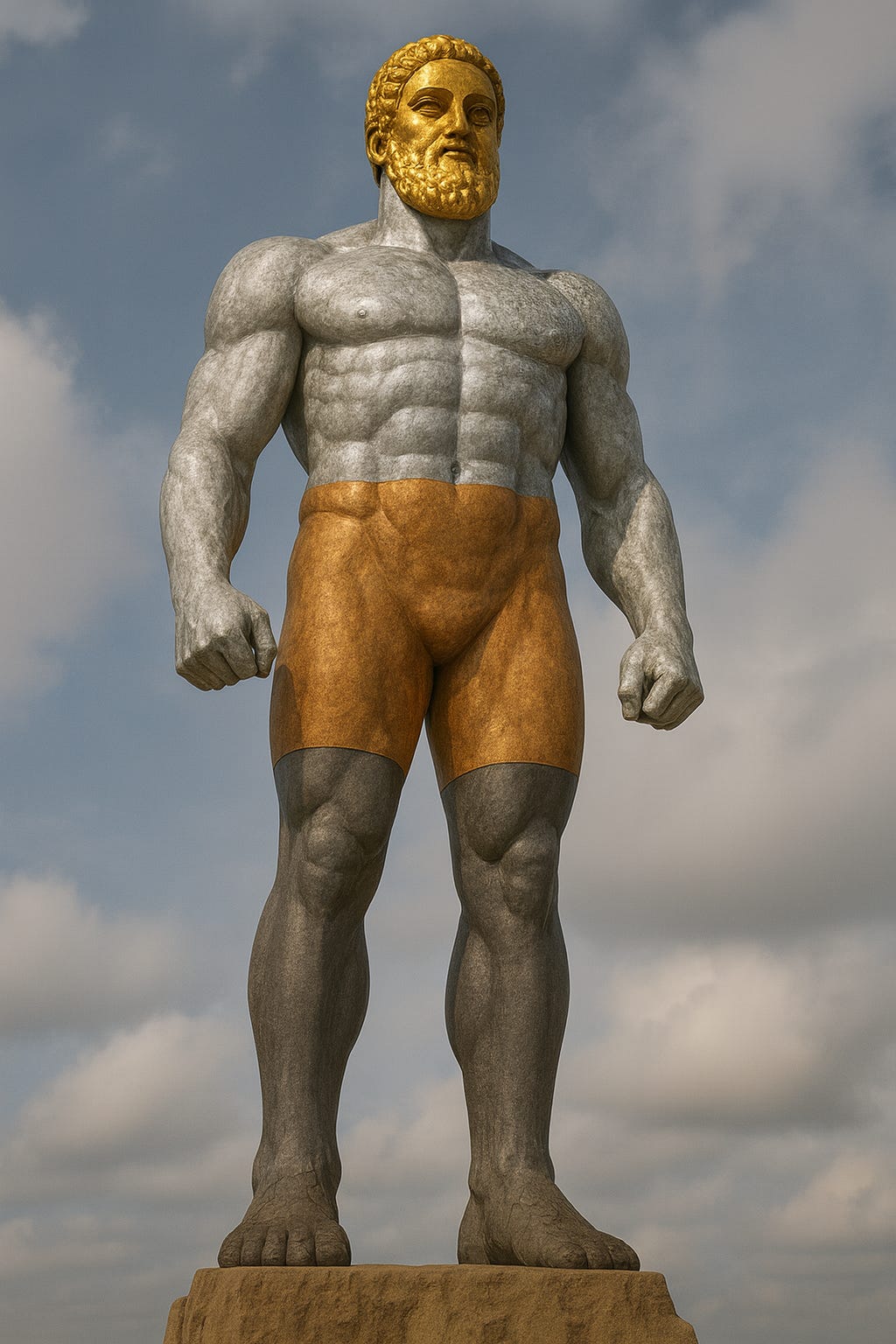
When he interprets the dream, Daniel explicitly states that the first kingdom is Nebuchadnezzar’s Babylon.
36 “This was the dream; and now we will tell its interpretation before the king. 37 You, O king, are the king of kings, to whom the God of heaven has given the kingdom, the power, the strength, and the honor; 38 and wherever the sons of mankind live, or the animals of the field, or the birds of the sky, He has handed them over to you and has made you ruler over them all. You are the head of gold. (Daniel 2:36-38)
Daniel goes on to say that another kingdom would arise “after you.” Then a “third kingdom of bronze” would come after the second kingdom.
39 And after you another kingdom will arise inferior to you, then another third kingdom of bronze, which will rule over all the earth. (Daniel 2:39)
Daniel very clearly is providing us an ordinal sequence of kingdoms. This is further reinforced by the fact that he goes on to discuss a “fourth kingdom.” Unlike the previous three empires, which are represented by one metal each, this final empire has two stages.
40 Then there will be a fourth kingdom as strong as iron; just as iron smashes and crushes everything, so, like iron that crushes, it will smash and crush all these things. 41 And in that you saw the feet and toes, partly of potter’s clay and partly of iron, it will be a divided kingdom; but it will have within it some of the toughness of iron, since you saw the iron mixed with common clay. 42 And just as the toes of the feet were partly of iron and partly of pottery, so some of the kingdom will be strong, and part of it will be fragile. 43 In that you saw the iron mixed with common clay, they will combine with one another in their descendants; but they will not adhere to one another, just as iron does not combine with pottery. (Daniel 2:40-43)
Nevertheless, God defeats the fourth empire and sets up an eternal, global kingdom in its place.
44 And in the days of those kings the God of heaven will set up a kingdom which will never be destroyed, and that kingdom will not be left for another people; it will crush and put an end to all these kingdoms, but it will itself endure forever. 45 Just as you saw that a stone was broken off from the mountain without hands, and that it crushed the iron, the bronze, the clay, the silver, and the gold, the great God has made known to the king what will take place in the future; so the dream is certain and its interpretation is trustworthy.” (Daniel 2:44-45)
Below is a summary of how many futurists have interpreted the statue.
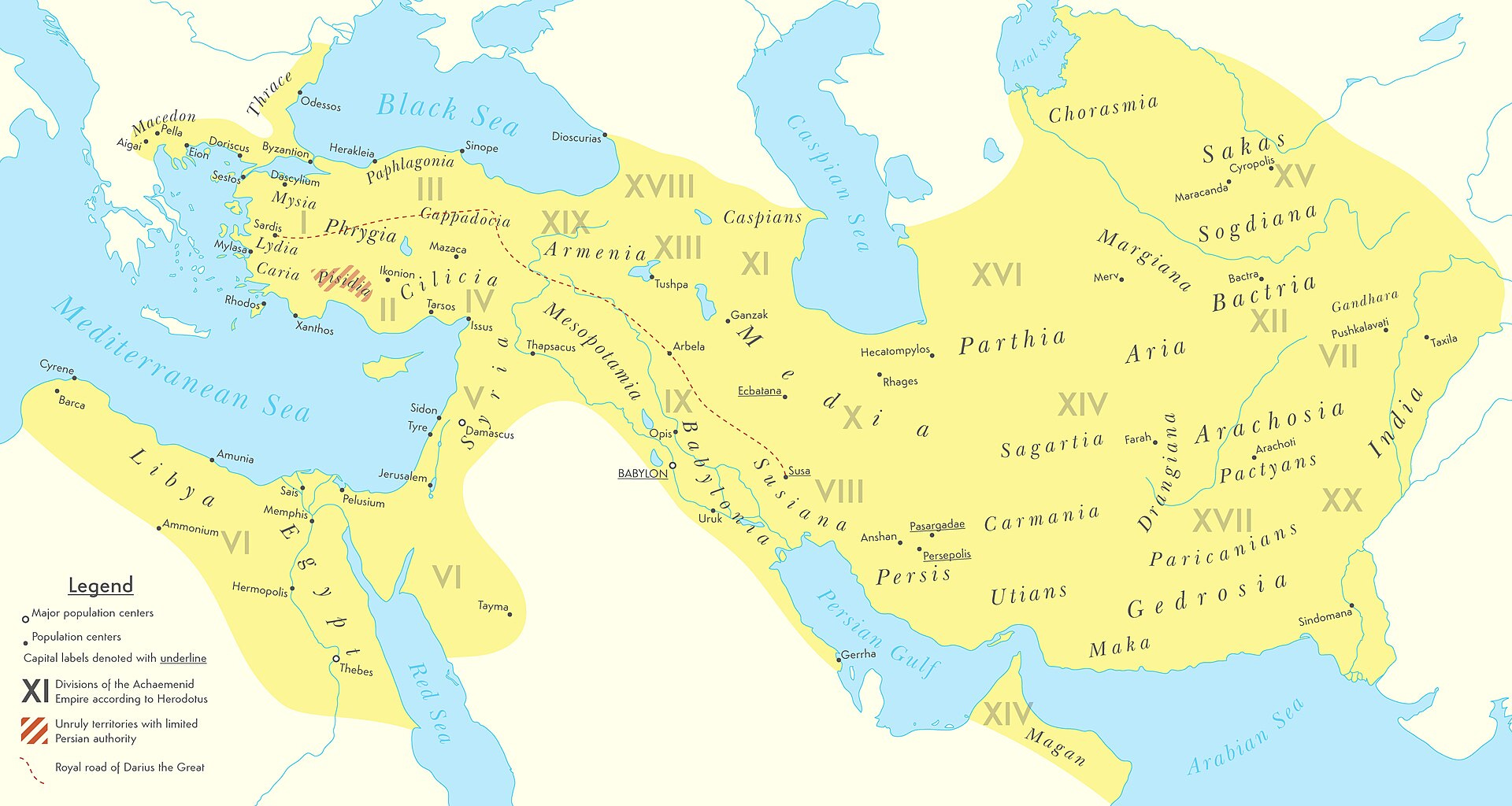
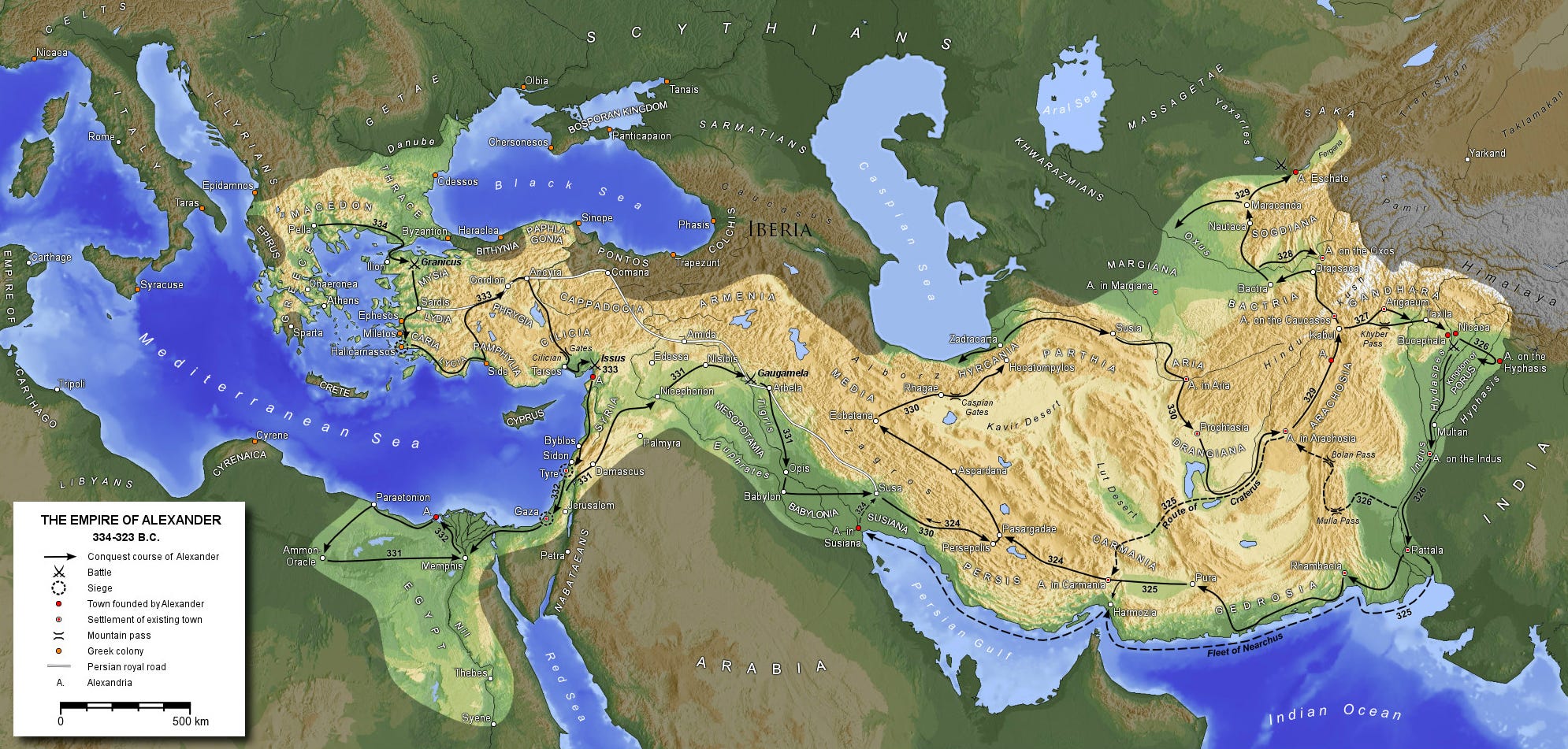
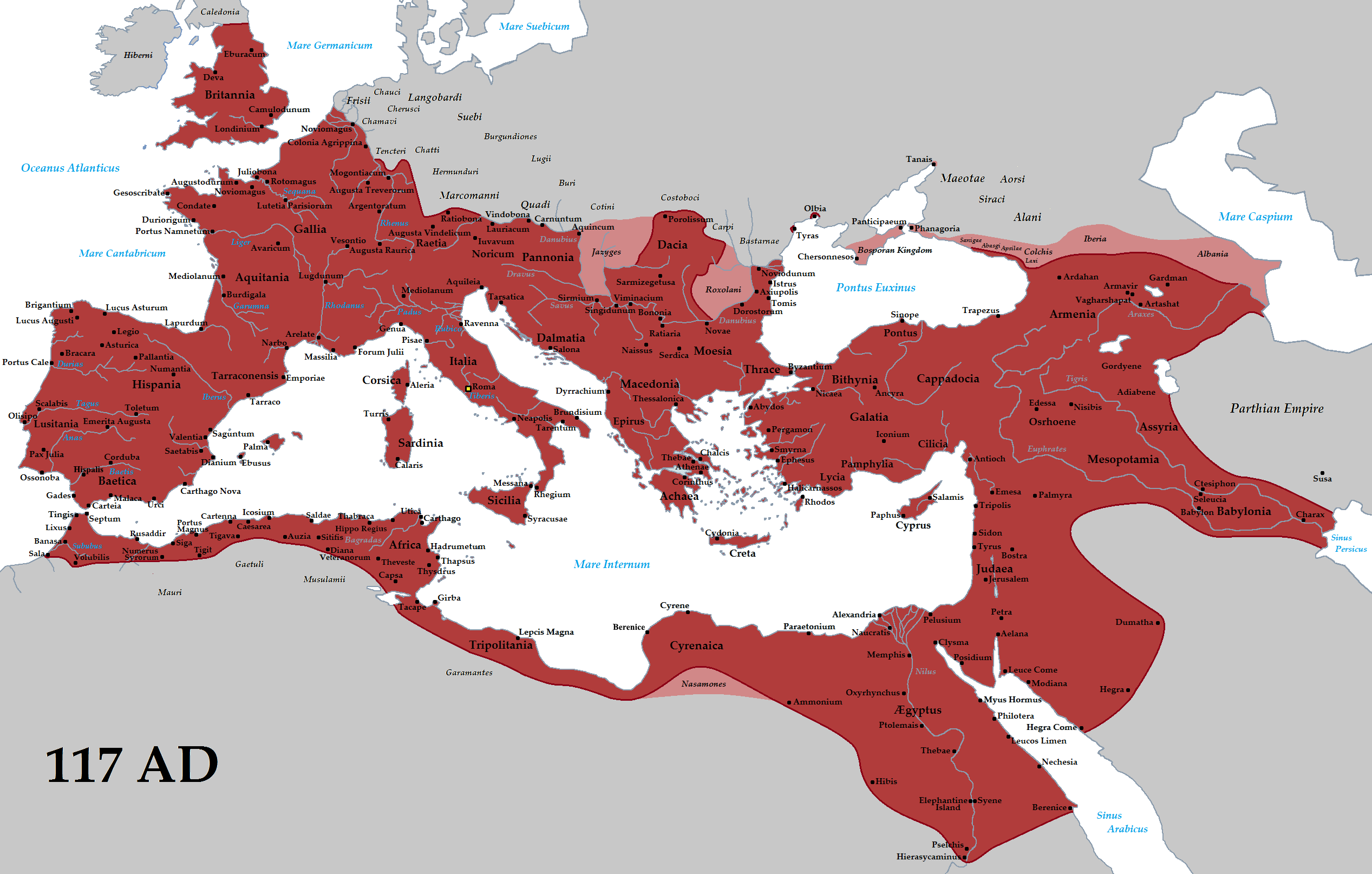
For context, here are some maps of each of those empires at their greatest extent.
#1 - The Neo-Babylonian Empire
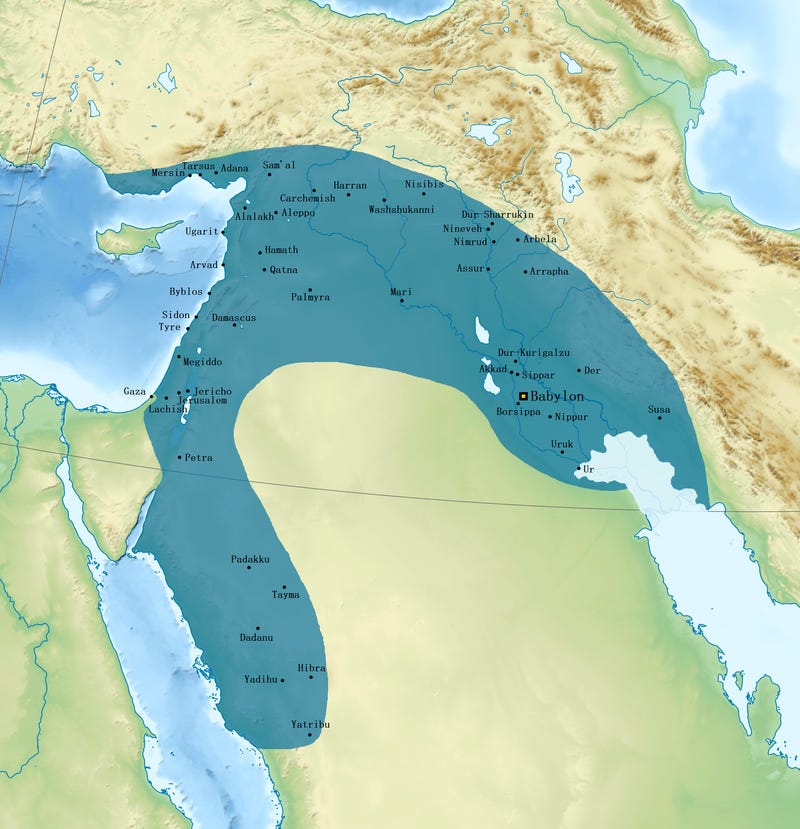
#2 - The Medo-Persian (Achaemenid) Empire
#3 - The Greek (Macedonian) Empire
#4 - The Roman Empire
The Fourth Kingdom in Daniel 7
Daniel sees a vision of the same four empires (and their defeat by God) on another occasion. But this time, the kingdoms aren’t represented by metals of decreasing value. They are symbolized by four “beasts” that come up out of the great sea.
Daniel said, “I was looking in my vision by night, and behold, the four winds of heaven were stirring up the great sea. 3 And four great beasts were coming up from the sea, different from one another. 4 The first was like a lion but had the wings of an eagle. I kept looking until its wings were plucked, and it was lifted up from the ground and set up on two feet like a man; a human mind also was given to it. 5 And behold, another beast, a second one, resembling a bear. And it was raised up on one side, and three ribs were in its mouth between its teeth; and they said this to it: ‘Arise, devour much meat!’ 6 After this I kept looking, and behold, another one, like a leopard, which had on its back four wings of a bird; the beast also had four heads, and dominion was given to it. 7 After this I kept looking in the night visions, and behold, a fourth beast, dreadful and terrible, and extremely strong; and it had large iron teeth. It devoured and crushed, and trampled down the remainder with its feet; and it was different from all the beasts that were before it, and it had ten horns. (Daniel 7:1-7)

Furthermore, imagery in Daniel 7 matches what we know of these four empires.
The fourth kingdom is not described as any specific animal. It is terrifying, ruthless and extremely strong, breaking everything to pieces. This corresponds to the historical Roman Empire.
Rome’s Final King and Subsequent Defeat
However, the text goes on to describe political features of this beast that do not correspond well to history.
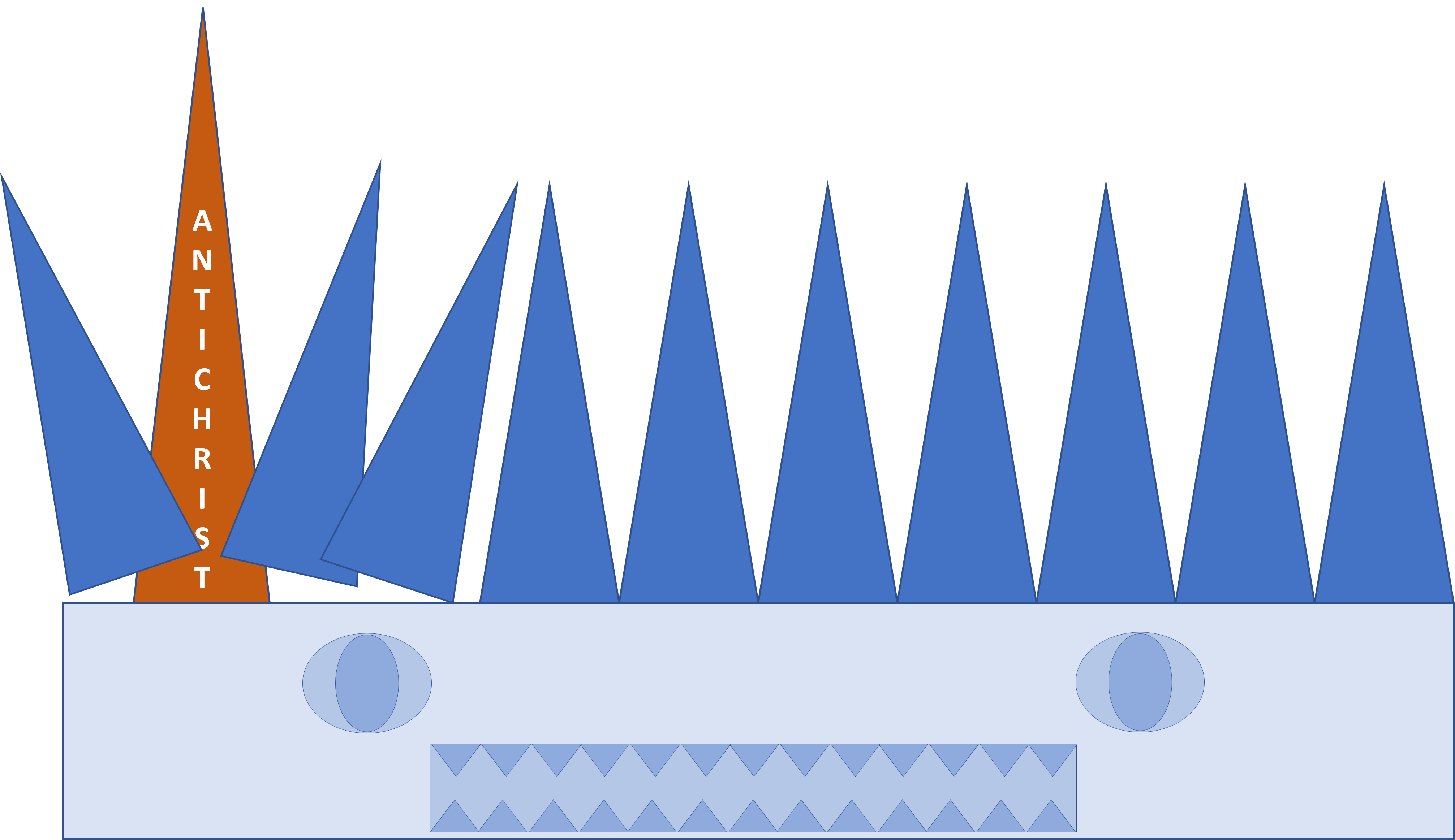
8 While I was thinking about the horns, behold, another horn, a little one, came up among them, and three of the previous horns were plucked out before it; and behold, this horn possessed eyes like human eyes, and a mouth uttering great boasts. (Daniel 7:8)

This figure is none other than the end time Antichrist. He meets his fate when God sets up an eternal kingdom in its place, led by the Messiah.
11 Then I kept looking because of the sound of the boastful words which the horn was speaking; I kept looking until the beast was killed, and its body was destroyed and given to the burning fire. 12 As for the rest of the beasts, their dominion was taken away, but an extension of life was granted to them for an appointed period of time. (Daniel 7:11-2)
In the vision, Messiah Jesus comes “with the clouds of heaven” to rule the entire world in God’s new kingdom.
“I kept looking in the night visions,
And behold, with the clouds of heaven
One like a son of man was coming,
And He came up to the Ancient of Days
And was presented before Him.
14 And to Him was given dominion,
Honor, and a kingdom,
So that all the peoples, nations, and populations of all languages
Might serve Him.
His dominion is an everlasting dominion
Which will not pass away;
And His kingdom is one
Which will not be destroyed. (Daniel 7:13-14)
Daniel is distressed by the vision. As a result, the angel provides a summary of its meaning:
17 ‘These great beasts, which are four in number, are four kings who will arise from the earth. 18 But the saints of the Highest One will receive the kingdom and take possession of the kingdom forever, for all ages to come.’ (Daniel 7:17-18)
Nevertheless, Daniel is particularly curious about the fourth beast and its final ruler.
19 “Then I desired to know the exact meaning of the fourth beast, which was different from all the others, exceedingly dreadful, with its teeth of iron and its claws of bronze, and which devoured, crushed, and trampled down the remainder with its feet, 20 and the meaning of the ten horns that were on its head, and the other horn which came up, and before which three of the horns fell, namely, that horn which had eyes and a mouth uttering great boasts, and which was larger in appearance than its associates. 21 I kept looking, and that horn was waging war with the saints and prevailing against them, 22 until the Ancient of Days came and judgment was passed in favor of the saints of the Highest One, and the time arrived when the saints took possession of the kingdom. (Daniel 7:19-22)

The angel further interprets this for Daniel, saying:
23 “This is what he said: ‘The fourth beast will be a fourth kingdom on the earth which will be different from all the other kingdoms, and will devour the whole earth and trample it down and crush it. 24 As for the ten horns, out of this kingdom ten kings will arise; and another will arise after them, and he will be different from the previous ones and will humble three kings. 25 And he will speak against the Most High and wear down the saints of the Highest One, and he will intend to make alterations in times and in law; and they will be handed over to him for a time, times, and half a time. 26 But the court will convene for judgment, and his dominion will be taken away, annihilated and destroyed forever. 27 Then the sovereignty, the dominion, and the greatness of all the kingdoms under the whole heaven will be given to the people of the saints of the Highest One; His kingdom will be an everlasting kingdom, and all the empires will serve and obey Him.’ (Daniel 7:23-27)
You can see how these correspond to Nebuchadnezzar’s dream in Daniel 2 here.
We can be sure of the identity of the four empires for these reasons:
Revived Roman Empire vs Revived Islamic Caliphate
Since this Roman empire exists in the end times, many futurists believe that the Roman Empire will be “revived” before the return of Christ. In contrast, Joel Richardson believes that the Islamic Caliphate will be revived in the end times, only to be defeated by God at Jesus’ return. Since he views the fourth kingdom culminating in the Ottoman Empire, it is that empire, not the Roman Empire, which will be revived in the end times. As Richardson states:
These ten horns represent the revived Islamic Caliphate and correlate to the feet of iron and clay in Daniel 2.2
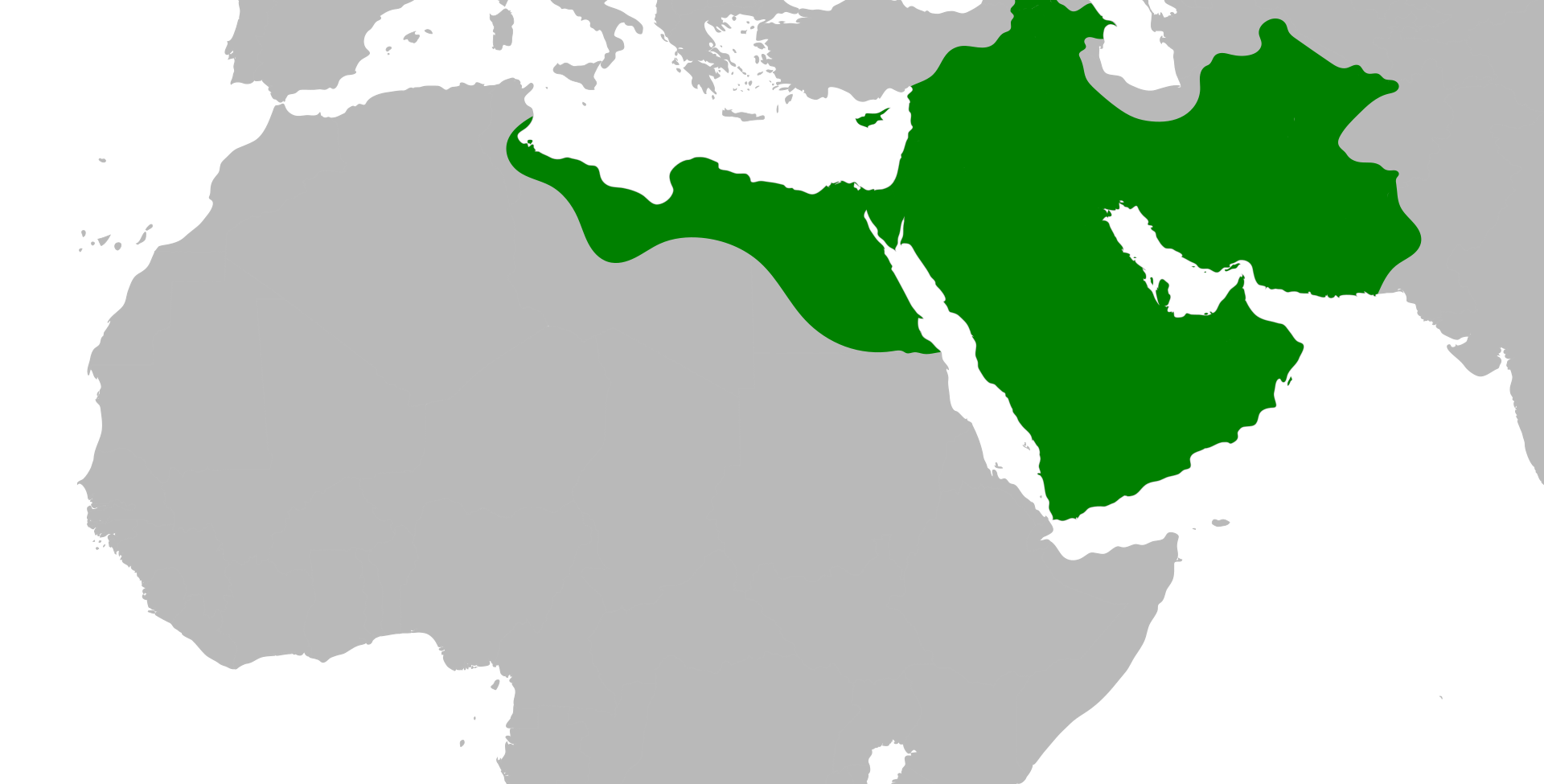
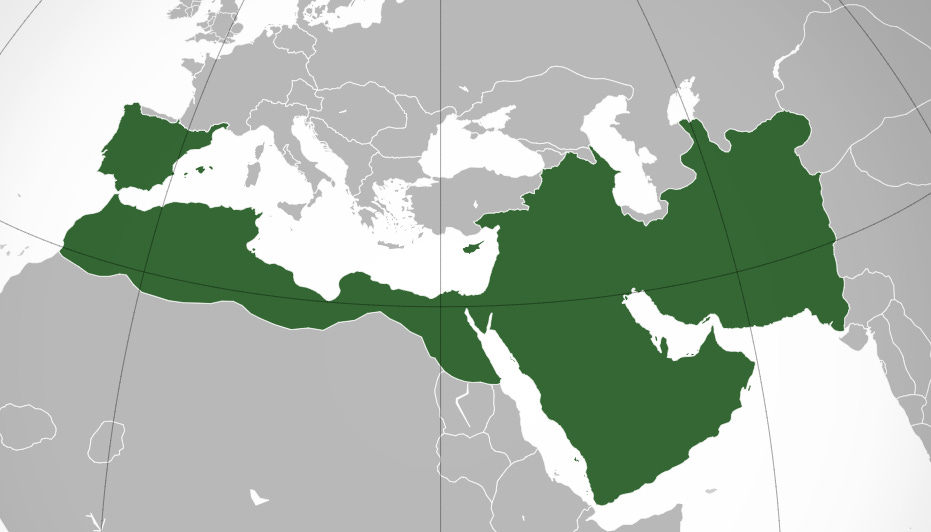
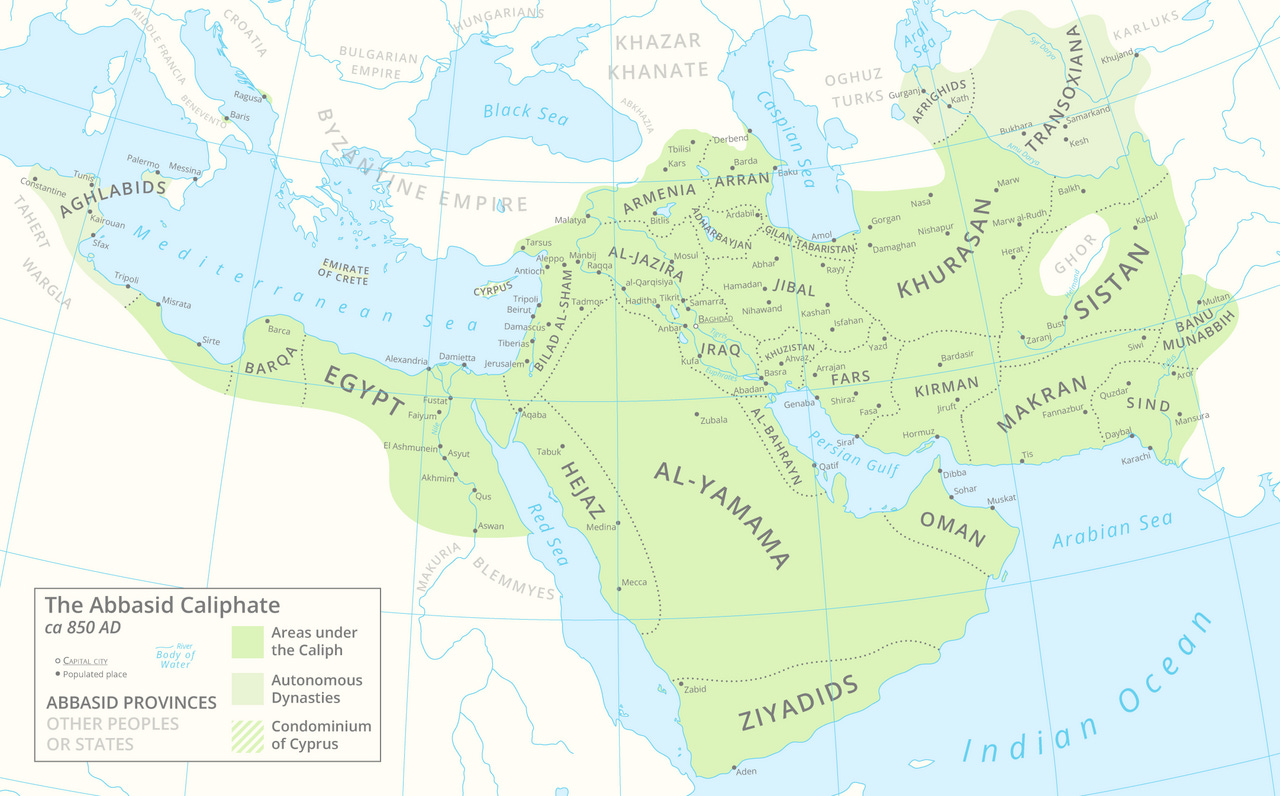
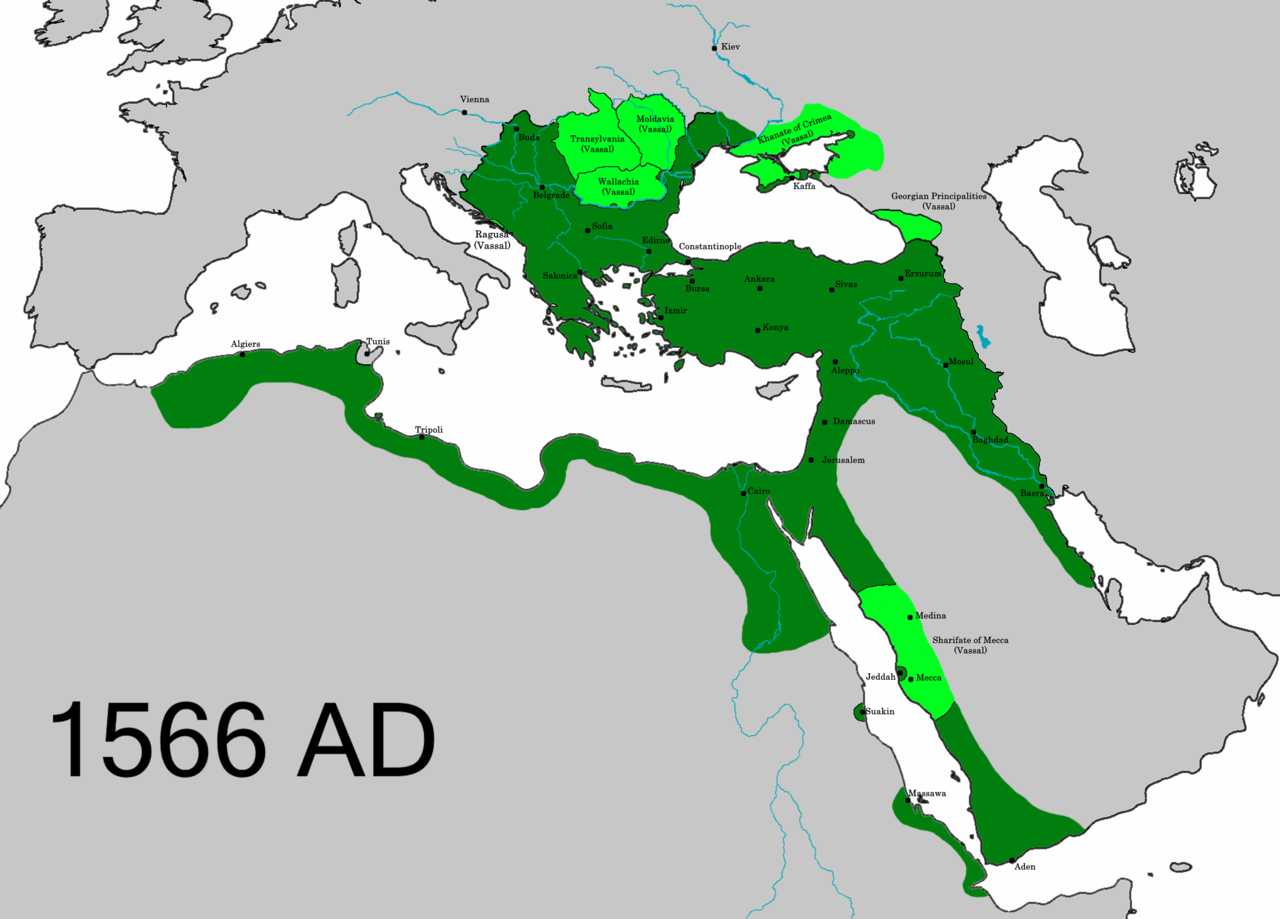
The Islamic Caliphate started in the 600’s A.D. and went until the early 1900’s. It went through a series of caliphs and caliphates, who were the legal successors to one another.
Rashidun Caliphate
Umayyad Caliphate
Abbasid Caliphate
Ottoman Caliphate (Empire)
The Roman Empire, not the Ottoman Empire, is the 4th Kingdom
The Roman Empire meets the texts requirements for being the fourth beast in ordinal succession, as Daniel 2 & 7 indicate. On the contrary, the Ottoman Empire is not the fourth kingdom on any system of counting.
In Daniel 2, Nebuchadnezzar is told that another kingdom will come “after you.”
And after you another kingdom will arise inferior to you, then another third kingdom of bronze, which will rule over all the earth. (Daniel 2:39)
Many empires came “after” Babylon. But what does Daniel mean here? He means that empire succeeded, replaced, or conquered the previous one. This is the precedent set by the book of Daniel itself.
For example, Daniel 5 describes how the Babylonian kingdom would be given to the Medo-Persians.
28 ‘Peres’—your kingdom has been divided and given to the Medes and Persians.” (Daniel 5:28)
This happens the very night that Daniel gives the prophecy:
30 That same night Belshazzar the Chaldean king was killed. 31 So Darius the Mede received the kingdom at about the age of sixty-two. (Daniel 5:30-31)
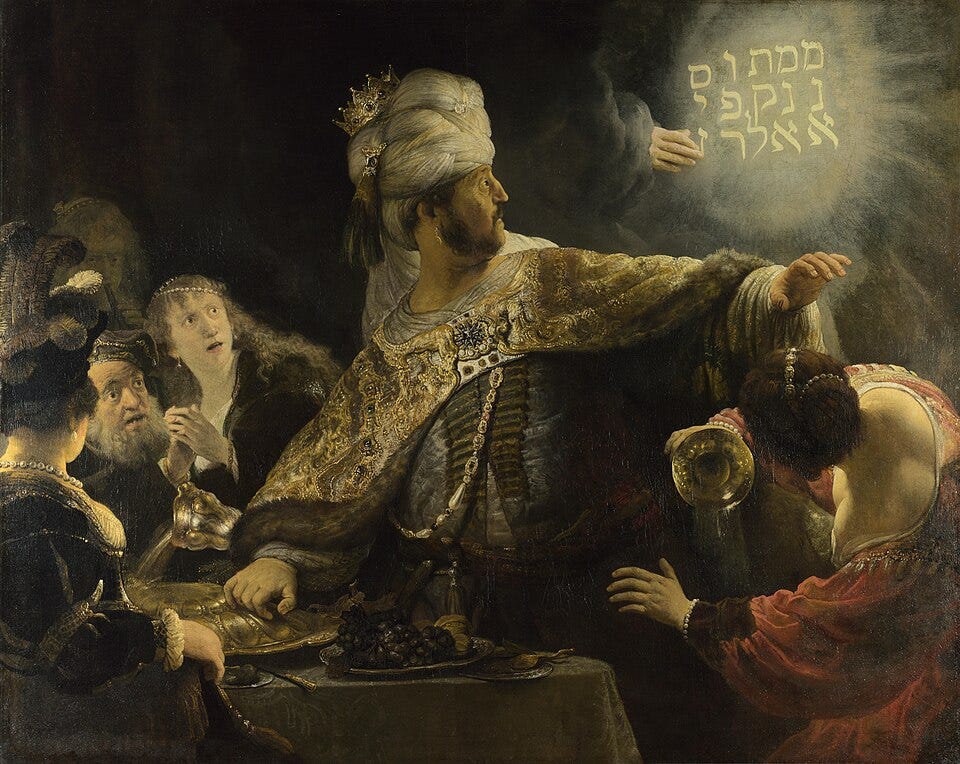
What about the Medo-Persian empire? Who replaced, succeeded, or conquered them? This was none other than Alexander the Great’s Macedonian (Greek) Empire. In chapter 8, Daniel sees a vision of a Ram and a Goat. In this vision, the Ram (Greece) violently attacks the Goat and throws it down. In the interpretation, the angel indicates to Daniel that the vision represents the defeat of the Medo-Persians by Greece, and subsequent history.
This is why Daniel 2:39 describes it as the “third” kingdom. It was the third kingdom in a succession, after Nebuchadnezzar’s Babylon.
To summarize what Daniel 2 says:
“You are the head of gold.”
“And after you another kingdom will arise inferior to you”
“then another third kingdom of bronze”
“Then there will be a fourth kingdom”
The same can be seen in Daniel 7. Regardless of who they represent, the four beasts are in an uninterrupted sequence.
“first was like a lion but had the wings of an eagle.”
“another beast, a second one, resembling a bear.”
“After this I kept looking, and behold, another one, like a leopard”
“After this I kept looking in the night visions, and behold, a fourth beast, dreadful and terrible”
It is not as if Daniel saw 5 or 6 beasts but only enumerated 4 of them. On the contrary, he saw four beasts in total, without any skipping. These are clearly in a temporal sequence by the counting (first, second, fourth) and the repeated use of “after this.” As it stands, the Ottoman Empire is not the “fourth” kingdom on any sequence of uninterrupted counting.
It is difficult to determine what is meant by “after you” in Daniel 2:39 without this succession criteria. These four civilizations actually overlapped one another in time. For example, the Medes and Persians existed before Babylon fell. The Greeks had always been there. Even the Roman civilization predated the Neo-Babylonian empire by hundreds of years. It was just not a hegemon at that point. If we don’t use this imperial succession criterion, our empire count gets tangled and confused.
This clearly sets a precedent for what is meant by “after.” In a chain of “who conquered who,” Rome is the clear fourth in an uninterrupted sequence of conquests.
On the contrary, the Ottoman Empire cannot be the fourth kingdom. It skips (one or two?) empires in between.
No Gaps in Ordinal Succession
Richardson believes that this “gap” is allowed, because gaps are a common feature in prophecy.3
…we frequently find in the Scriptures an intermingling of the historical and the future into one seamless passage.4
He is absolutely right about the presence of gaps. But there are not gaps in ordinal sequences like this.
Daniel 11:1-4 is a perfect example of a passage that uses a gap and a numbered sequence.
“In the first year of Darius the Mede, I arose to be of assistance and a protection for him. 2 And now I will tell you the truth. Behold, three more kings are going to arise in Persia. Then a fourth will gain far more riches than all of them; as soon as he becomes strong through his riches, he will stir up the entire empire against the realm of Greece. 3 And a mighty king will arise, and he will rule with great authority and do as he pleases. 4 But as soon as he has arisen, his kingdom will be broken up and parceled out toward the four points of the compass, though not to his own descendants, nor according to his authority which he wielded, because his sovereignty will be removed and given to others besides them. (Daniel 11:1-4)
We know from Daniel 5 that “Darius the Mede” took the throne the moment the Babylonian empire fell. The text says that three more kings will arise in Persia. “More” implies in addition to the first one. As a result, we have this sequence:
“In the first year of Darius the Mede”
Cyrus the Persian /Darius the Mede
“three more kings are going to arise in Persia”
Cambyses II
Gaumata
Darius I
“Then a fourth will gain far more riches than all of them”
Xerxes I
Xerxes I was in fact, the fourth in an uninterrupted sequence of four kings in Persia.5 Yet this is not the case of the next king that is mentioned.
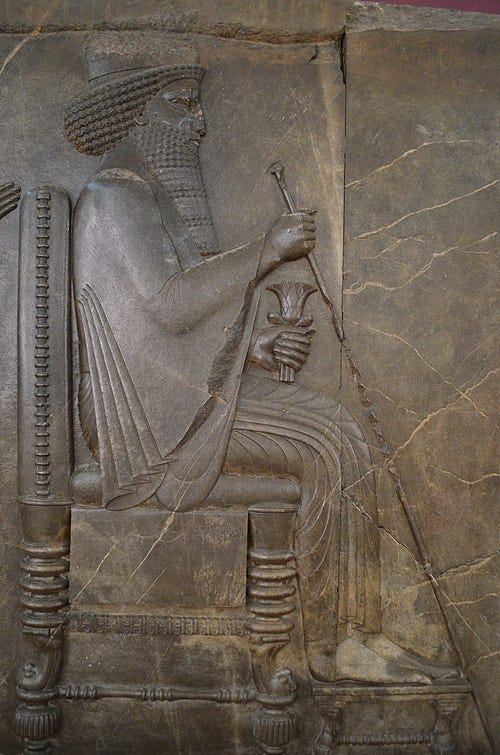
“And a mighty king will arise”
Alexander the Great
There were approximately 6 more kings after Xerxes I until Alexander the Great.6 Yet despite being mentioned in the next sentence, Alexander is never called the “fifth” king.
“But as soon as he has arisen, his kingdom will be broken up and parceled out toward the four points of the compass”
After decades of fighting, Alexander’s successors stabilized into the four kingdoms of the Diadochi after the Battle of Ipsus in 301 B.C.7
Diadochi:
Ptolemy I Soter
Cassander
Lysimachus
Seleucus I Nicator
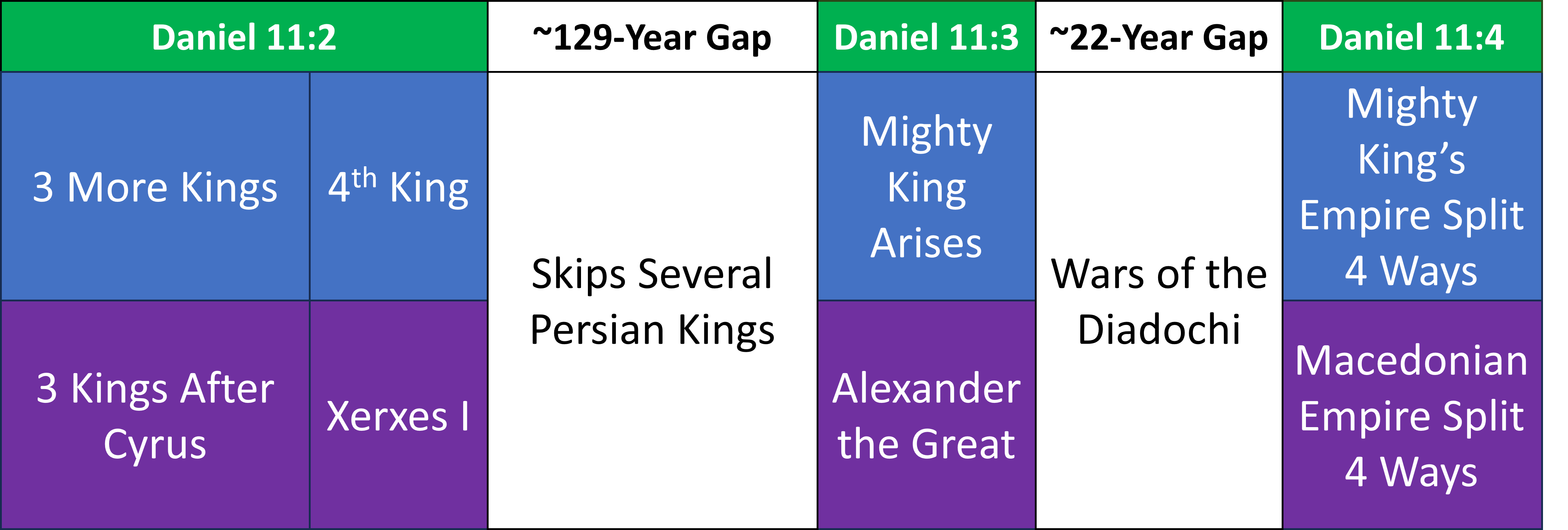
Though gaps exist in prophecy, we cannot appeal to one when there is an ordinal succession of people or empires. Therefore, the Ottoman Empire cannot be the fourth kingdom.
2. Rome Meets the Description of the Fourth Kingdom
The Roman Empire meets the description of the fourth kingdom in both Daniel 2 and 7. The Ottoman may or may not meet some of these features as well. Nevertheless, this is a moot point, as the fourth empire in the sequence (Rome) adequately meets the criteria without having to resort to another candidate.
Dreadful, Terrible, and Extremely Strong
The Roman Empire was indeed dreadful, terrible, and exceedingly strong. This is most clearly indicated in Daniel 7.
7 After this I kept looking in the night visions, and behold, a fourth beast, dreadful and terrible, and extremely strong; and it had large iron teeth. It devoured and crushed, and trampled down the remainder with its feet; and it was different from all the beasts that were before it, and it had ten horns. (Daniel 7:7)
The angel interprets this later on:
“This is what he said: ‘The fourth beast will be a fourth kingdom on the earth which will be different from all the other kingdoms, and will devour the whole earth and trample it down and crush it. (Daniel 7:23)
This is corroborated by Daniel 2, which says:
40 Then there will be a fourth kingdom as strong as iron; just as iron smashes and crushes everything, so, like iron that crushes, it will smash and crush all these things. (Daniel 2:40)
Adrian Goldsworthy is one of the most prominent historians of the Roman military. In his book, Pax Romana, he describes the ruthless ferocity of Roman conquests.
The Romans were warlike and aggressive, but that scarcely requires saying for empires are not created or maintained without violence. Precision is impossible, but we can confidently state that over the centuries millions died in the course of the wars fought by Rome, millions more were enslaved, and still more would live under Roman rule whether they liked it or not.8
Goldsworthy is quite aware of the nuances of this statement. In fact, his entire 500-page book is devoted to if the Pax Romana (Roman Peace) was a real thing. He agrees that it was. However, Rome’s aggression was the very reason such a peace existed within its borders. As he also says:
The conquered were given ‘Roman Peace’ whether they liked it or not, and the method was through the use or threat of military force,9
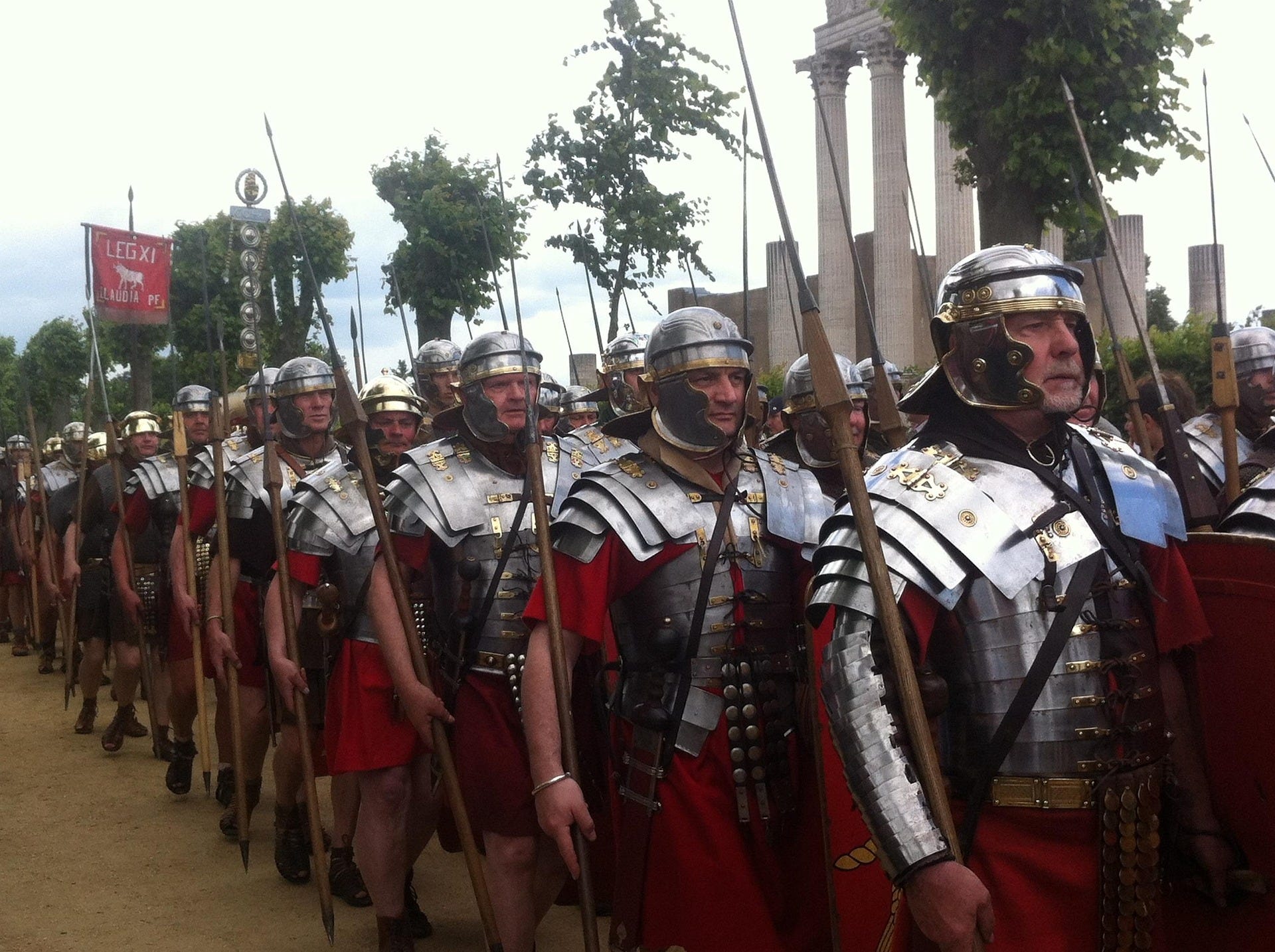
Goldsworthy is quite aware that there have been historically different views on Rome’s ferocity:
In the nineteenth and early twentieth centuries – an era when modern empires had colonised much of the globe – many were ready to take the Romans’ own claims at face value. Faced with hostile neighbours, the Romans fought only to protect themselves, and so won conflict after conflict and acquired an empire almost accidentally.10
Nevertheless, he states that modern scholarship has swung to the opposite extreme.
More recently the pendulum swung to the opposite extreme, a view that crystallised among English-speaking academics in the years following the Vietnam War, and especially among scholars who had become adults in the decades after the Second World War. […] Any talk of defence was a sham, and the Romans were active and determined predators who attacked other peoples year after year.11
Goldsworthy agrees that the Romans were violent conquerors.
The Romans were warlike, aggressive imperialists, who exploited their conquests for their own benefit.12
Yet he adds a degree of nuance that other authors don’t have. He is well aware that the surrounding peoples were no better and would have done the same if they had the chance.
Rome was uniquely successful at war-making and empire-building, but other contemporary states and peoples time and again proved themselves every bit as aggressive and savage.13
Goldsworthy is not alone in his assessment that Rome was aggressive. In The Cambridge History of Greek and Roman Warfare, Dr. John Serrati writes:
Nevertheless, it is now generally accepted that the Romans were an aggressive imperialist power, even though not all of their wars fell into this pattern and not all of their aggression stemmed from conscious political choice.14
In another place, Serrati writes:
Rome was a society for which war and conquest were the norm, and it would not be too strong a statement to say that, during the early and mid Republic at least, the Romans were socialized to make war.15
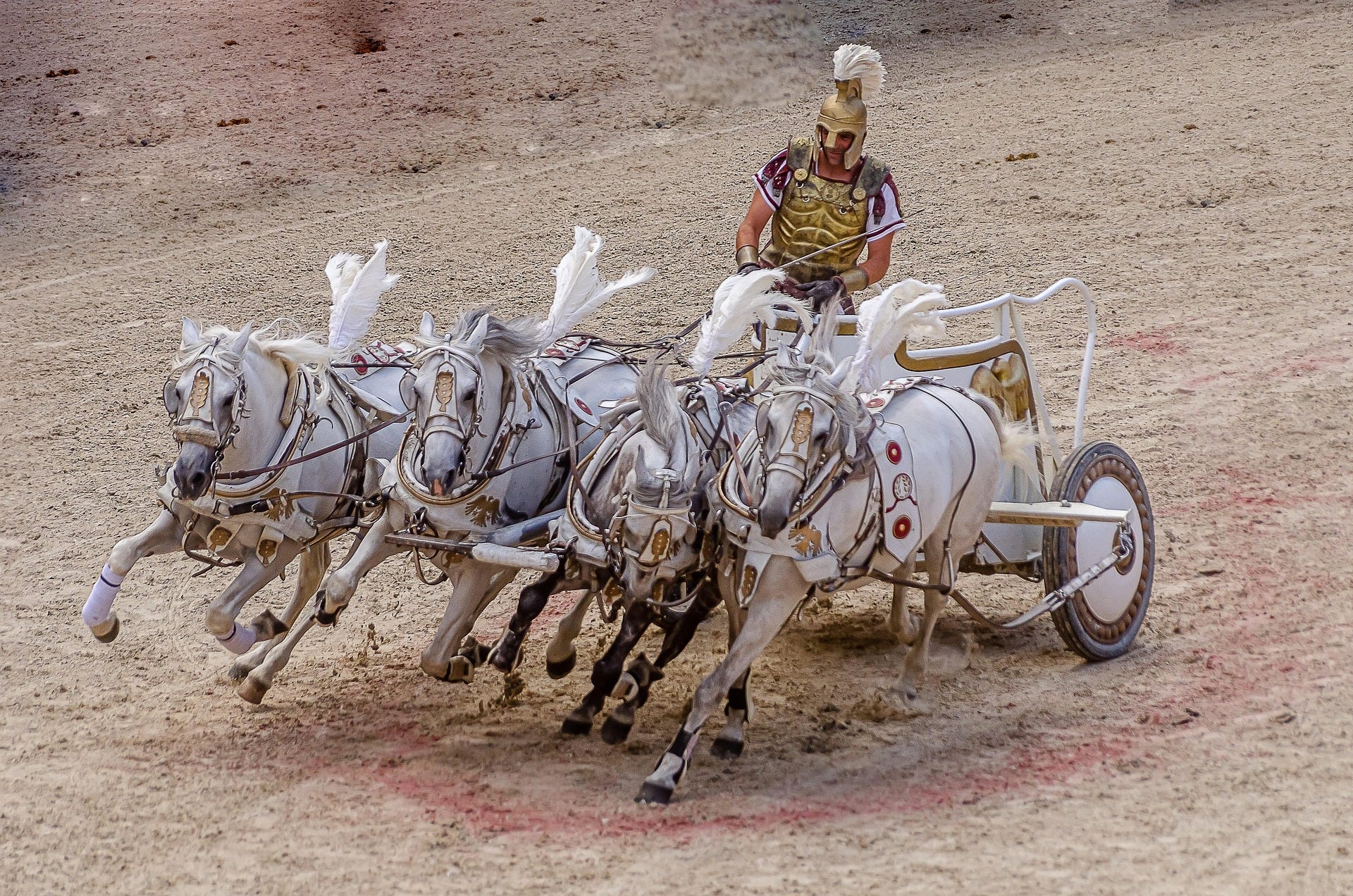
Devouring, Crushing, and Trampling the Rest
Daniel 7 says that the fourth kingdom would be “devouring”, “crushing” and “trampling” the rest. The EBSCOhost Research Starter on Roman warfare states:
Under a strong general, the storming and plundering of a city proceeded by well-defined stages, announced by signals. First the troops slaughtered. Next they looted. Finally they disposed of their spoils, with the profits distributed equally among all the soldiers. More often, however, the general made little attempt to restrain them. They held the power of life and death, and they did whatever they wished to the inhabitants of a captured city. In these cases, of course, every soldier looted for himself, and everything he laid his hands on became his private property.16
There are several specific examples of this.
The Siege of Carthage
In the third Punic war, the Romans managed to wipe an entire Mediterranean civilization off of the map, never to rise again. The siege of Carthage resulted in significant casualties. As Encyclopedia Britannica notes:
Of a city population perhaps exceeding a quarter of a million, only 50,000 remained at the final surrender. The survivors were sold into slavery, the city was razed to the ground, and its site was condemned by solemn imprecations to lie desolate for ever. The territory of Carthage, which had recently been much narrowed by Masinissa’s encroachments, was converted into the Roman province of Africa.17
The Battle of Corinth
Corinth faced a similar (though less permanent) fate as Carthage. In the same year as the siege of Carthage, Corinth was destroyed by Roman general Lucius Mummius.1819
The Revolt of Spartacus
After a gladiator slave revolt led by Spartacus, 6000 of the participants were crucified along the Appian way. This showed the Romans capacity to torture those who would rebel, putting terror in the hearts of anyone walking by who might think of trying something similar.20
The Gallic Wars
Julius Caesar’s conquest of Gaul is a very poignant example of the terrible atrocities that the Romans were capable of. Though casualty numbers are difficult to determine, Goldsworthy remarks that:
…it was claimed that one million enemies died during Julius Caesar’s Gallic campaigns alone. It may well be that more human beings were killed by Roman gladius swords than any other weapon before the modern era21
Though some details remain murky, the article Caesar and Genocide: Confronting the Dark Side of Caesar’s Gallic Wars gives specific examples of what we would consider to be examples of genocide and war crimes by today’s standards.22
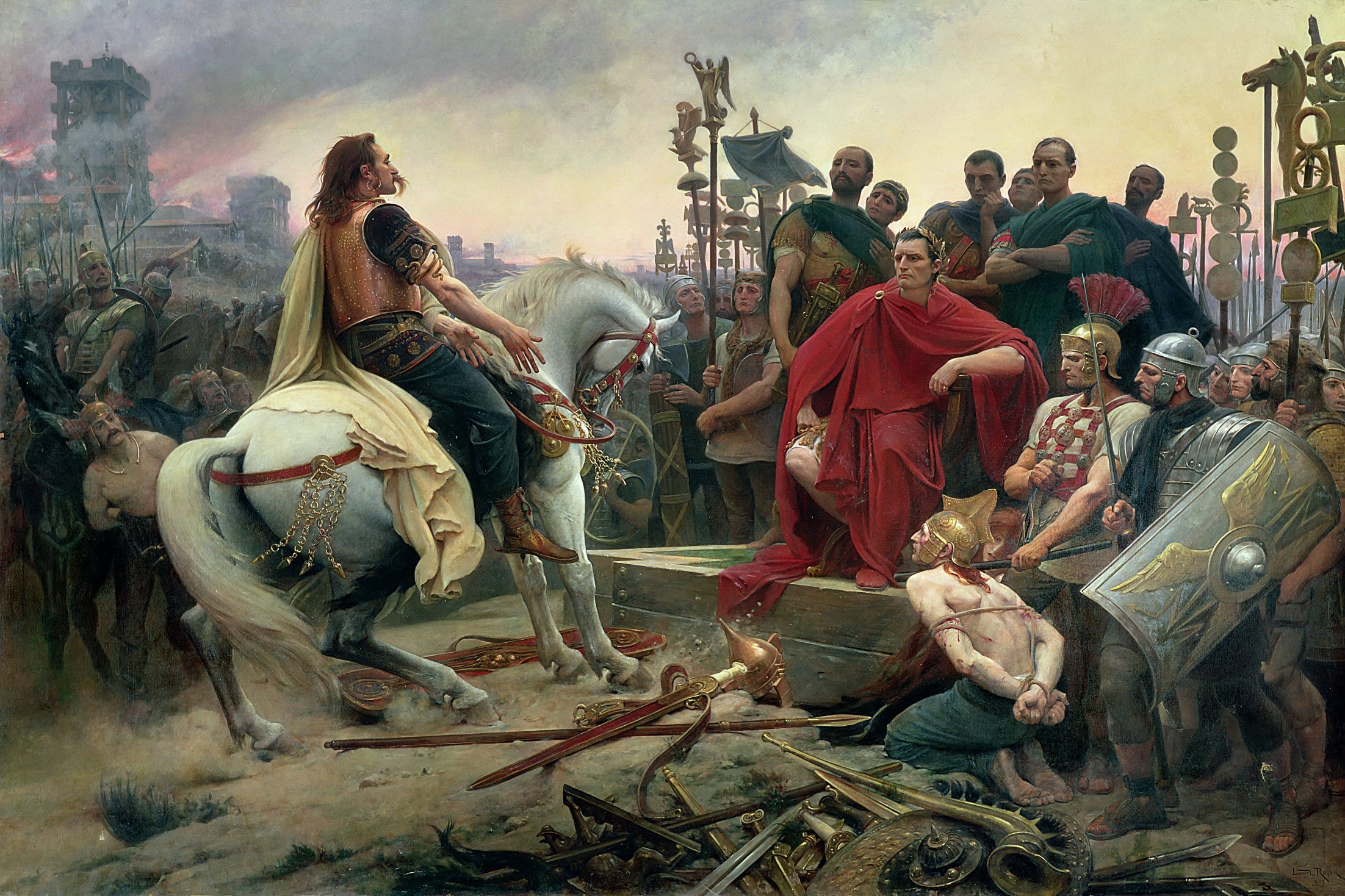
The Jewish Roman Wars
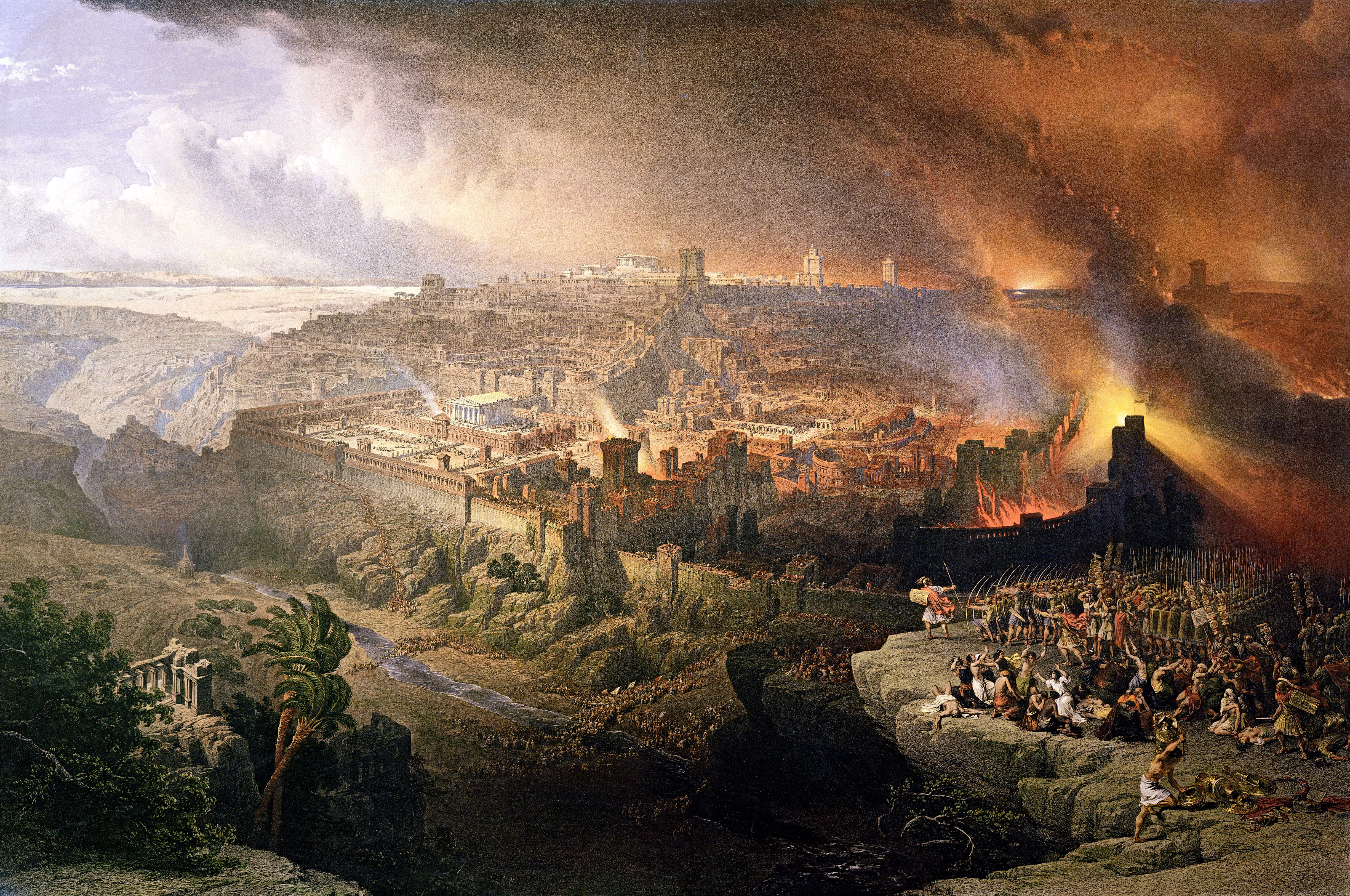
The Jewish-Roman wars were particularly devastating. In the climactic siege of the First Jewish Roman war, the Romans destroyed Jerusalem and burned the temple. According to World History Encyclopedia:
It is estimated by the ancient historians Tacitus (l. c. 56 - c. 118 CE) and Flavius Josephus (36-100 CE) that there were about 600,000 to 1,100,000 people killed in the siege.23
To summarize, the Romans were very strong, terrifying, and crushed those who would oppose them. According to Roman historian Tacitus, a chieftain in Britannia strongly urged his men to fight against the incoming Romans, because:
They have pillaged the world: when the land has nothing left for men who ravage everything, they scour the sea. If an enemy is rich, they are greedy, if he is poor, they crave glory. Neither East nor West can sate their appetite. They are the only people on earth to covet wealth and poverty with equal craving. They plunder, they butcher, they ravish, and call it by the lying name of ‘empire’. They make a desert and call it ‘peace.’24
Richardson responds, saying that the Roman Empire was relatively tolerant, whereas the Ottoman Empire completely replaced the cultures of the previous empires. He explains that:
Rome’s law and the protection of its military also created a peace and stability that came to be famously known as the Pax Romana. Rather than being a crushing force, the Roman Empire was often a positive influence to its conquered peoples.25
Nevertheless, this mistakenly cherry picks the data. Sure, both empires were oppressive in their own ways.
But this is a moot point anyway. There were lots of empires “worse” than Rome. The Mongol Empire was far worse than either of them.26 Neither of us count that in our sequence. Yet the question is not “which empire was worse.” It is “which is the fourth kingdom in the sequence, and does it meet the dreadful and destructive criteria described in both passages?” We’ve already seen that Rome meets both of these. The Ottoman Empire fails at least one, in that it was not the fourth kingdom in the sequence.
Furthermore, Richardson tells us that hyperbole is a common feature in Biblical literature.
The Middle Eastern culture that gave birth to the Bible is particularly fond of hyperbole. And because the Bible uses the idioms common to the peoples of the region, to correctly interpret multitudes of biblical passages requires an understanding of this device.27
Richardson believes that this literary device is used when describing the kingdoms in Daniel. This is true to a large extent. As he rightly notes, Daniel uses hyperbolic throne language to describe the extent of Nebuchadnezzar’s empire (Daniel 2:36-38).28
Yet this cuts both ways. If hyperbole is allowed, then Rome most definitely meets the criteria listed in Daniel 2 and 7. In either case, we have no need to appeal to another empire candidate, as Rome sufficiently meets the brutal, fearsome, and violent criteria listed in the passage.
(The issue of hyperbole and interpretation will be addressed more later on.)
The Mediterranean Sea
The empires are also said to come up out of “the great sea.”
Daniel said, “I was looking in my vision by night, and behold, the four winds of heaven were stirring up the great sea. 3 And four great beasts were coming up from the sea, different from one another. (Daniel 7:2-3)
In the Bible, this is a consistent reference to the Mediterranean Sea. (Though its meaning is probably not limited to just that.) There are several examples of this in Scripture:
‘As for the western border, you shall have the Great Sea, that is, its coastline; this shall be your western border. (Numbers 34:6)
From the wilderness and this Lebanon, even as far as the great river, the river Euphrates, all the land of the Hittites, and as far as the Great Sea toward the setting of the sun will be your territory. (Joshua 1:4)
And repeatedly in Ezekiel (a contemporary of Daniel).
“And the west side shall be the Great Sea, from the south border to a point opposite Lebo-hamath. This is the west side. (Ezekiel 47:20)
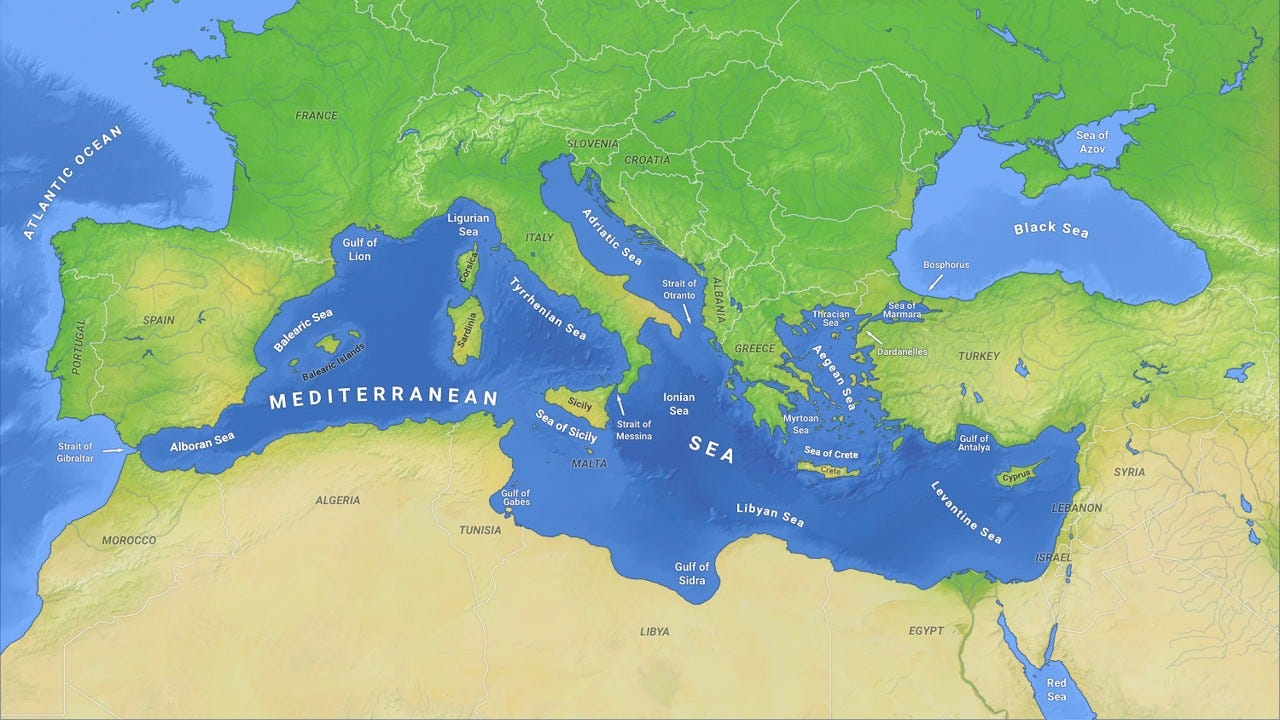
The Roman Empire fits this criterion quite well, as it covered the entire Mediterranean, unlike the first three.
Control of the Holy Land
The Roman Empire was the fourth empire to control Israel/Judea. While not explicitly stated in the text, the context would indicate this to be the case. Richardson agrees that the Bible “is and always has been a thoroughly Jerusalem-, Israel-, and Middle Eastern–centric book.”29
For the most part, I would agree. Nevertheless, saying that it is “Middle Eastern-centric” is only true because Israel is in the Middle East. I do not think the Bible is constrained to speak only of the Middle East, since Israel and most of her enemies just so happen to be there. On the contrary, the Bible speaks of Israel’s enemies regardless of their location.
From Daniel’s perspective, he is concerned with the empires that directly affect Jerusalem and its people. As it turns out, this is true of all four empires. As far as military occupation of the holy land is concerned, Rome was probably the worst offender. As mentioned before, Jerusalem and the temple were destroyed during the First Jewish-Roman War. Hundreds of thousands of Jews were killed by the Romans at this time. In this way, the Israel-centricity of the Bible is actually evidence for the Roman thesis.
To summarize, Miller states:
The incredible might and cruelty of Rome are aptly depicted by Daniel’s fourth beast. Just as this monster was “different” from all the others, so the Roman Empire differed from those that had preceded it. Rome possessed a power and longevity unlike anything the world had ever known. Nations were crushed under the iron boot of the Roman legions, its power was virtually irresistible, and the extent of its influence surpassed the other three kingdoms.30
Problems with The Geographic Criterion
Richardson believes that Rome cannot be the fourth kingdom, since he says it fails to fulfill Daniel 2:40:
And after you another kingdom will arise inferior to you, then another third kingdom of bronze, which will rule over all the earth. Then there will be a fourth kingdom as strong as iron; just as iron smashes and crushes everything, so, like iron that crushes, it will smash and crush all these things. (Daniel 2:40)
Richardson contends that the Roman Empire didn’t conquer the previous three empires as Daniel 2:40 says. However, the Ottoman Empire conquered the geographic area that belonged to the previous four kingdoms.
The text is clear that the fourth kingdom would “crush,” or conquer, all three of these empires. The three empires never coexisted, of course, and thus we must ask what the text means when it says that the fourth empire would “crush” all of the others.
TO CONQUER GEOGRAPHICALLY
The first meaning of the word crush refers simply to geography.31
Neither the Roman Empire nor the Ottoman Empire crushed the Medo-Persian, or Babylonian empires. The Romans did conquer the Greeks, but the Medo-Persian and Babylonian empires were long gone by then.
Richardson tries to resolve this tension by insisting that “all these” refers back to the land area where they used to be, not the kingdoms themselves.
Yet the text is clear; to fulfill the criterion of Daniel 2:40, an empire would need to crush, not one, but all three of these. The Roman Empire simply does not fulfill this requirement.32
Later on, Richardson says:
If we are to be honest, to say the Roman Empire fulfilled Daniel 2:40 would be a stretch at best. On the other hand, the historical Islamic Caliphate fully, absolutely, completely conquered all the lands of the others. 33
Contrary to Richardson’s view, the text does not say that the fourth kingdom would conquer the land area where the previous three kingdoms used to be. “All these things” clearly refers back to the empires themselves, not the territory they used to occupy after they were long gone.
However, there are textual indications that the geographical criterion is not what Daniel has in mind here. First, Daniel 2:39 indicates the kingdoms are sequential, succeeding one another. Therefore, “all these things” cannot mean that the fourth kingdom literally conquered the first two empires, since they were no longer hegemons by the time the Ottomans or the Romans showed up.
Second, Daniel 2 says that the statue was “crushed all at the same time.”
34 You continued watching until a stone was broken off without hands, and it struck the statue on its feet of iron and clay, and crushed them. 35 Then the iron, the clay, the bronze, the silver, and the gold were crushed to pieces all at the same time, and they were like chaff from the summer threshing floors; and the wind carried them away so that not a trace of them was found. (Daniel 2:34-35a)
As a result, the vision indicates that all four empires are crushed “all at the same time” by God’s kingdom, not by the fourth kingdom.
Daniel 7:12 supports this interpretation as well:
Then I kept looking because of the sound of the boastful words which the horn was speaking; I kept looking until the beast was killed, and its body was destroyed and given to the burning fire. 12 As for the rest of the beasts, their dominion was taken away, but an extension of life was granted to them for an appointed period of time. (Daniel 7:11-12)
The fourth beast is violently defeated by God at the Second Coming of Jesus. However, the angel makes clear that the first three beasts would live on in some way, after their status as imperial hegemons was long over.
Daniel 2:40 must be read in light of these other two verses about the fate of the first three empires, not merely in isolation. As Paul Benware notes:
The first three empires had their domination over other nations ended by the appearance of stronger empires. But when they did lose their dominion, they still continued to exist in many ways. For example, when Babylon came to end in October of 539 B.C. at the hands of the Medes and Persians, there were elements of Babylonian religion, philosophy, government, language and learning that continued on long past 539 B.C. Elements of old Babylon would be detected centuries later for those who had eyes to see. And so it was for the first three empires. This is why they (the lion, bear and leopard) are seen embodied in the last terrible beast in Revelation 13:2. So to each of the three, after their defeat, “an extension of life was granted to them for an appointed period of time” (Dan. 7:12). But this was not to be the case with the fourth and final beast. It too would be deprived of its empire, but it would not experience “an extension of life” as Revelation 19:19-20; 20:10 makes abundantly clear. It would be totally destroyed (along with the remaining vestiges of the first three beasts) and would vanish completely forever in order that God’s kingdom could be instituted.34
As Miller likewise states:
7:12 The other beasts, namely, the first three empires, had their authority taken away but were allowed to continue (lit., “length of life was given to them”) “for a period of time.” How could these beasts lose their authority and still exist? The explanation is that their dominance ceased, but they continued to live because they were absorbed into the next empire. For example, Greece was conquered by Rome; and although Greek dominance came to an end, the nation continued to live by being absorbed into another one of the earthly kingdoms, the Roman Empire. But the fourth empire will be completely destroyed and replaced by a totally new world order, the kingdom of God. In chap. 2 the continued existence of the defeated kingdoms is paralleled in that the statue did not collapse until its lowest part, the iron and clay feet and toes (representing the final phase of the last empire), was struck by the stone.35
We cannot introduce the geographic criterion to solve one way of reading one verse (Daniel 2:40), only two leave out two others (Daniel 2:35; 7:12). Our interpretation of Daniel 2:40 must be in harmony with all the verses in question, not just one.
Richardson also points to the beast in Revelation 13 as evidence of the geographic criterion. The ten-horned, seven-headed beast has elements of every preceding empire in it.
Then I saw a beast coming up out of the sea, having ten horns and seven heads, and on his horns were ten crowns, and on his heads were blasphemous names. 2 And the beast that I saw was like a leopard, and his feet were like those of a bear, and his mouth like the mouth of a lion. And the dragon gave him his power and his throne, and great authority. (Revelation 13:1-2)
Richardson correctly notes that these animals were the first three beasts in Daniel’s four beast sequence. He then argues that this final beast must encompass the land area of all three previous empires.
If we were to combine the geographic “bodies” of Greece, Babylon, and Medo-Persia, what empire would we have? Would it look like the Roman Empire or the Islamic Empire? The answer is obvious to anyone with an understanding of the geography of the region.36
Although the ten horned beast in Daniel 7 seems to only have one head (Daniel 7:19-20), the Revelation beast has seven heads (Revelation 13; 17). As Richardson and I agree, the seven heads represent kingdoms that have persecuted God’s people throughout history.37 As a result, the seven-headed beast represents all the empires opposed to God’s people throughout history, with a climactic finale in the Antichrist’s rule.
The book of Revelation telescopes the beast’s entire history into one monster. A similar literary device is used in Daniel 7 to describe the Hellenistic world.
6 After this I kept looking, and behold, another one, like a leopard, which had on its back four wings of a bird; the beast also had four heads, and dominion was given to it. (Daniel 7:6)
The third beast is a leopard with four wings and four heads. However, the leopard and wings part clearly refer to the swift nature of Alexander the Great’s conquests. Whereas the four heads refer to the four kingdoms of the Diadochi. Yet Alexander died many years before these four kingdoms emerged.
This is an example of how the third beast has its whole history compressed into one image. The same is true of the beast in Revelation 13. There, the past, present, and future world empires are all compressed into one monstrous animal.
Alternatively, the Revelation beast and its final Antichrist empire probably does include the remnants of the previous four empires. As will be argued later, the Antichrist kingdom at its height will be global in scope, despite starting off as a regional power.
Furthermore, it is safe to say that the Antichrist’s empire will have the characteristics of the previous three beasts in it as well. It will be big like Medo-Persia, fast like Alexander’s empire, and strong like Rome.
Another problem with the geographic rule is Richardson’s inconsistent use of the criterion. When comparing maps of the Roman Empire and the Islamic Caliphate, he does not use a map of Rome at its greatest extent. This is the case because, admittedly, Trajan didn’t occupy what is now Syria/Iraq very long. However, when making maps of the extent of Islamic Caliphate, he superimposes a map of areas that all the Caliphates ever controlled at any time in history.38
3. The People of the Coming Prince Were the Romans
Daniel 9:26 states that the people of a coming ruler will destroy Jerusalem and the temple.
26 Then after the sixty-two weeks, the Messiah will be cut off and have nothing, and the people of the prince who is to come will destroy the city and the sanctuary. And its end will come with a flood; even to the end there will be war; desolations are determined. (Daniel 9:26)
This happened in 70 A.D., when the Romans destroyed Jerusalem and burned the temple. However, the text does not say that “the prince who is to come” will do the destroying. On the contrary, it says that “the people OF the prince” who is coming will do so.
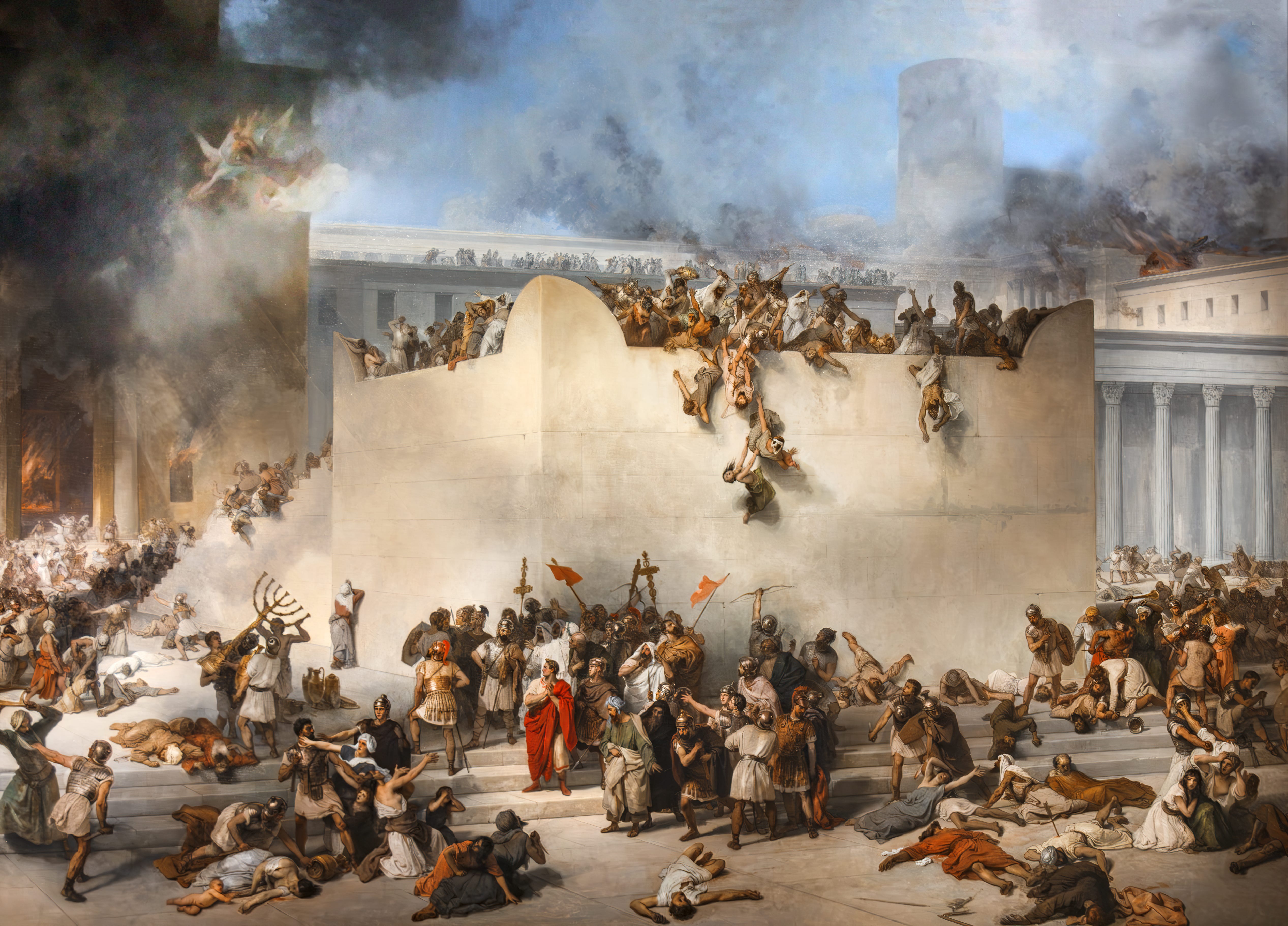
This leaves room for the coming ruler in verse 27, who will stop sacrifices and desecrate the temple in the end times.
27 And he will confirm a covenant with the many for one week, but in the middle of the week he will put a stop to sacrifice and grain offering; and on the wing of abominations will come the one who makes desolate, until a complete destruction, one that is decreed, gushes forth on the one who makes desolate.” (Daniel 9:27)
The most straightforward identification of the “people” in verse 26 were the Romans. Richardson takes issue with this, saying that the Hebrew word for people (am) refers to an ethnic group. As Richardson says:
If we look up the meaning of that word (am) in the Hebrew, we find that it is an ethnic denotation. It does not refer to the kingdom or empire under which the people lived, but rather the people themselves.39
It does mean an ethnic group in many cases. However, the Hebrew and Aramaic Lexicon of the Old Testament (HALOT) even has an entry for a use of the word that is “not national.” Therefore, this word has uses that are not limited to ethnicity. For example, HALOT says:
—3. עַם not national: a) the people Is 42:5 (:: 6, see Stamm Fschr. vRad (1971):510ff); b) race, people: הָעָם of Bethlehem Ru 4:9, עַם יְרוּשָׁלַיִם 2C 32:18, עַם כְּנַעַן Zeph 1:11; the people around a particular person Gn 32:8 1K 19:21 2K 4:41; the people which Ju 3:18; עַם רַב many people Nu 21:6; בְּזוּי עָֽם scorned by the people Ps 22:7, the derision of the people Jb 17:6 (rd. לִמְשַׁל for לִמְשֹׁל and ? עַם for עַמִּים) → B; c) young people Hos 4:14 (Rudolph KAT 13/1:107 and 112 :: Wolff BK 14/12:111: the whole population including the young), population of a city Jr 39:8 (for בֵית, rd. בָּתֵּי, BHS cf. 52:13), later, of a synagogue; d) military personnel 2K 13:7, the garrison 2K 18:26 parallel with Is 36:11, militia Ju 20:10 1S 14:17 2S 2:26 10:10 etc. (Rost Credo 91 and 100; Junge 4ff, 29ff, = צָבָא); e) relative importance: the right people Jb 12:2 :: Davies VT 25 (1975):670f; the poor and oppressed people עֲנִיֵּי עַמִּי Is 10:2, עֲ׳ עַמּוֹ 14:32, עַםּ־עָנִי Ps 18:28 parallel with 2S 22:28 (rd. ? עָנָו); הָעָם הַדַּלִּים Jr 39:10; מתי עם common people Sir 7:16 (Sept. ἁμαρτωλοί). 40
In this context especially, we are certainly warranted in thinking that this is not an ethnic designation. It says “the people of the prince” who is coming. This construct (“people of X”) is found throughout the Old Testament. Here are some examples of what we find in English translations:
“people of the land” (very common)
In our case, we have “the people of the prince.” What does prince mean? Let’s have a look at what HALOT says:
נָגִיד: cs. נְגִ(י)ד: pl. נְגִידִים: chief, leader, sovereign:—1. sovereign, prince, of Tyre Ez 28:2, sg. coll. of Assyria 2 C 32:21;—2. in small sphere of authority: a) officers in Assyrian army alongside śar 2 C 32:21, w. David 1 C 13:1, commanders of cities 2 C 11:11; b) court officials, e.g. nāgîd lebêt yehûdâ 2 C 19:11; c) head of family 2 C 11:22, people of rank Jb 29:10;—3. cultic officials: nāgîd bebêt yhwh = high priest Je 21:1; chief officer of contributions 2 C 31:12; chief of doorkeepers 1 C 9:20;—4. leader of Isr. appointed by Y.: Saul 1 S 9:16, David 13:14, Solomon 1 K 1:35 &c.;—5. var.: mašîaḥ nāgîd, ‘am nāgîd Dn 9:25f; negîd berît = high priest Dn 11:22.41
“Nagid” means “chief, leader, or “sovereign.” It’s military and temple use shows that it doesn’t require that the leadership be over an ethnic group.
The Old Greek Septuagint (LXX) translation of Daniel 9 also shows that the translators did not view this in ethnic terms. Written before the time of Christ, the Old Greek was written long before the events described transpired. In the University of Pennsylvania English translation of the Septuagint, it says:
And after seven and seventy and sixty-two weeks, an anointing will be removed and will not be. And a king of nations will demolish the city and the sanctuary along with the anointed one, and his consummation will come with wrath even until the time of consummation. He will be attacked through war. (Daniel 9:26 English Translation of the LXX Old Greek)42
The point here is not that the authors of the Septuagint did a good job translating the Hebrew into Greek. (At many times, it was not a good translation of the Hebrew.) However, the point is that whoever was translating the Hebrew into Greek did not even translate “people” and certainly did not have an ethnic meaning in mind. Theodotion’s Greek translation is even closer to the Hebrew, but still makes no mention of the people, but only a political leader.
And after the sixty two weeks, an anointing will be destroyed, and there is no judgment in it. And it will destroy the city and the sanctuary along with the leader who is to come. And they will be cut off by a flood and there will be annihilations to finish of a shortened war. (Daniel 9:26 English Translation of the LXX Theodotion)43
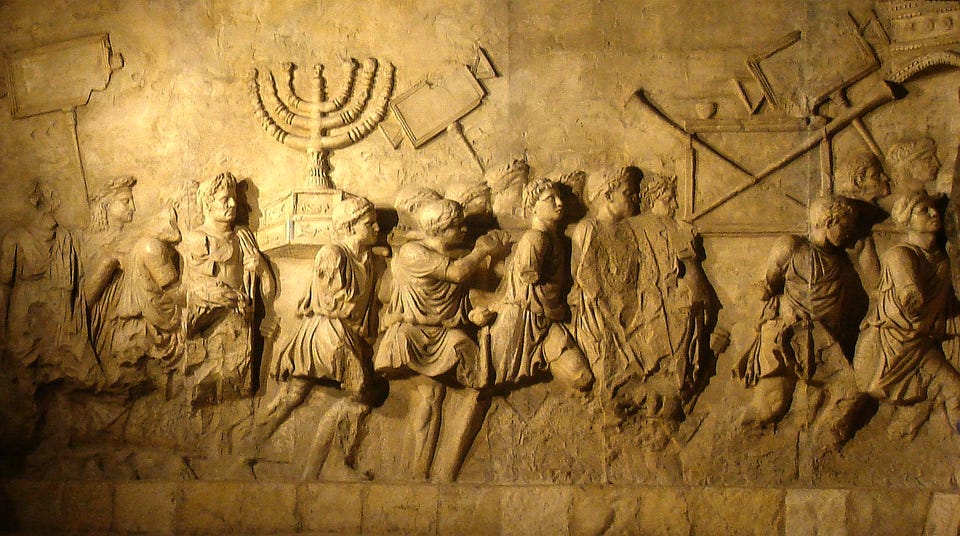
Syrians, Arabs, and Middle Easterners
Richardson says that the Roman armies had a large contingent of Syrians, Arabs, and Middle-Easterners in their ranks.44 Yet this misses the forest for the trees. If an ethnic group is being talked about here, then we have to pick which one. Arabs have an origin south of Israel, while Syrians have origins north of Israel. Yet the Bible presents this mixed group as one people.
Furthermore, the fact that the Roman army was so ethnically mixed (it did include Europeans after all) shows us that God was not trying to tell us about an ethnic group, but precisely, the people of a future ruler. This future ruler is the little horn in Daniel 7.
Richardson points out that the attackers of Jerusalem destroyed the temple, despite the fact that Roman general Titus didn’t actually want this.45 Though Titus didn’t want them to burn the temple, it was still destroyed by the “people of the prince” (not the prince himself, whether that be Titus or Antichrist).
Furthermore, Richardson also makes an anachronistic argument, when he equates these Syrians and Arabs with “Muslims.”
The overwhelming evidence from both ancient historians and modern-day scholarship points out the ethnic identity of the “Roman” peoples that destroyed Jerusalem and the Temple: they were the ancestors of the Muslim peoples that dominate the entire region today.46
But Syrians and Arabs are not religious groups, but ethnic ones, existing long before the coming of Mohammed and Islam.
Richardson also claims that “the Romans” is too vague to be a meaningful ethnic designation.47 Here he is correct. The Roman “people” were not an ethnic group. The “people” are a political group (or military personnel, see Joshua’s “people of war”), associated with the coming leader. The simplest way to interpret this is that they are associated with the kingdom of this coming leader (Daniel 7). Therefore, it doesn’t require that the Antichrist be of any specific ancestry, whether that be Italian, Syrian, Arab, or Middle Eastern descent.
4. The Antichrist’s Domain Will Start Regional and Become Global
Richardson also states that the Antichrist will have only a regional empire, not a global government.48 I appreciate the nuance here, and I think the traditional revived Roman Empire interpretation has not been sufficiently clear on this point. I would agree that the Antichrist starts off as a regional power. He fights regional wars, only to emerge victorious. As John Walvoord says:
With the northern kingdom destroyed there is no major political force standing in the way of the Roman Empire, and the world empire is achieved by proclamation.49
Through military conquest and religious deception, he briefly achieves something akin to world domination.
It was also given to him to make war with the saints and to overcome them, and authority was given to him over every tribe, people, language, and nation. (Revelation 13:7)
However, cracks start to show in his alliances, causing his status as global hegemon to be challenged by others (Daniel 11:44-45). Furthermore, it does not say that the Antichrist has “a kingdom” over the whole planet. It is the ten kings who have given their “kingdom” to him, and it is these who wage war against Jesus in the end times at his command (Revelation 17:17).
2 The ten horns which you saw are ten kings who have not yet received a kingdom, but they receive authority as kings with the beast for one hour. 13 These have one purpose, and they give their power and authority to the beast.
14 These will wage war against the Lamb, and the Lamb will overcome them because He is Lord of lords and King of kings; and those who are with Him are the called and chosen and faithful.”
15 And he *said to me, “The waters which you saw where the prostitute sits are peoples and multitudes, and nations and languages. 16 And the ten horns which you saw, and the beast, these will hate the prostitute and will make her desolate and naked, and will eat her flesh and will burn her up with fire. 17 For God has put it in their hearts to execute His purpose by having a common purpose, and by giving their kingdom to the beast, until the words of God will be fulfilled. 18 The woman whom you saw is the great city, which reigns over the kings of the earth.” (Revelation 17:12-18)
(Footnote for “reigns” says “Lit has a kingdom”)
One way to think about this is in terms of a police officer. “Authority” (exousia) is the police officer’s badge. “Power” (dunamis) is the gun. “Authority” is the legal right to carry out certain tasks on behalf of the government. “Power” entails the means or ability to do that. You can have the authority (badge) without the power (gun). Or you can have the power (gun) without the authority (badge), as criminals do.
This is what the ten kings give the beast in the end times. Furthermore, they even go so far as to give their “kingdom” (Revelation 17:17 NASB) or “royal power” (Revelation 17:17 ESV) to him as well.
“Authority” seems to be a weaker term than “kingdom.” For example, he cannot simply order the kings from the east to do what he wants, as they are a separate group (Rev. 16:12; Dan. 11:44).

Hyperbole in Daniel
Richardson argues that Revelation 13:7 is hyperbole, just like some of the language used in Daniel. For example:
37 You, O king, are the king of kings, to whom the God of heaven has given the kingdom, the power, the strength, and the honor; 38 and wherever the sons of mankind live, or the animals of the field, or the birds of the sky, He has handed them over to you and has made you ruler over them all. You are the head of gold. (Daniel 2:37-38)
This is clearly hyperbolic. Of course, Nebuchadnezzar knew about the Medes and Persians, did he not? He was not literally king over every human on the planet. The same could be said of the third (Greek) empire.
And after you another kingdom will arise inferior to you, then another third kingdom of bronze, which will rule over all the earth. (Daniel 2:39)
Richardson infers the same for the fourth beast.
“This is what he said: ‘The fourth beast will be a fourth kingdom on the earth which will be different from all the other kingdoms, and will devour the whole earth and trample it down and crush it. (Daniel 7:23)
Certainly, this could include the entire planet. For example, Daniel 2:35 has the exact same Aramaic expression used to refer to the Messiah’s global kingdom. I don’t know of anyone who thinks the Messianic kingdom is merely regional.
35 Then the iron, the clay, the bronze, the silver, and the gold were crushed to pieces all at the same time, and they were like chaff from the summer threshing floors; and the wind carried them away so that not a trace of them was found. But the stone that struck the statue became a great mountain and filled the entire earth. (Daniel 2:35)
We also see hyperbole in Daniel 3:
7 Therefore as soon as all the peoples heard the sound of the horn, flute, lyre, trigon, psaltery, bagpipe, and all kinds of musical instruments, all the peoples, nations, and populations of all languages fell down and worshiped the golden statue that Nebuchadnezzar the king had set up. (Daniel 3:7)
Clearly, every ethnic group on the planet was not present when Nebuchadnezzar ordered everyone to bow to his golden statue.
We see this exact same phrasing in Daniel 7, which describes the scope of the Son of Man’s reign.
And to Him was given dominion,
Honor, and a kingdom,
So that all the peoples, nations, and populations of all languages
Might serve Him.
His dominion is an everlasting dominion
Which will not pass away;
And His kingdom is one
Which will not be destroyed. (Daniel 7:14)
Again, here is a clear case where what is sometimes spoken of hyperbolically is literally true. Jesus will reign over every ethnic group on the planet. This is reaffirmed in Daniel 7:27, which is much more politically comprehensive.
Then the sovereignty, the dominion, and the greatness of all the kingdoms under the whole heaven will be given to the people of the saints of the Highest One; His kingdom will be an everlasting kingdom, and all the empires will serve and obey Him.’ (Daniel 7:27)
Unlike the fourth kingdom, “all the empires” will serve and obey God in his new kingdom.

Hyperbole in Revelation?
This literary flexibility is certainly present in Daniel. But is it present in Revelation? Regarding the beast, it says “authority was given to him over every tribe, people, language, and nation.” Let’s compare that to a similar expression in Revelation 7.
9 And they *sang a new song, saying,
“Worthy are You to take the scroll and to break its seals; for You were slaughtered, and You purchased people for God with Your blood from every tribe, language, people, and nation.
10 You have made them into a kingdom and priests to our God, and they will reign upon the earth.” (Revelation 5:9-10)
And also:
9 After these things I looked, and behold, a great multitude which no one could count, from every nation and all the tribes, peoples, and languages, standing before the throne and before the Lamb, clothed in white robes, and palm branches were in their hands; (Revelation 7:9)
This is clearly global in scope. This is especially the case since the word “tribes” is used. In Revelation 7, John just got done seeing 12,000 people sealed from the 12 tribes of Israel. Each tribe is named. According to context, when it speaks of all the tribes and languages in Revelation 7:9, it means every ethnic group on the planet.
Other passages in the New Testament indicate that the Great Commission is ethnically comprehensive.50 The other uses of this language in Revelation seem to indicate that it is global in scope.
Keep in mind, Revelation was written in Greek, whereas Daniel was written in Hebrew/Aramaic. Furthermore, John was writing 600 years after Daniel, in a different place. It is unsurprising then, that the literary conventions in Daniel’s writing don’t have a one-to-one correspondence to those used in Revelation.
However, the type of rule will be different. Antichrist merely has “authority” over the world, but his “kingdom” is only the ten kings. Whereas Christ and his subjects will literally “reign” on the earth (Revelation 5:10).
I do not subscribe to the Left Behind notion that there will be a super-organized world government system. I’m more inclined to think that there will be an unchallenged global hegemon who controls the entire world by the threat of (or actual) military force and religious deception. Nor do I agree that this empire will start off globally (i.e. with ten world regions).

On the contrary, the ten kings are local to the Roman Empire, as many Daniel commentators have suggested. The ten kings are present before the Antichrist rises to power, not after. Furthermore, he does not achieve world power instantly, since he has competitors. The ten kings arise before, not after, he becomes world hegemon. Therefore, the ten kings are local to the Euro-Mediterranean area.
As we will see later on, process of elimination leads us to believe that at least most of these ten kings will be from the European mainland.
Seven Heads/Mountains/Kings
We learned that the beast in Daniel 7 has ten horns on “its head” (implying just one head, see Daniel 7:19-20). However, the beast in Revelation 13 has seven heads. Though some believe these seven heads correspond to Roman emperors, many futurist interpreters believe that it corresponds to a series of empires. Mark Hitchcock does a good job defending that view here.51 So does John Walvoord elsewhere.52 Since Richardson and I agree on this point, I will not repeat those arguments.
In his debate with Dr. Thomas Ice, Richardson stated that his sequence of empires makes more sense of the seven king/kingdom sequence in Revelation 17, rather than the traditional futurist view. He argues that the futurists are usually inconsistent, in that they have Rome three times in the sequence. Whereas Richardson’s model only has the Ottoman Empire twice in the sequence, as he says it should be.53
I will argue that the typical futurist view of Revelation 17:9-11 is in fact consistent with the different topical sections involved: Daniel 7, Revelation 17:8, Revelation 17:10-11 itself, and Revelation 17:12-18.
On the contrary, Richardson’s list of the seven kings and kingdoms do not fit as well with those four passages. At worst, Richardson’s view is actually inconsistent, because he borrows Rome in the Revelation 17 sequence of kings, but skips it in Daniel.
Regardless of one’s view, the interpretation of this passage is quite confusing and complicated. Though not perfect, I believe the traditional view is best.
9 Here is the mind which has wisdom. The seven heads are seven mountains upon which the woman sits, 10 and they are seven kings; five have fallen, one is, the other has not yet come; and when he comes, he must remain a little while. 11 The beast which was, and is not, is himself also an eighth and is one of the seven, and he goes to destruction. (Revelation 17:9-11)
Here’s my take on the seven heads/kings sequence.
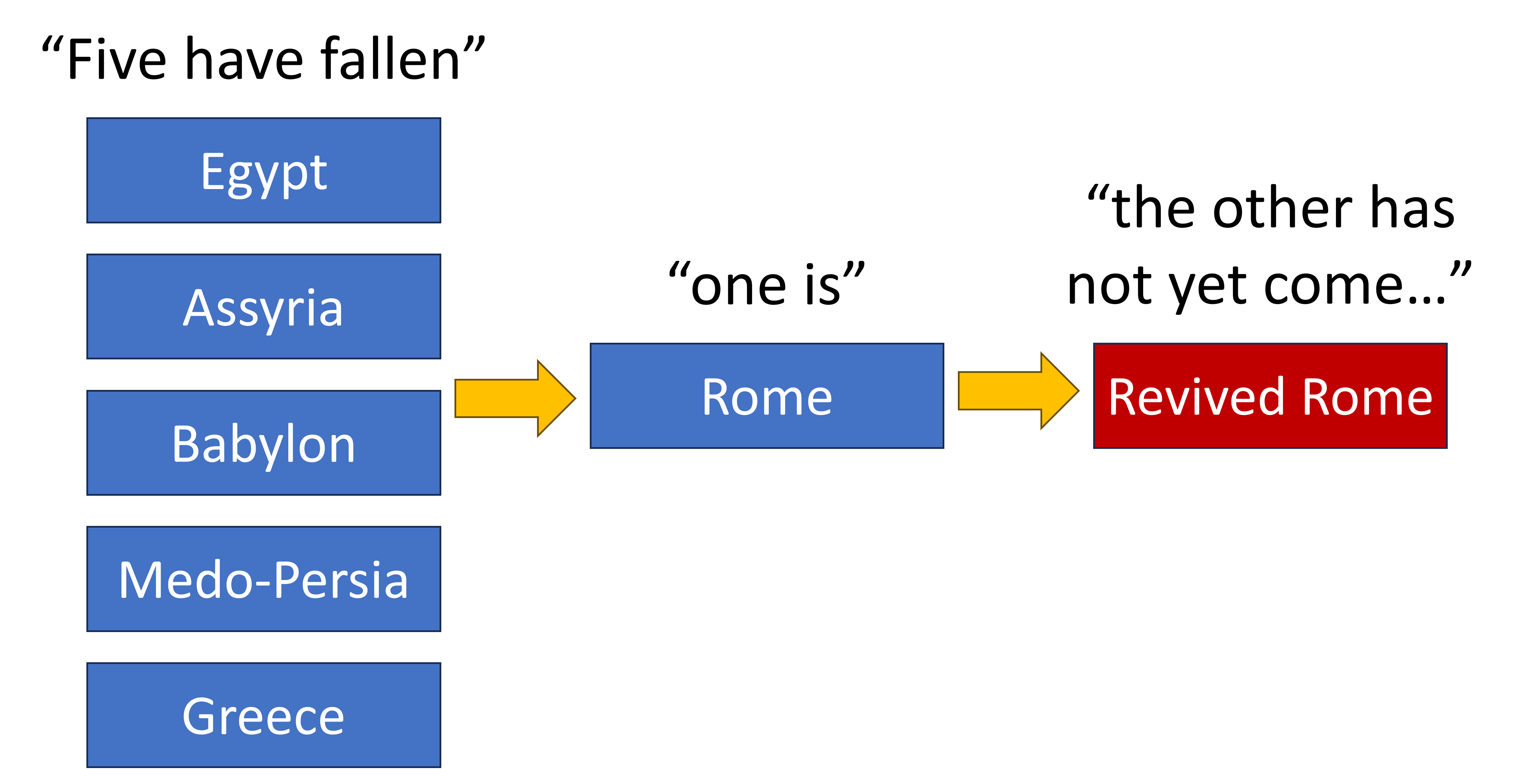
As you can see in the picture, five kings/kingdoms who persecuted God’s people had fallen by the time John received the Revelation vision on the island of Patmos. One existed during the time of John’s exile, namely, Rome. However, the angel goes on to say that there is another king/kingdom coming.
(Note, he does not say that this kingdom is 7th in an ordinal succession. Only that it “has not yet come.” It is 7th, in that this empire represents the 7th head on the beast.)
Furthermore, the revived Roman Empire will be short-lived and only remain a “little while.”
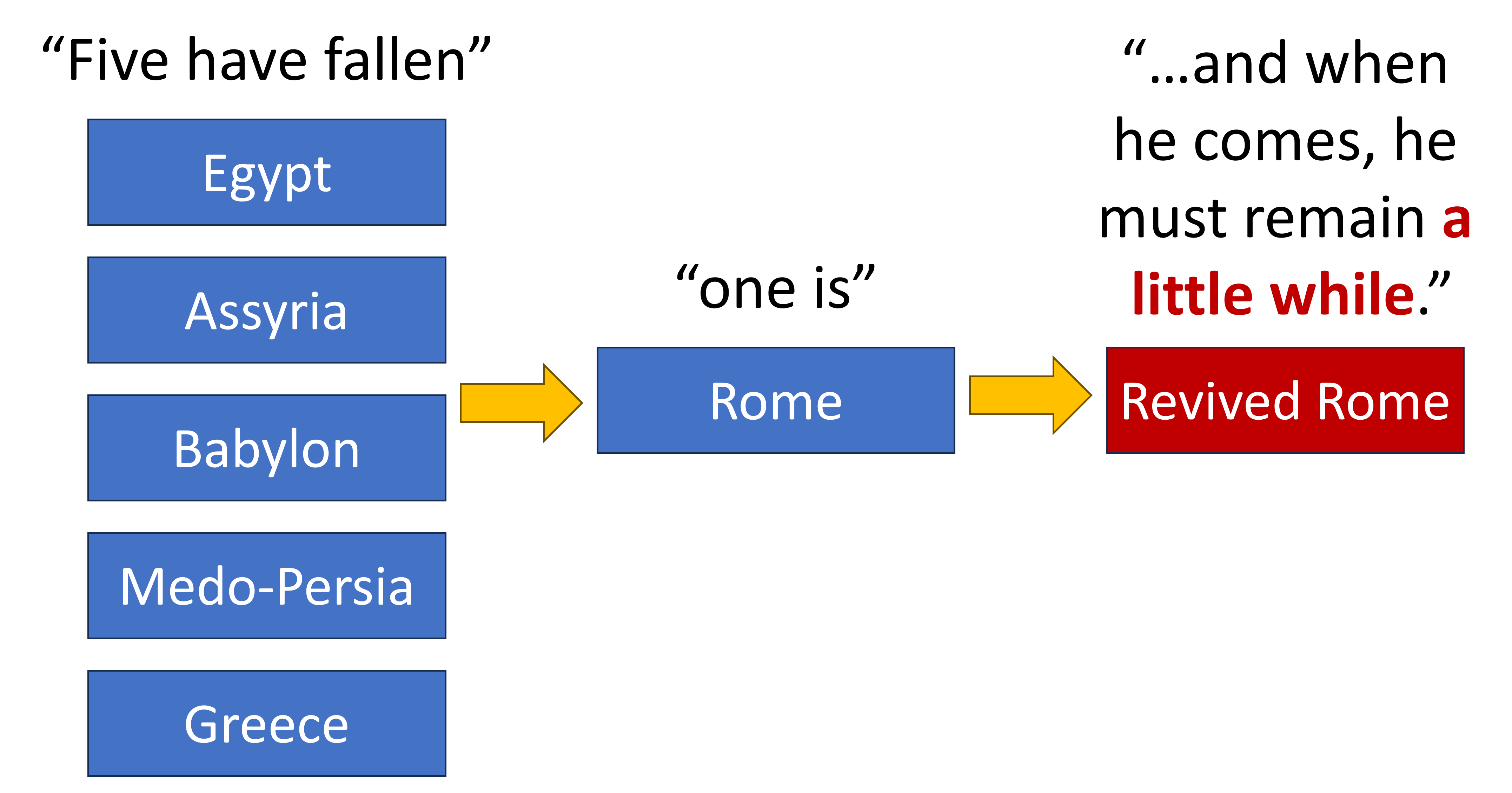
The angel tells us that the beast (Antichrist) “is himself also an eighth.”
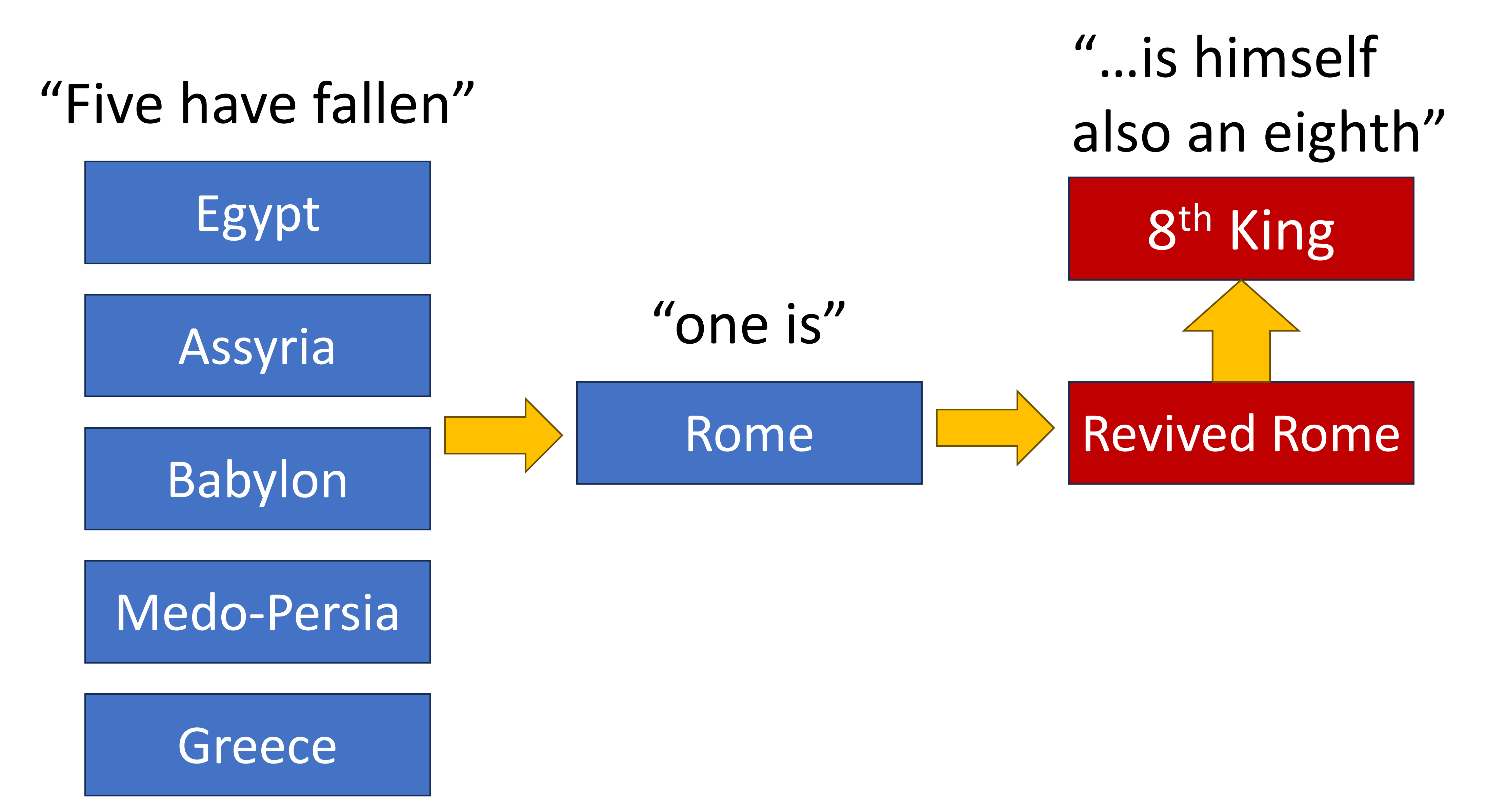
But there’s a problem! The beast in John’s vision only has 7 heads, not 8. What then are we to make of this?
The angel says that the eighth is “of the seven.” The phrase “one of the seven” (ek ton hepta) is in NASB, but “one” is italicized in that translation, because it’s not in the original text. Another literal translation, the English Standard Version, says the beast “belongs to the seven.”
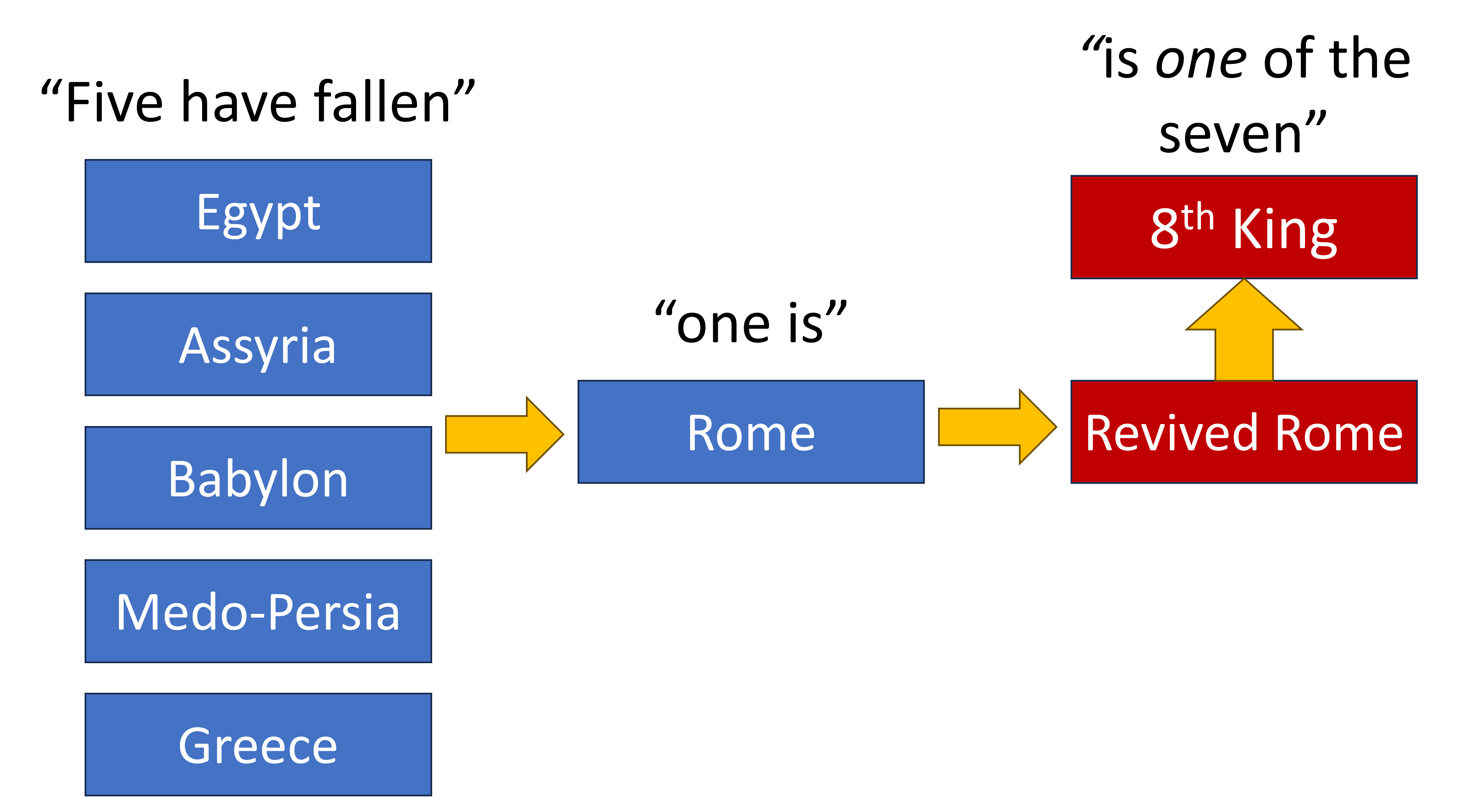
The Greek word “of” (ek) implies “out of” or “from” something. Such an expression can mean he is just one of the seven kings. We find a similar expression in the book of Acts.
On the next day we left and came to Caesarea, and we entered the house of Philip the evangelist, who was one of the seven, and stayed with him. (Acts 21:8)
Though it is not italicized in the NASB, “one” is not in the original text of Acts 21:8, as you can see here. For the nerds out there, this is called a “partitive genitive.”54
These men in the early church were in charge of taking care of the orphans and widows (Acts 6). There were literally seven men, and they are all named. It’s the same expression as found in Revelation 17:11.
Interestingly, the book of Revelation doesn’t usually use this expression when describing someone who is “one of” seven. In fact, it almost always literally says “one of the seven.” (heis ek ton hepta) For example, even in that very same chapter, it says:
Then one of the seven angels who had the seven bowls came and spoke with me, saying, “Come here, I will show you the judgment of the great prostitute who sits on many waters, (Revelation 17:1)
Later in chapter 21, it says:
9 Then one of the seven angels who had the seven bowls, full of the seven last plagues, came and spoke with me, saying, “Come here, I will show you the bride, the wife of the Lamb.” (Revelation 21:9)
And also:
Then I saw when the Lamb broke one of the seven seals, and I heard one of the four living creatures saying as with a voice of thunder, “Come!”
Even when referring to “one of” the seven seals or “one of” the four living creatures, it always literally states “one of” (heis ek) in Greek. This is in contrast to Revelation 17:11, which unusually, just says, “of,” (ek) just like the expression in Acts 21:8.
Since the beast only has 7 heads, how can he be the eighth? Does this mean he reigns twice?
This is likely, but there is more to it than that. We can see how the second phase of his reign is qualitatively different than the short phase of co-rule with the ten kings.
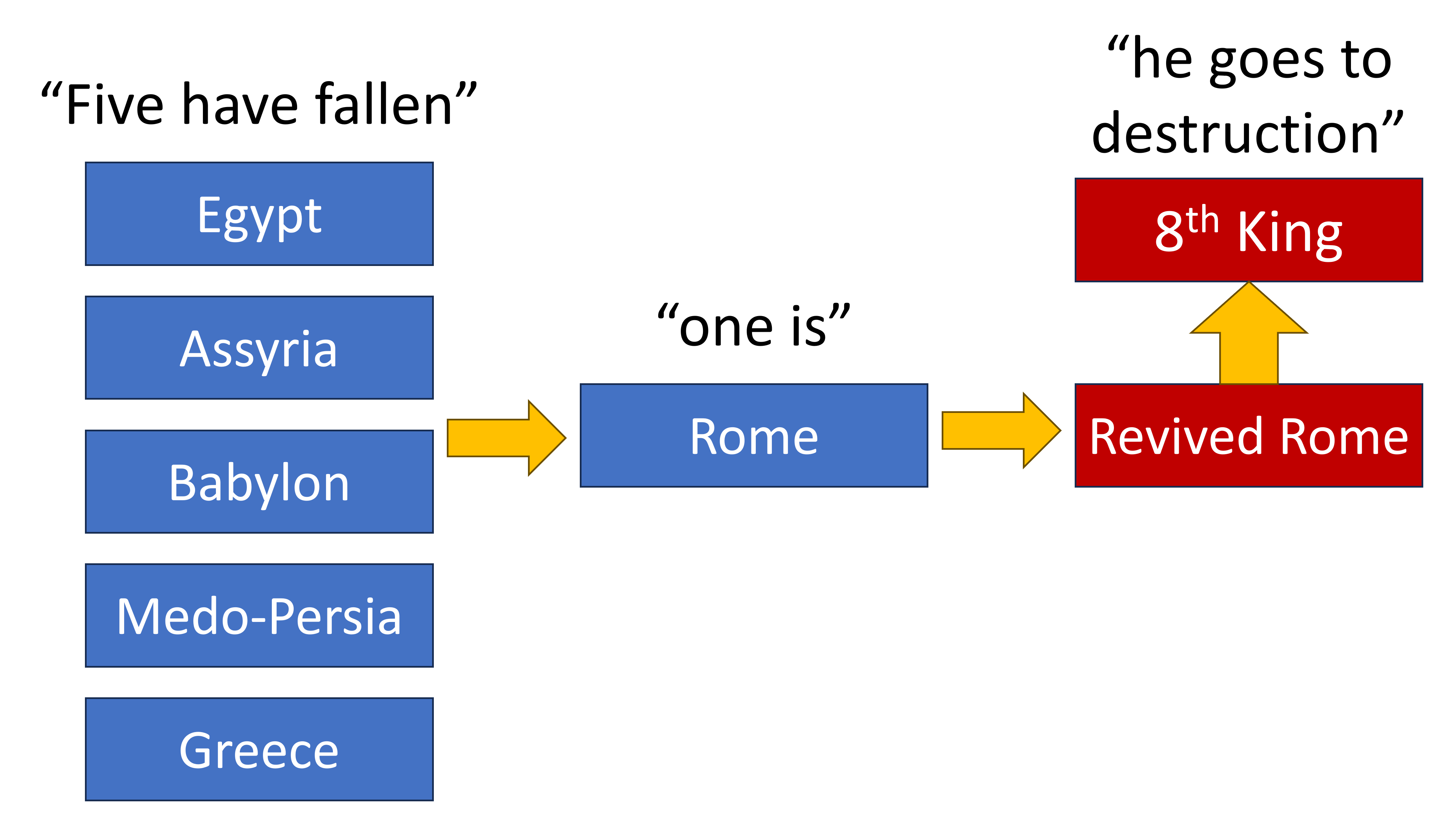
Saying that the Antichrist originates from among the seven, and reigns again in a more terrifying way makes the most sense of what we see in Daniel 7. In that chapter, there is a fourth kingdom, which is the historical Roman Empire. Then, the group of ten kings comes “out of” the Roman Empire (Daniel 7:24). As a result, the Antichrist himself originates from the revived Roman Empire, briefly co-rules with the ten, and goes on a 3 1/2-year global reign of terror.
Ultimately, the Roman Empire has three phases to its career:
Historical Roman Empire
Revived Roman Empire: Antichrist and Ten Kings Co-Rule
Global Reign of Terror: Antichrist’s Exclusive Rule
The Beast’s Career in Daniel 7
Below is the sequence of events in Daniel 7, along with excerpts from the relevant portions of Daniel 7.
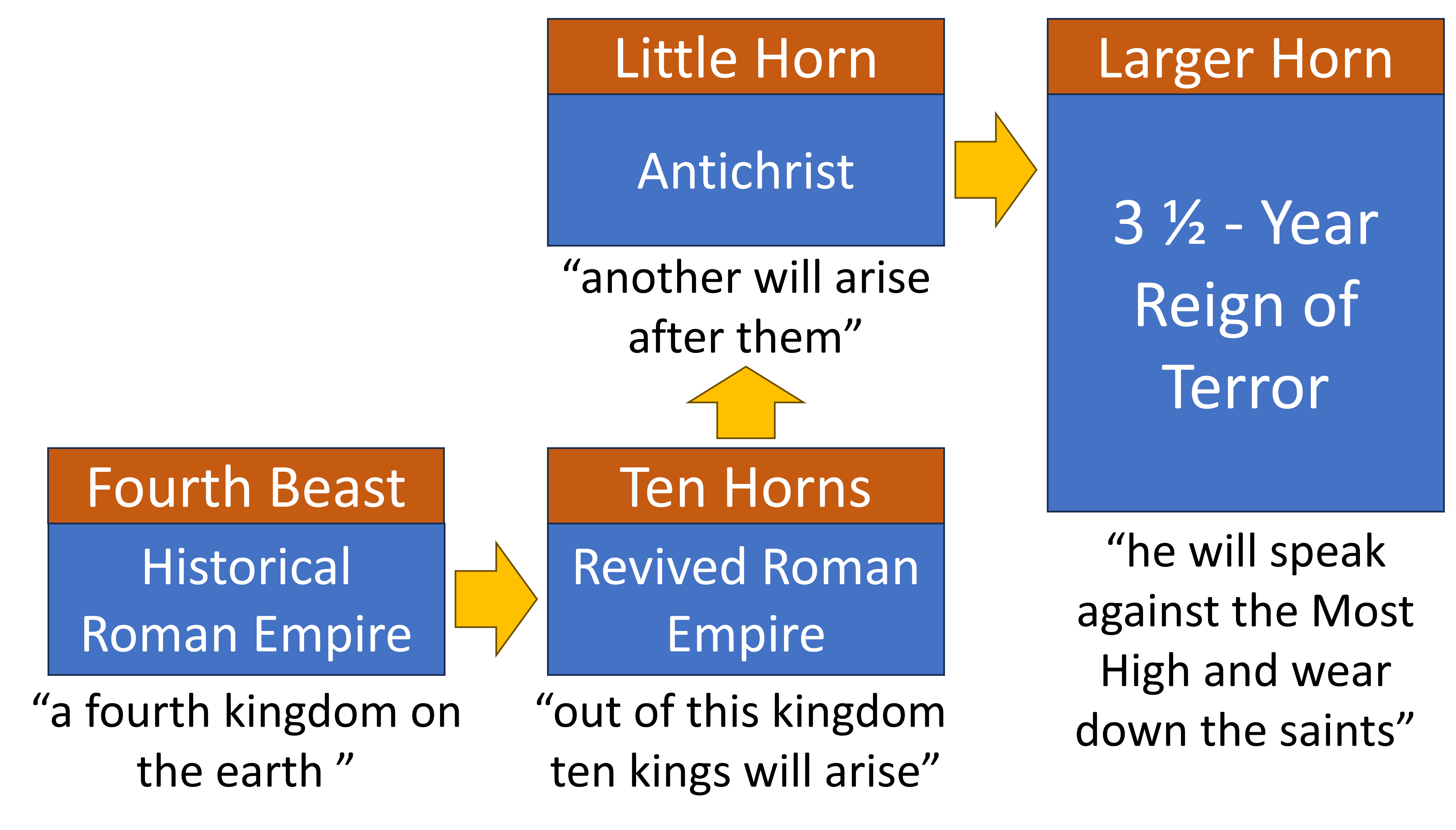
This coincides quite nicely with what Revelation 17:9-11 says, in that both have the Antichrist originating from the ten-horned stage of the Roman Empire.
Rome existed while the apostle John was in exile on Patmos, receiving the Revelation vision. However, the future revived Roman Empire (in its ten-nation format) did not exist yet (Revelation 17:12).
However, the Antichrist comes from (ek) that seventh kingdom and goes on a reign of terror for 3 1/2 years (Revelation 13:5). Again, if we map excerpts of Revelation 17:10-11 to the sequence of events in Daniel, we get a similar picture.
Daniel 7’s Consistency with Revelation 17:11
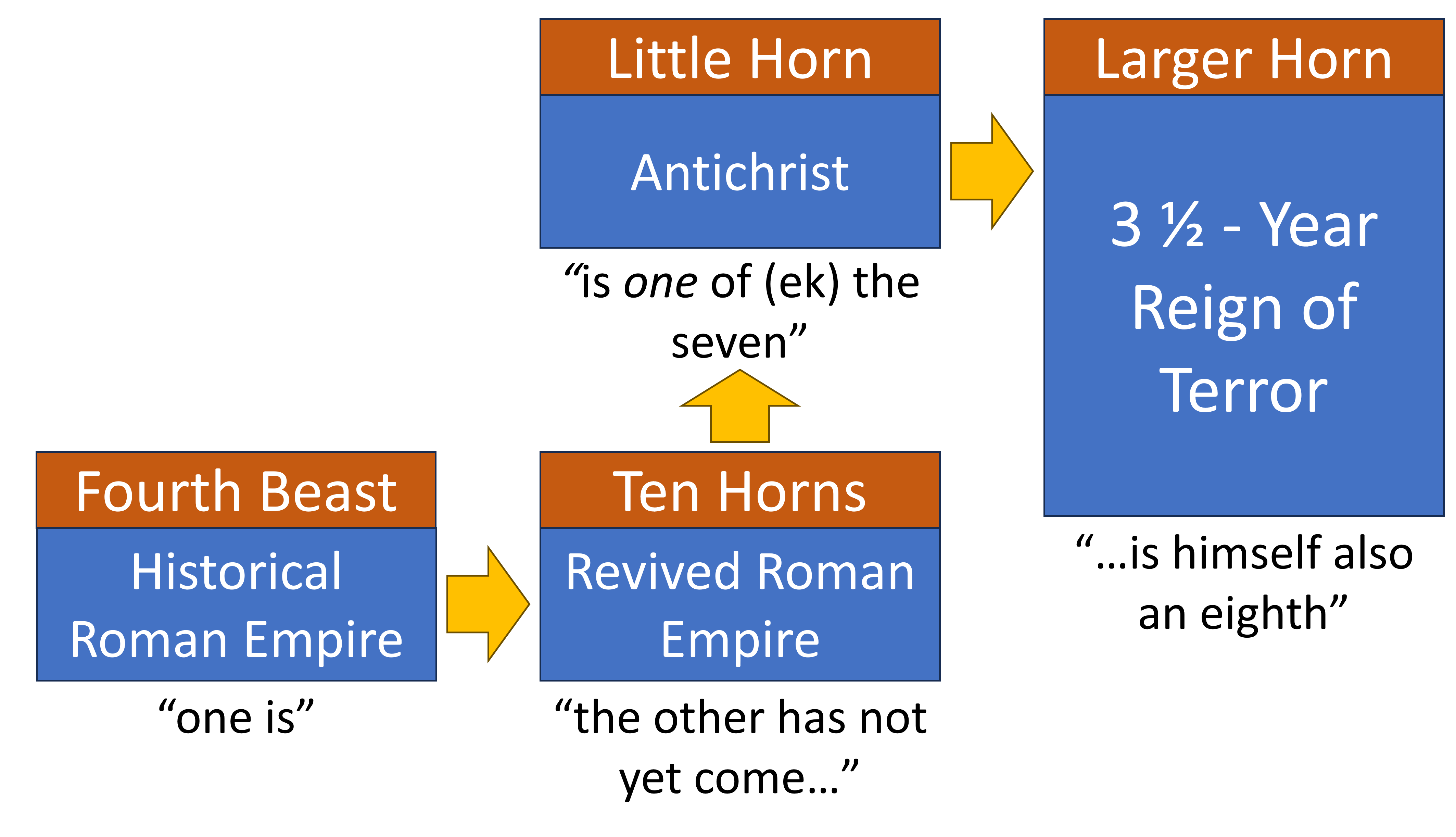
We know Antichrist’s entire career is actually longer than 3 1/2 years, as he is active to confirm a 7-year covenant with Israel (Daniel 9:27.) However, his final 3 1/2 persecution phase is singled out in both Daniel and Revelation (Daniel 7:25; Revelation 13:5).
Once again, the period of co-rule with the ten kings is only a “little while” (Revelation 17:10). This too is consistent with excerpts from Revelation 17:10-11 (see below).
Daniel 7 is Consistent with Revelation 17:10
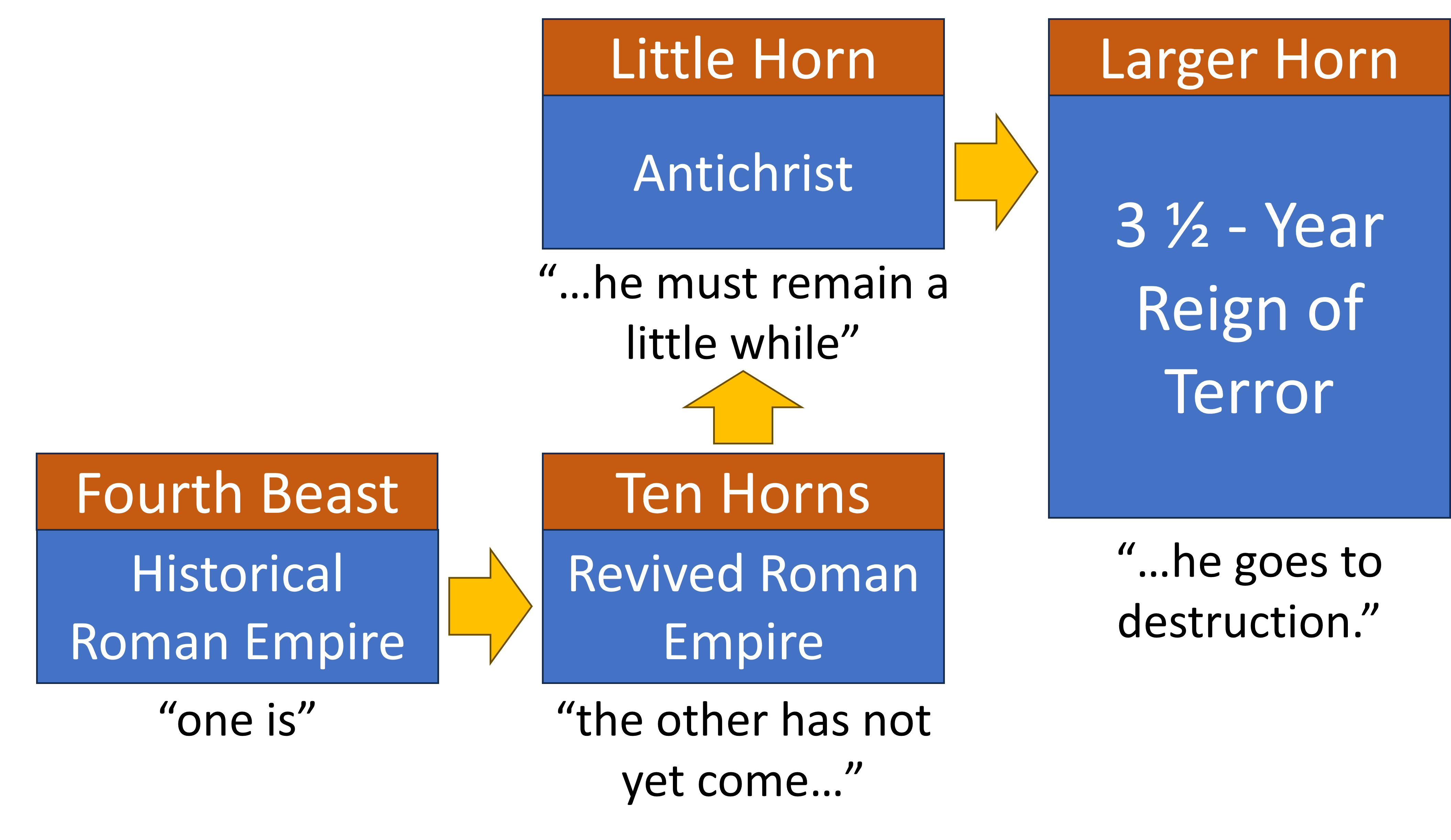
This lines up with what the angel says about the ten kings as well. Though the Roman Empire (historical) existed in at the time John received this vision, the ten kings (revived Roman Empire) hadn’t arrived yet.
When they do arrive, they briefly co-rule with the beast, only to give up their power and authority to him. If we superimpose excerpts from Revelation 17:12-18 onto our Daniel 7 sequence, we get another consistent narrative of the beast’s career.
Daniel 7 is Consistent with Revelation 17:12-13
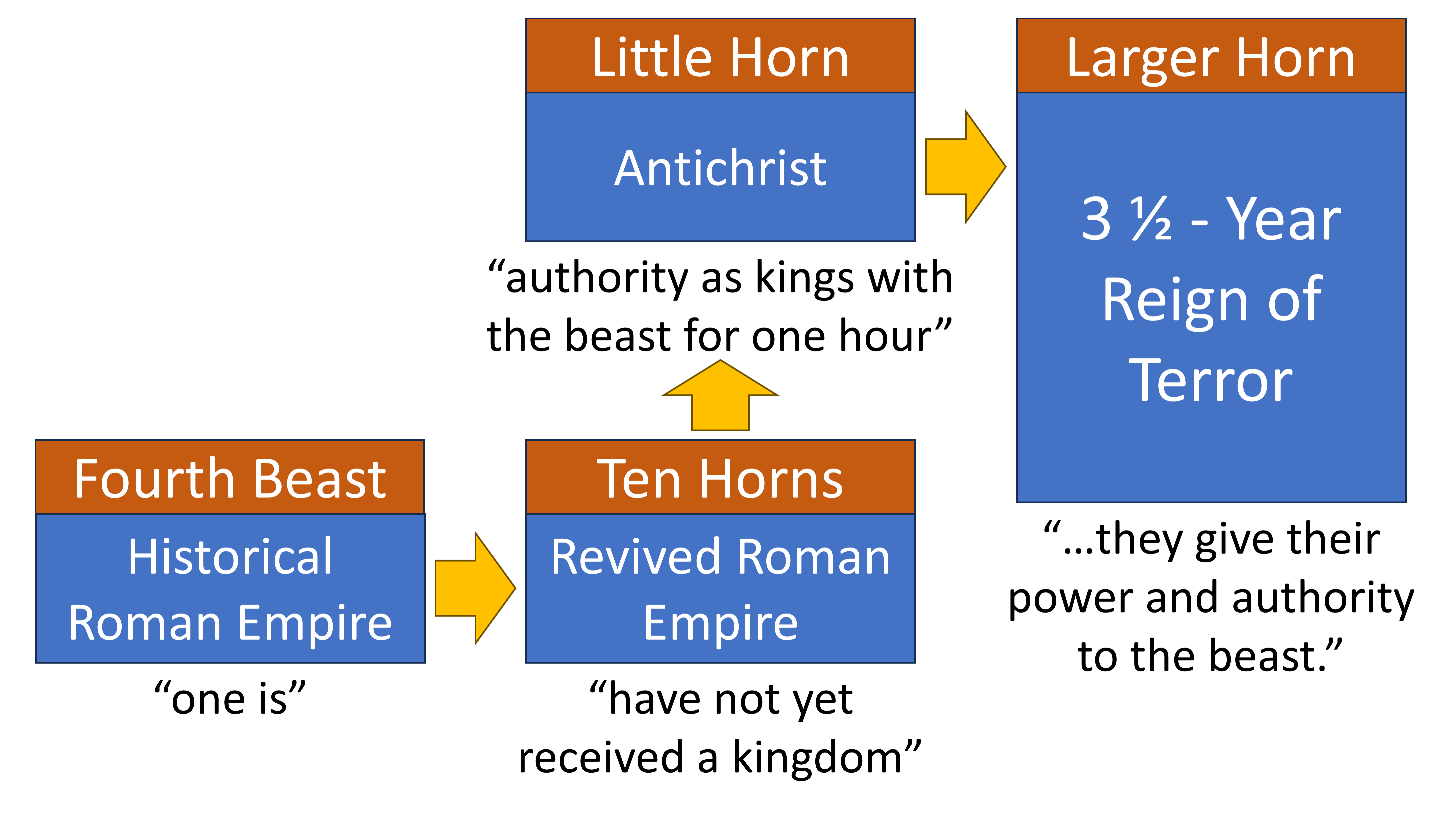
This “co-rule” phase and “dictatorial” phase represent the 7th and the 8th king. The 7th king/kingdom is the ten-nation confederacy, co-ruling with the Antichrist. That kingdom is brief, only lasting “a little while” or “one hour.”55
However, the 8th king has total authority and has a much bigger impact. Though he is both “one of the seven,” and also “of the seven,” in that he originates from that group of seven.56
Revelation 17:10 is Consistent with Revelation 17:12-18
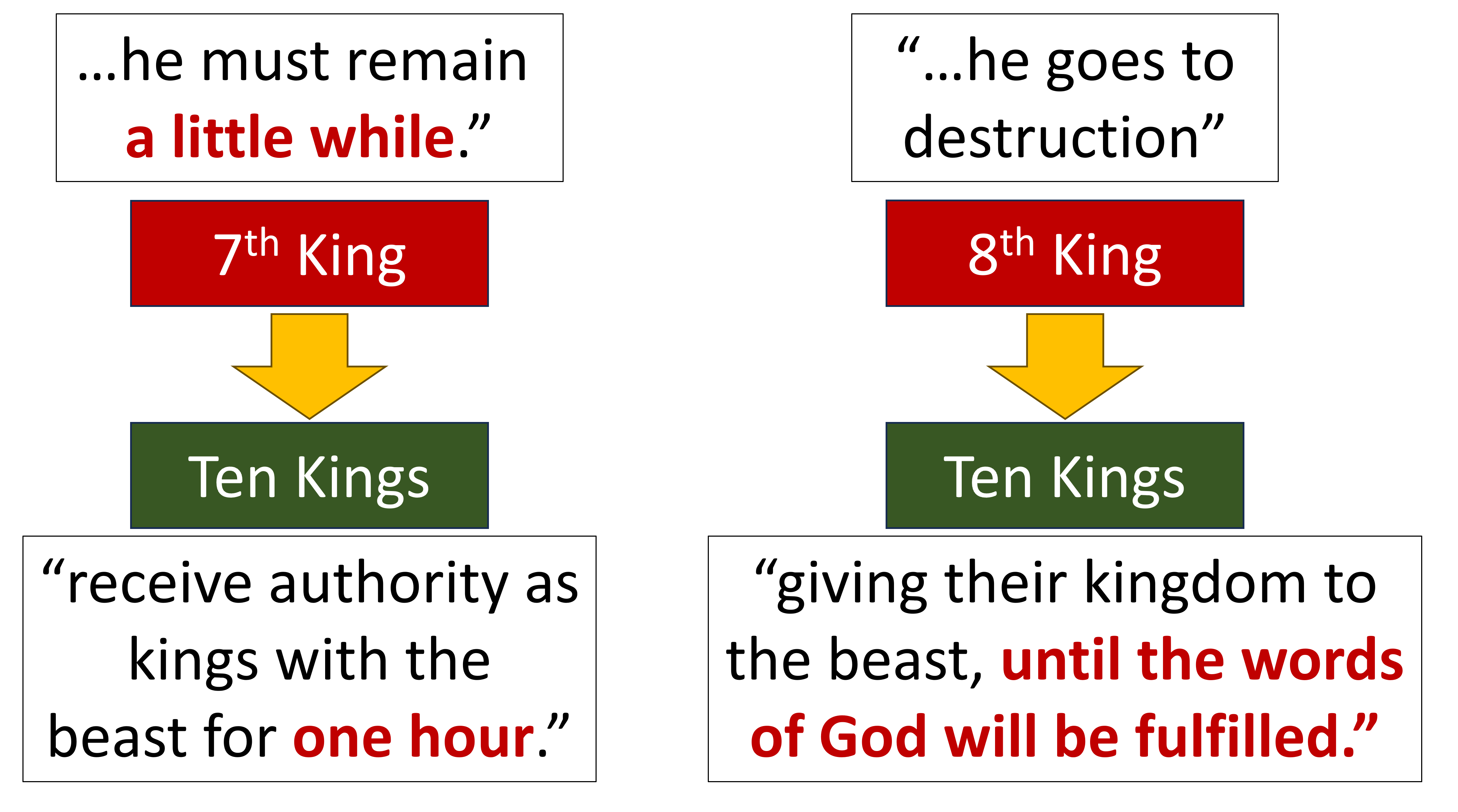
Note, the 7th king reigns only a little while. The 7th is not said to “go to destruction.” But the 8th is said to “go to destruction.” We can speculate then, that there is a gap of time between these two reigns, with the latter being “far more dynamic and dominant than before.”57
All this to say, there are not two, but three stages that concern us:
Historical Roman Empire
Revived Roman Empire: Antichrist and Ten Kings Co-Rule
Global Reign of Terror: Antichrist’s Exclusive Rule
Therefore, the typical reading of these 7 kings/kingdoms is completely consistent with the Antichrist’s career in Daniel 7 and Revelation 17.
Richardson’s 7 King/Kingdom Sequence
Richardson does not have the advantage of this consistency. If we map his views onto my chart, it goes something like this.
First thing you will notice, is that Richardson keeps Rome here.58 He’s right about that. But he does not use Rome in the 4-kingdom sequence of Daniel 2 & 7. This is inconsistent.
This reading forces Richardson to say that the Ottoman Empire only lasted “a little while” (Revelation 17:10). On the contrary, the Ottoman empire lasted longer than any of the previous five empires. This fact fits best with the typical interpretation, wherein the beast and the ten kings co-rule for a brief time, prior to his reign of terror.
Furthermore, it is an unnecessarily complex interpretation to say that Rome is present in the Revelation 17 sequence, but not in Daniel. On the Roman view, it is present in both, since Daniel treats the empires as back-to-back. As with any theory, if there are two competing systems, you should go with the simplest one that explains all the facts. This idea is known as Occam’s Razor.
Furthermore, there are heavy symbolic parallels between Daniel 7 and Revelation 17. To say that Daniel skipped Rome, but it is present in Revelation 17, would be most unusual.
Richardson responds, saying that the empires in Daniel 2 & 7 were from the perspective of Babylon, not all evil empires in history.
As we have seen, these passages simply speak of the empires that would rise after Nebuchadnezzar in Babylon, and the Roman Empire was not included among these.59
In a way, his hermeneutic works against his own view. The Roman Empire actually is the fourth from the perspective of Nebuchadnezzar. It is the 4th in a series of imperial conquest and replacement, which started with Babylon.
But let us concede Richardson’s point for a moment. Perhaps the statue in Daniel 2 is from the perspective of Babylon. Yet this cannot be said of Daniel 7, where we see the empires from God’s perspective as they really are: ruthless beasts.60 This is further reinforced by the fact that Daniel sees the final ruler persecuting God’s people (Daniel 7:21; 25).
Of all the books of the Bible, Daniel sees things from a Gentile perspective. Both Nebuchadnezzar and Daniel see a series of Gentile kingdoms that rise up out of the Mediterranean, one after another. The book of Daniel has a very “Gentile” vantage point, in that Daniel is in exile in a foreign king’s palace at the time of writing. This differs significantly from most other Hebrew prophets.
Daniel also mentions the Roman Empire (at least, indirectly, on Richardson’s view) by referring to the destruction of Jerusalem and the temple. The fact that the empire which killed the Messiah and caused the biggest exile in the history of the Jewish people was skipped in Daniel, only to be included in Revelation, is a very awkward reading of both.
No matter your view of the date of Revelation (most say 90’s A.D.), the phrase “one is” in Revelation 17:10 clearly refers to Rome. If Richardson was consistent, he would leave out Rome and put the Ottoman Empire there. But this would be incorrect, as the Islamic Caliphate didn’t emerge until after the Roman Empire fell.
There are other ways to read the details of Revelation 17:8-11. Mine is just one of them. Nevertheless, I give my view to show that it is consistent with the Roman Empire view. On the contrary, Richardson’s view lacks the consistency that the Roman view has.
5. Antichrist Will Be Self Deifying, Not Islamic
The Antichrist will be self-deifying, not Islamic. Daniel 11:36-39 describes his personality:
36 “Then the king will do as he pleases, and he will exalt himself and boast against every god and will speak dreadful things against the God of gods; and he will be successful until the indignation is finished, because that which is determined will be done. 37 And he will show no regard for the gods of his fathers or for the desire of women, nor will he show regard for any other god; for he will boast against them all. 38 But instead he will honor a god of fortresses, a god whom his fathers did not know; he will honor him with gold, silver, precious stones, and treasures. 39 And he will take action against the strongest of fortresses with the help of a foreign god; he will give great honor to those who acknowledge him and will make them rulers over the many, and will parcel out land for a price. (Daniel 11:36-39)
The text goes to great lengths to let us know that the Antichrist does not serve any traditional deity of any kind. Instead, he will exalt himself against all of them. The apostle Paul makes an allusion to this passage, when he states:
3 No one is to deceive you in any way! For it will not come unless the apostasy comes first, and the man of lawlessness is revealed, the son of destruction, 4 who opposes and exalts himself above every so-called god or object of worship, so that he takes his seat in the temple of God, displaying himself as being God. (2 Thessalonians 2:3-4)
Paul adds the additional detail that he will set himself up in the temple “displaying” himself as being God. This is not the only time that such an event is mentioned. Jesus himself uses the masculine participle to refer to the abomination of desolation. Which is why ESV renders it as the following:
“But when you see the abomination of desolation standing where he ought not to be (let the reader understand), then let those who are in Judea flee to the mountains. (Mark 13:14; ESV)
In the book Three Views on the Rapture: Pretribulation, Prewrath, or Posttribulation, all writers from each viewpoint unanimously conclude that this is related to the Antichrist himself. This is true, despite their differences on the Rapture.
As Craig Blaising (pretribulationist) states:
Although Mark omits this middle reference to false christs, he does use the masculine participle hestēkota with the neuter abomination of desolation (in contrast to Matthew, who maintains proper subject-verb agreement), indicating that the desecration is linked to the presence of the perpetrator himself in the temple.61
As Alan Hultberg (prewrath) argues:
In Matthew this period is during the “great tribulation” (vv. 21, 23 – 24) that follows “the abomination of desolation spoken of by the prophet Daniel, standing in the holy place” (v. 15 ESV, emphasis added; cf. the masculine participle in Mark 13:14, “standing where he does not belong”).50 This language corresponds to Paul’s when he speaks of the Man of Lawlessness taking his seat in the temple of God, displaying himself as being God (2 Thess. 2:4). For this reason, and due to the allusion to Daniel 11:36 in 2 Thessalonians 2:4, most scholars are agreed that Paul is thinking of the abomination of desolation when he mentions the session of the Man of Lawlessness.62
As Douglas Moo (posttribulational) states:
Is Jesus envisaging an event that transpired in AD 70, when Jerusalem and its temple were destroyed and desecrated by the armies of Rome? Or is he referring to the end-time Antichrist? Several indications could point to the latter interpretation. First, the phrase “abomination of desolation” clearly alludes to the same prophecies in Daniel that we have just seen Paul citing to describe the end-time Antichrist (in 2 Thess. 2:3 – 4). Second, Mark (13:14) suggests, by using a masculine participle after the neuter “abomination,” that he is thinking of a person — and, again, the similarities to the Antichrist described in 2 Thessalonians 2 are clear.63
Despite their differences on timing, they all seem to think that the Antichrist is himself associated with an idolatrous act in the temple.
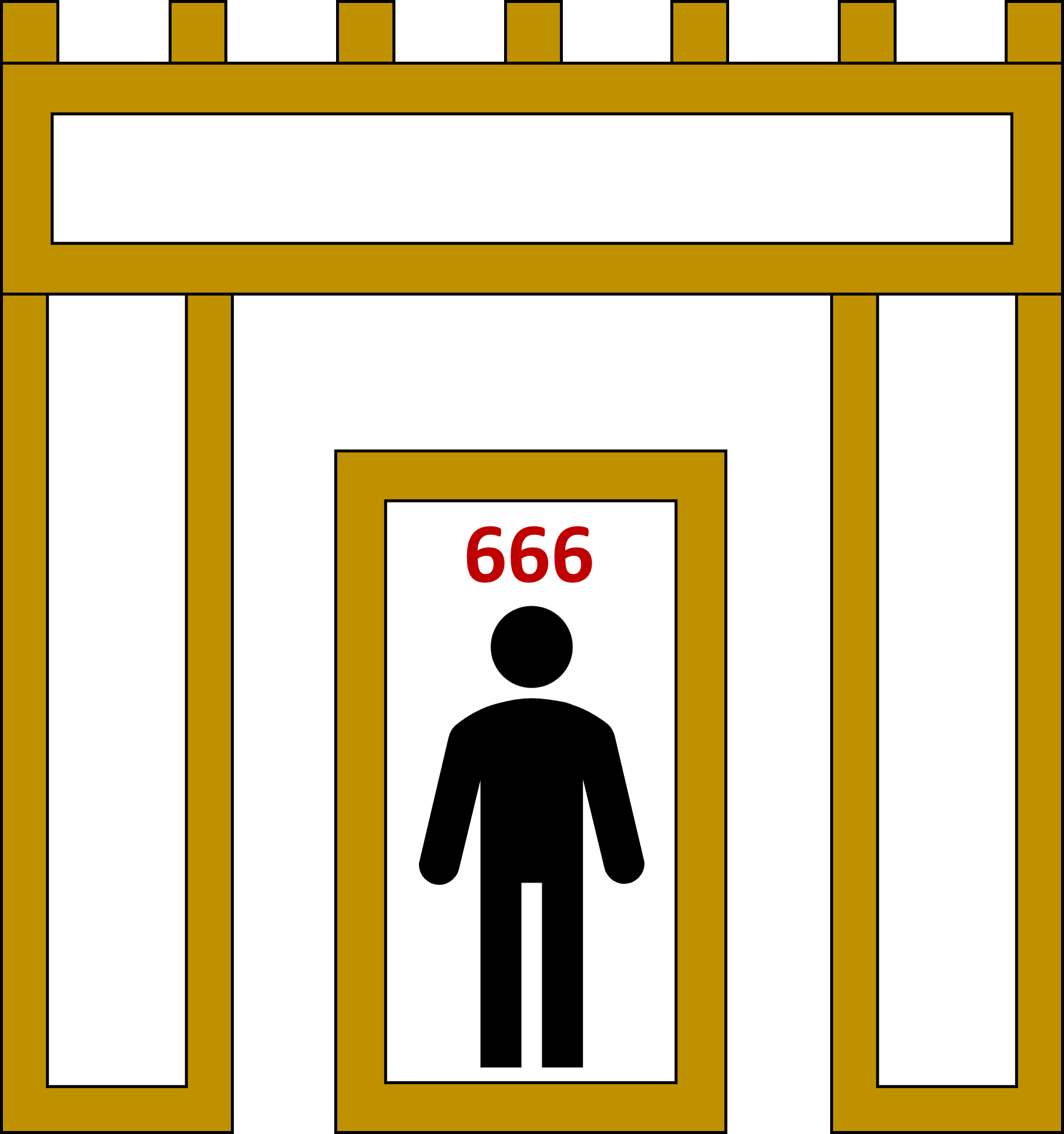
Abomination of Desolation
Abomination of desolation itself is a technical term for the placement of an idol in the Jewish temple, causing it to be abandoned in shock and horror. “Abomination of desolation” language is used three times in the Old Testament, all within Daniel.
The first abomination of desolation happened in 167 B.C. when Antiochus IV Epiphanes set up an altar to Zeus on the Jewish temple altar.64 Daniel predicted this when he says:
31 Forces from him will arise, desecrate the sanctuary fortress, and do away with the regular sacrifice. And they will set up the abomination of desolation.
The rededication of the temple after this event is now celebrated as Hanukkah.
English Bibles use the word “abomination” in a broader sense for everything God hates. For example, the NASB of Leviticus 18:22 says that it is an “abomination” for a man to have relations with another man. However, the Hebrew word for abomination that we are concerned with in Daniel has a much narrower meaning. It’s only used 28 times in the Old Testament, referring very specifically to idolatry or idolatrous practices.
In 167 B.C. a statue of Zeus or the altar to Zeus was the idolatrous thing in the temple. But in the end times, the idol is a person. This is reinforced by the fact that Daniel 9:27 uses the same language to describe what the Antichrist does halfway through the final 7-year period before the final restoration of Israel.
27 And he will confirm a covenant with the many for one week, but in the middle of the week he will put a stop to sacrifice and grain offering; and on the wing of abominations will come the one who makes desolate, until a complete destruction, one that is decreed, gushes forth on the one who makes desolate.” (Daniel 9:27)
Just like in Mark 13, it is the person that makes desolate, not an inanimate statue.
Will the Antichrist Really Claim to Be God?
Richardson states that the Antichrist won’t really claim to be God in 2 Thessalonians 2:4, but will stop short of doing that.
While it is clear that the Antichrist will be a shameless self-promoter and will demand absolute allegiance, subservience, and submission, there is also the possibility that he will stop just shy of actually proclaiming himself to be God Almighty.65
Furthermore, Richardson says that if he does claim to be God, it is not the God of the Bible.
But what exactly does the text mean when it says that the Antichrist will show himself as God? Will he claim to be Yahweh, the God of the Jewish people? It does not appear so.66
Now, if the Antichrist is setting himself up in the “temple of God,” then what God would he be claiming to be, other than the one true God? This is especially the case, given he exalts himself above all traditional deities.
Richardson is right on one point, namely that 2 Thessalonians 2 doesn’t say the Antichrist necessarily “claims” to be God with his words at that time. It says he will be “displaying” himself as being God. This is perfectly aligned with the idea of the abomination of desolation standing in the holy place. In this case, the idol is a person, not a statue.
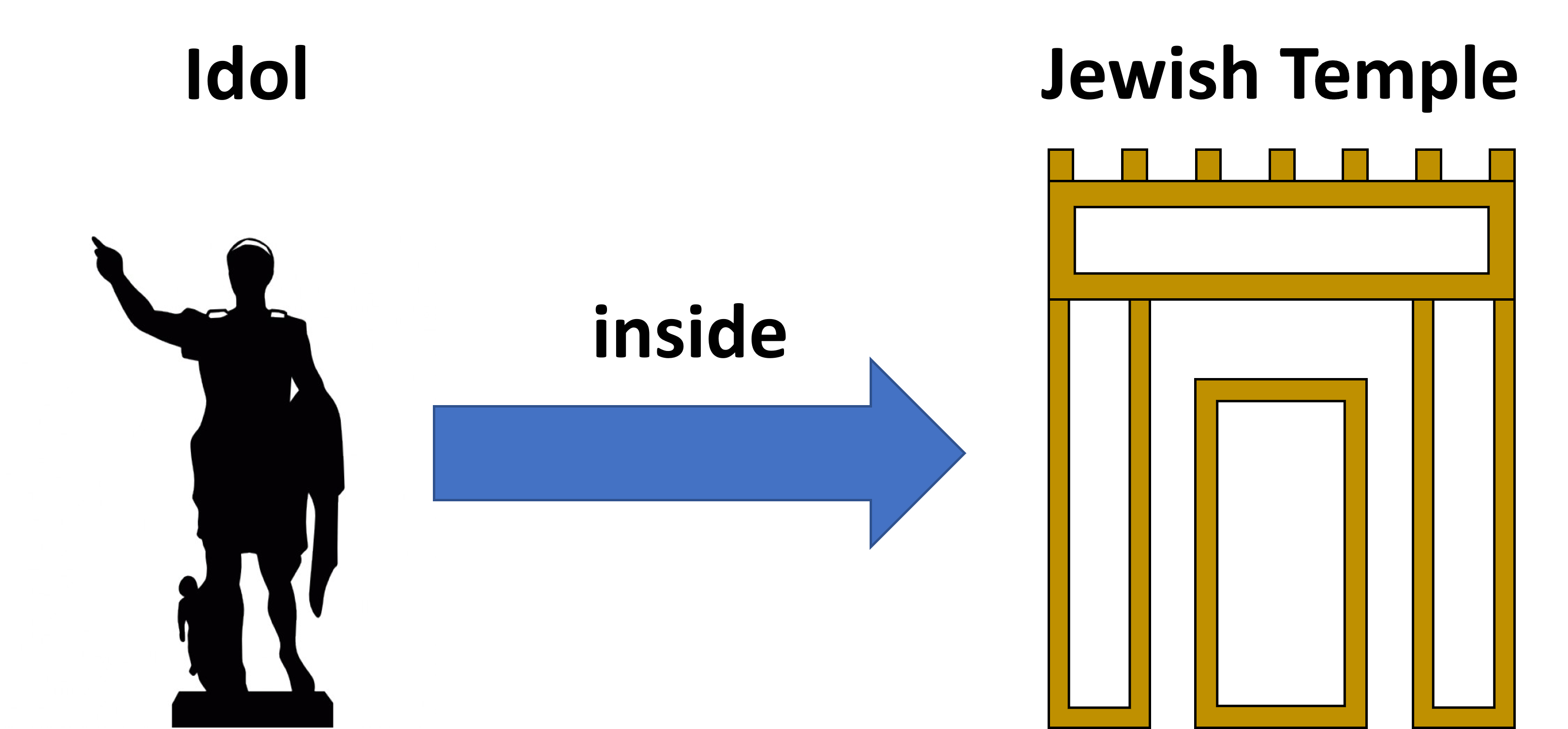
Richardson also claims that the image worshipers in Revelation 13 are paying homage to the beast, not worshiping it as God.
Most reason that because the beast receives worship, he must be viewed as a god. But this is not necessarily so. The word used here for “worship” is the Greek proskyneō,[…]67
Richardson is right that proskuneo can mean bowing to a king or an authority figure.68
But its context determines its specific meaning. If proskuneo is not a reference to worshiping someone as God, then we are unable say that Jesus is worshiped as God when he walks on water. This seems to be a high price to pay, based on the context of that and other passages.
After Jesus walks on water, the disciples worship Jesus:
And those who were in the boat worshiped Him, saying, “You are truly God’s Son!” (Matthew 14:33)
This is clearly in the divine sense. Before this, Jesus is walking on the water, when He says:
But immediately Jesus spoke to them, saying, “Take courage, [q]it is I; do not be afraid.” (Matthew 14:27)
q. “Lit I am”
Jesus is walking on the water, which the book of Job says that God does (Job 9:8). Then, Jesus says “I am, do not be afraid” (see John 8:58). Then he gets in the boat, and they worship (proskuneo) him. It is clear from the context that the disciples are worshiping Jesus as God, not just paying humble reverence.
The same is true of the beast in Revelation 13. In that passage, you have an idol that people have to worship, or else they are killed (Revelation 13:15). Furthermore, those who worship the idol are consigned to torment in hell (Revelation 13:9-12). This clearly involves more than just bowing down or giving reverence to a king. It involves worshiping the beast as God.
The God of Fortresses
Daniel 11:36-37 goes to great lengths to show that the Antichrist has no god, not even the God/gods of his ancestors. However, Daniel 11:38 states that he does serve a god!
38 But instead he will honor a god of fortresses, a god whom his fathers did not know; he will honor him with gold, silver, precious stones, and treasures. 39 And he will take action against the strongest of fortresses with the help of a foreign god; he will give great honor to those who acknowledge him and will make them rulers over the many, and will parcel out land for a price. (Daniel 11:36-39)
What are we to make of this?
I believe the common futurist explanation is the best one. The Antichrist will worship warfare and military strength in place of any traditional or ancestral deity. This is not unprecedented in the Bible. Speaking of the Babylonian military in Habakkuk 1:11, God says:
Then they fly along like the wind and pass on.
But they will be held guilty,
They whose strength is their god. (Habakkuk 1:11)
Context would seem to support this idea. The next verse goes on to say that he will attack “the strongest of fortresses” (Daniel 11:39). Antichrist will place his trust in the financing of his war machine. It speaks of him using “gold, silver, precious stones, and treasures.”
Very similar language is used to describe the Antichrist military campaigns, when he extracts the wealth of Egypt for his own purposes (Daniel 11:43). Therefore, context would lead us to believe that this “gold” and “silver” is not for purposes of decorating a temple, but for financing warfare.
43 But he will gain control over the hidden treasures of gold and silver, and over all the precious things of Egypt; and Libyans and Ethiopians will follow at his heels. (Daniel 11:43)
It goes on to say that he will do all this with the help of a “foreign god.” Foreign god is an Old Testament term for the gods of the surrounding nations (Psalm 81:9).
But how can he be helped by a foreign god? Isaiah 44 is clear that idols can’t do anything. In that passage, Isaiah gives a parody of idolatry. In his satire, the craftsman takes one block of wood to cook his dinner, and the other half to make a god.
16 Half of it he burns in the fire; over this half he eats meat, he roasts a roast, and is satisfied. He also warms himself and says, “Aha! I am warm, I have seen the fire.” 17 Yet the rest of it he makes into a god, his carved image. He bows down before it and worships; he also prays to it and says, “Save me, for you are my god.” (Isaiah 44:16-17)
Even Paul says idols are “nothing at all in the world.”
4 Therefore, concerning the eating of food sacrificed to idols, we know that an idol is nothing at all in the world, and that there is no God but one. (1 Corinthians 8:4)
Though the false gods are nothing in themselves, the powers behind them are something.
19 What do I mean then? That food sacrificed to idols is anything, or that an idol is anything? 20 No, but I say that things which the Gentiles sacrifice, they sacrifice to demons and not to God; and I do not want you to become partners with demons. (1 Corinthians 10:19-20)
If we check out Revelation 13, this foreign god appears to be Satan. He is the one who empowers the Antichrist.
I saw one of his heads as if it had been fatally wounded, and his fatal wound was healed. And the whole earth was amazed and followed after the beast; 4 they worshiped the dragon because he gave his authority to the beast; and they worshiped the beast, saying, “Who is like the beast, and who is able to wage war with him?” (Revelation 13:3-4)
Furthermore, this passage also reinforces the idea that it is military power the Antichrist serves. In fact, this is the very reason the world worships him.
Richardson acknowledges that this means the Antichrist worships a “specific god of war.”69 As a result, he states that Allah is the god of war, and that Allah is Satan. Yet this interpretation of Daniel 11 doesn’t make the best sense. If the Antichrist is a traditional monotheist, Daniel 11, 2 Thessalonians 2, and Mark 13:14 sure have a strange way of communicating that, given verses 36 and 37.

A God Unknown to His Fathers
The most serious problem for the view that Allah is the “god of fortresses” is that it explicitly states that his ancestors did not know this god. First, it says he will not honor the gods/God of his fathers.
Whether this refers to the true God, or to pagan deities, the text is not clear. The Hebrew word for “God” (elohim) is plural. In context, it could be read to refer to multiple pagan deities, as most translations have it. But it could also be a reference to the true God in the phrase “the God of his fathers.” Either way, the god of fortresses is decidedly not the god that his ancestors worshiped.
If that weren’t clear enough, it goes on to say that that the god of fortresses is “a god whom his fathers did not know.” But if the Antichrist is from an Islamic Caliphate, then his fathers (ancestors) most certainly did know and serve Allah.
Richardson does not spend much time on this objection. However, he does address it when he says
If Islam is the religion of the Antichrist, then the phrase “a god whom his fathers did not know,” could easily be understood as a reference to Allah, the moon-and-war god of Arabia.70
Perhaps Richardson is alluding to the fact that the Antichrist’s distant ancestors worshiped a different god other than Allah? But here, the wording makes it sound like the Antichrist (on his view) does worship a god of his distant ancestors. (Perhaps Richardson can clarify his views on this subject, as I do not want to misrepresent him.)
Perhaps the Antichrist could be a convert to Islam, when his parents and ancestors were not Muslim. Nevertheless, this seems quite unlikely, given that the Antichrist comes from an Islamic Caliphate on Richardson’s view.
6. The Northern Foe is Not the Antichrist
Richardson successfully argues for a northern foe who is active in the end times. I would agree. This foe (or foes) are called “Gog and Magog”, “the Assyrian,” and the “King of the North.” Richardson argues that these refer to the area directly north of Israel, especially Syria and Turkey, though it is not limited to that. Furthermore, he believes that these are all separate names for the Antichrist.71
Furthermore, he works hard to prove that Gog and Magog primarily refer to Turkey only, not Russia as well.72 For sake of argument, I am willing to concede that point. As far as I’m concerned, Richardson makes a valuable contribution to the Russia and/or Turkey debate regarding the identity of Gog and Magog.
Regional Beginnings Allow for Multiple Antagonists
If at the very least, the Antichrist starts out as a regional power (as Richardson and I seem to agree), then there is plenty of room for multiple villains on the global chessboard in the end times. Richardson already apparently agrees, as the “kings from the east” (Revelation 16:12) and Edom (Obadiah) are separate from the Antichrist.
Gog and Magog Is Not the Antichrist
Richardson says that God “directly says” that Gog is the Antichrist.
GOD DIRECTLY DECLARES THAT GOG IS THE ANTICHRIST
But beyond all of the evidences that we have seen thus far, perhaps the clearest and most direct proof that Gog is the Antichrist is quite simply because God says so. 73
He argues for this using two main reasons:
This hardly amounts to God “directly” saying that Gog is the Antichrist. Lots of battles happen in the Day of the Lord (Daniel 11:40-45). Furthermore, scholars have always found it difficult to determine where else God predicted the Gog and Magog invasion prior to Ezekiel. (I can think of a few possibilities such as Isaiah 29 or the end of Isaiah 17, but I cannot be dogmatic.)
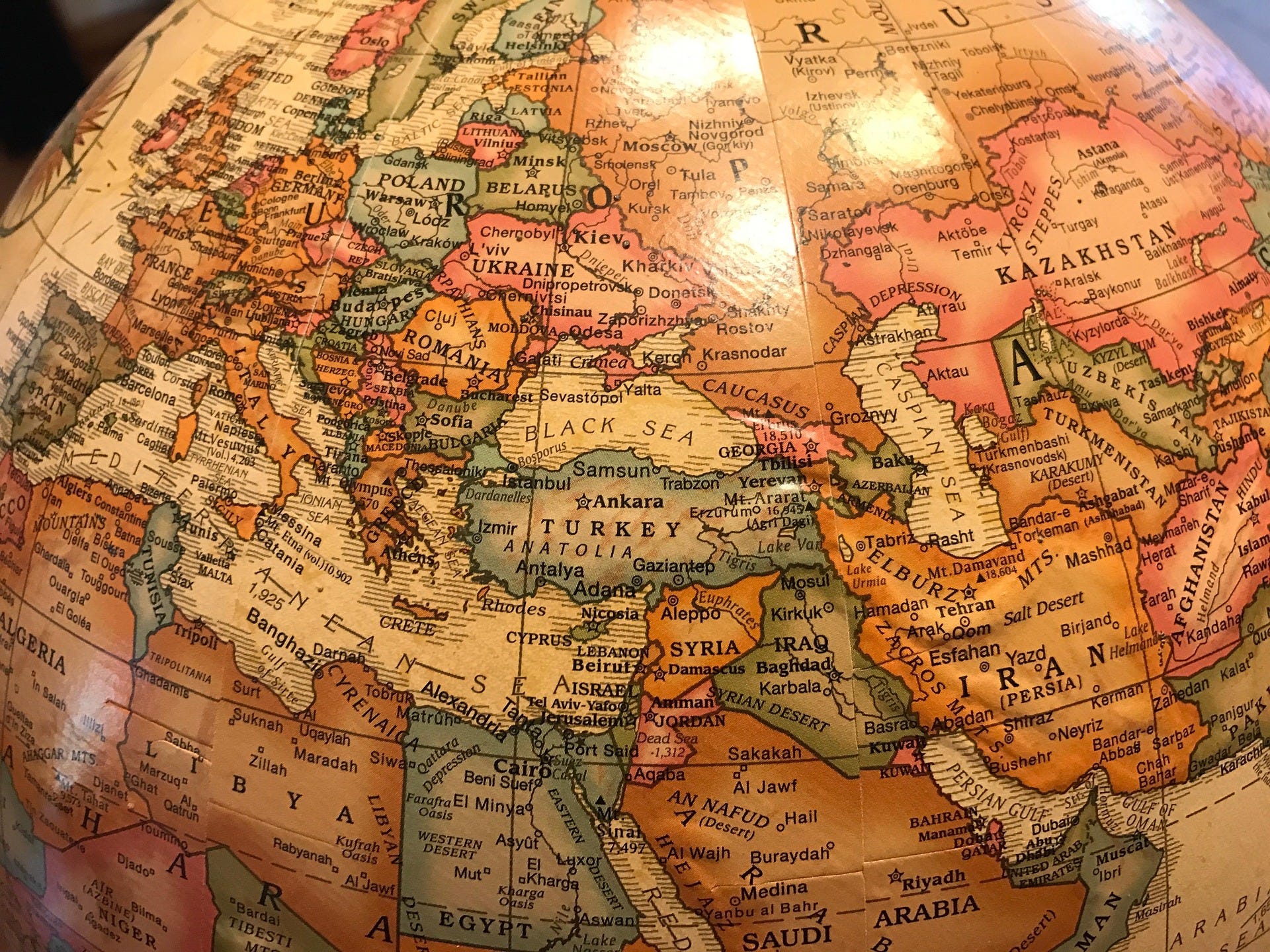
Richardson argues that Gog and Magog are destroyed at the battle of Armageddon.76 Personally, I am not entirely persuaded of when the Gog and Magog invasion happens. There are multiple views on the subject. In fact, there are about as many views on the Gog/Magog war timing as there are Rapture views.
Even if true, this does not prove that Gog is the Antichrist. Jesus defeats “the kings of the earth” (Revelation 19:19) and the kings from the east (Revelation 16:12) as well as the ten kings (Revelation 17:14) and perhaps also Edom (Isaiah 63) at Armageddon.
To say that this foe is defeated at Armageddon does nothing to prove who he is, other than that he is an end times villain.
Furthermore, Richardson also makes the argument that Gog (just like the Antichrist) makes a surprise attack on Israel.77 However, this is characteristic of invaders generally, not the Antichrist specifically.
The Assyrian is Not the Antichrist
Richardson claims that “the Assyrian” mentioned in Isaiah and Micah is also the same as the Antichrist.78 I agree the Assyrian could plausibly be the same as Gog, since the Assyrian empire encompassed some of modern-day Turkey (as well as Syria and Iraq).79 Perhaps Jesus will personally defeat the Assyrian in the end times. Or he will do it via delegation to his people. It is not entirely clear. For example, Isaiah says:
24 Therefore this is what the Lord God of armies says: “My people, you who dwell in Zion, do not fear the Assyrian who strikes you with the rod, and lifts up his staff against you the way Egypt did. 25 For in a very little while My indignation against you will be ended and My anger will be directed toward their destruction.” 26 The Lord of armies will wield a whip against him like the defeat of Midian at the rock of Oreb; and His staff will be over the sea, and He will lift it up the way He did in Egypt. (Isaiah 10:24-26)
Nevertheless, God often uses military powers to carry out judgment on his behalf. This is what it seems to be saying in Micah. Speaking of Messiah, he says:
This One will be our peace.
When the Assyrian invades our land,
When he tramples on our citadels,
Then we will raise against him
Seven shepherds and eight leaders of people.
6 They will shepherd the land of Assyria with the sword,
The land of Nimrod at its entrances;
And He will rescue us from the Assyrian
When he invades our land,
And when he tramples our territory. (Micah 5:5-6)
This passage says that the Messiah defeats the Assyrian. But it also says that there will be shepherds and leaders who “shepherd” the land of Assyria with the sword. Perhaps Jesus the Messiah will conquer the Assyrian by delegating this role to Israel.
It is unclear what relationship the Assyrian has with the destruction of Damascus mentioned in Isaiah 17.
The pronouncement concerning Damascus:
“Behold, Damascus is about to be removed from being a city
And will become a fallen ruin.
2 The cities of Aroer are abandoned;
They will be for herds to lie down in,
And there will be no one to frighten them.
3 The fortified city will disappear from Ephraim,
And sovereignty from Damascus
And the remnant of Aram;
They will be like the glory of the sons of Israel,”
Declares the Lord of armies. (Isaiah 17:1-3)
Again, this describes a foe north of Israel who has an important role to play in the end times. Whether he is the same or different from Gog and Magog remains to be seen. However, just because Jesus defeats him in the end times does not mean he is the Antichrist, as Jesus defeats many villains in the end times.
The Web of Antichrist Passages
Though interesting for prophecy studies, there are no specific cross-references from this northern foe(s) to the Antichrist. Uncontroversial New Testament references to the end time Antichrist seem to consistently converge on the same ideas and passages.
For example, Paul speaks of the man of lawlessness, with clear cross-references to Daniel 11:36.
4 who opposes and exalts himself above every so-called god or object of worship, so that he takes his seat in the temple of God, displaying himself as being God. (2 Thessalonians 2:4)
Compare to Daniel 11:36:
36 “Then the king will do as he pleases, and he will exalt himself and boast against every god and will speak dreadful things against the God of gods; and he will be successful until the indignation is finished, because that which is determined will be done. (Daniel 11:36)
Furthermore, his devastating reign is for 3 1/2 years (Revelation 13:5), just like the boastful horn in Daniel 7, who is also destroyed by Jesus at His Second Coming.
7 And I heard the man dressed in linen, who was above the waters of the stream, as he raised his right hand and his left toward heaven, and swore by Him who lives forever that it would be for a time, times, and half a time; and as soon as they finish smashing the power of the holy people, all these events will be completed. (Daniel 12:7)
A very similar phrase is used in Daniel 7 to describe the reign of a boastful figure.
25 And he will speak against the Most High and wear down the saints of the Highest One, and he will intend to make alterations in times and in law; and they will be handed over to him for a time, times, and half a time. (Daniel 7:25)
This boastful figure is defeated and given over to being burned.
11 Then I kept looking because of the sound of the boastful words which the horn was speaking; I kept looking until the beast was killed, and its body was destroyed and given to the burning fire. (Daniel 7:11)
This king is defeated when the Messiah comes on the clouds of heaven and receives a kingdom.
13 “I kept looking in the night visions,
And behold, with the clouds of heaven
One like a son of man was coming,
And He came up to the Ancient of Days
And was presented before Him.
14 And to Him was given dominion,
Honor, and a kingdom,
So that all the peoples, nations, and populations of all languages
Might serve Him.
His dominion is an everlasting dominion
Which will not pass away;
And His kingdom is one
Which will not be destroyed. (Daniel 7:13-14)
If you recall, Jesus quotes this passage when talking about His Second Coming.
And then the sign of the Son of Man will appear in the sky, and then all the tribes of the earth will mourn, and they will see the Son of Man coming on the clouds of the sky with power and great glory. (Matthew 24:30)
Furthermore, when Jesus speaks of the abomination of desolation, he is speaking of the Antichrist, as we noted before (Mark 13:14).
We can do all kinds of literary cross-referencing with these various passages, as you can see here. The important thing to note here is that Gog and Magog, the Assyrian, and as we will see, the King of the North, do not fit into this web very well.
The King of the North Is Probably Not the Antichrist…Though It Technically Doesn’t Matter
Throughout Daniel 11, there are a series of prophecies about battles between the “king of the South” and the “king of the North.” The king of the North has consistently referred to Syria/Turkey (Seleucid empire) and the king of the South consistently referred to Egypt (Ptolemaic empire).
Seleucid Empire
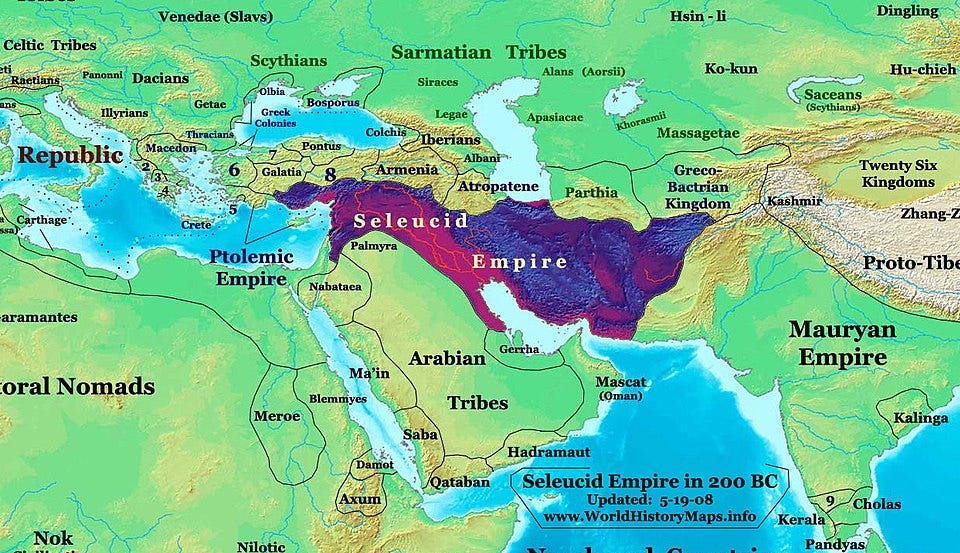
The prophecies found in Daniel 11:1-35 were fulfilled in the past. Nevertheless, at verse 36, the prophecies no longer accurately describe historical events. In fact, the context indicates that these events pertain to the end times, since they happen at the “time of the end” (Daniel 11:40). Interestingly, the “king of the South” and “king of the North” are mentioned as having a role to play in the end times as well.
Ptolemaic Empire
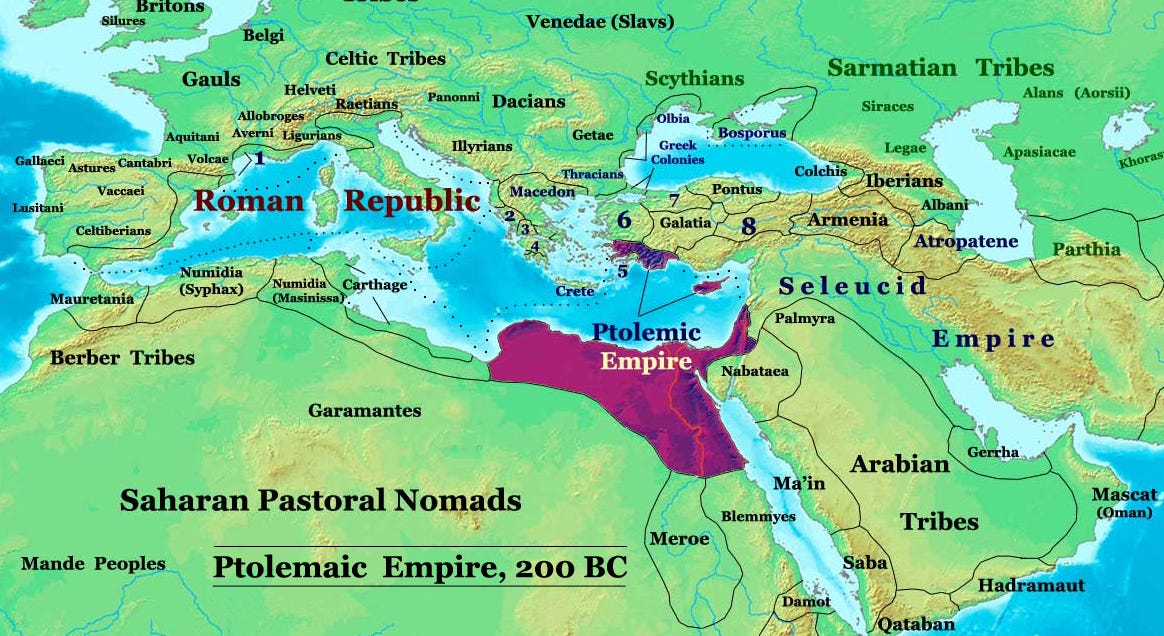
Richardson believes that the Antichrist is the “king of the North” described in the following passage.80
36 “Then the king will do as he pleases, and he will exalt himself and boast against every god and will speak dreadful things against the God of gods; and he will be successful until the indignation is finished, because that which is determined will be done. 37 And he will show no regard for the gods of his fathers or for the desire of women, nor will he show regard for any other god; for he will boast against them all. 38 But instead he will honor a god of fortresses, a god whom his fathers did not know; he will honor him with gold, silver, precious stones, and treasures. 39 And he will take action against the strongest of fortresses with the help of a foreign god; he will give great honor to those who acknowledge him and will make them rulers over the many, and will parcel out land for a price.
40 “And at the end time the king of the South will wage war with him, and the king of the North will storm against him with chariots, horsemen, and with many ships; and he will enter countries, overflow them, and pass through. 41 He will also enter the Beautiful Land, and many countries will fall; but these will be rescued out of his hand: Edom, Moab, and the foremost of the sons of Ammon. 42 Then he will reach out with his hand against other countries, and the land of Egypt will not escape. 43 But he will gain control over the hidden treasures of gold and silver, and over all the precious things of Egypt; and Libyans and Ethiopians will follow at his heels. 44 But rumors from the East and from the North will terrify him, and he will go out with great wrath to eliminate and annihilate many. 45 And he will pitch the tents of his royal pavilion between the seas and the beautiful Holy Mountain; yet he will come to his end, and no one will help him.
Commentators who believe this refers to the end time Antichrist are quite divided on who the pronoun “he” is referring to at the end of verse 40.
There are two main views:
“He” refers back to the Antichrist, who is the same person as the king of the North (Two-King view)
“He” refers back to the Antichrist, who is not the same person as the king of the North. (Three-king view).
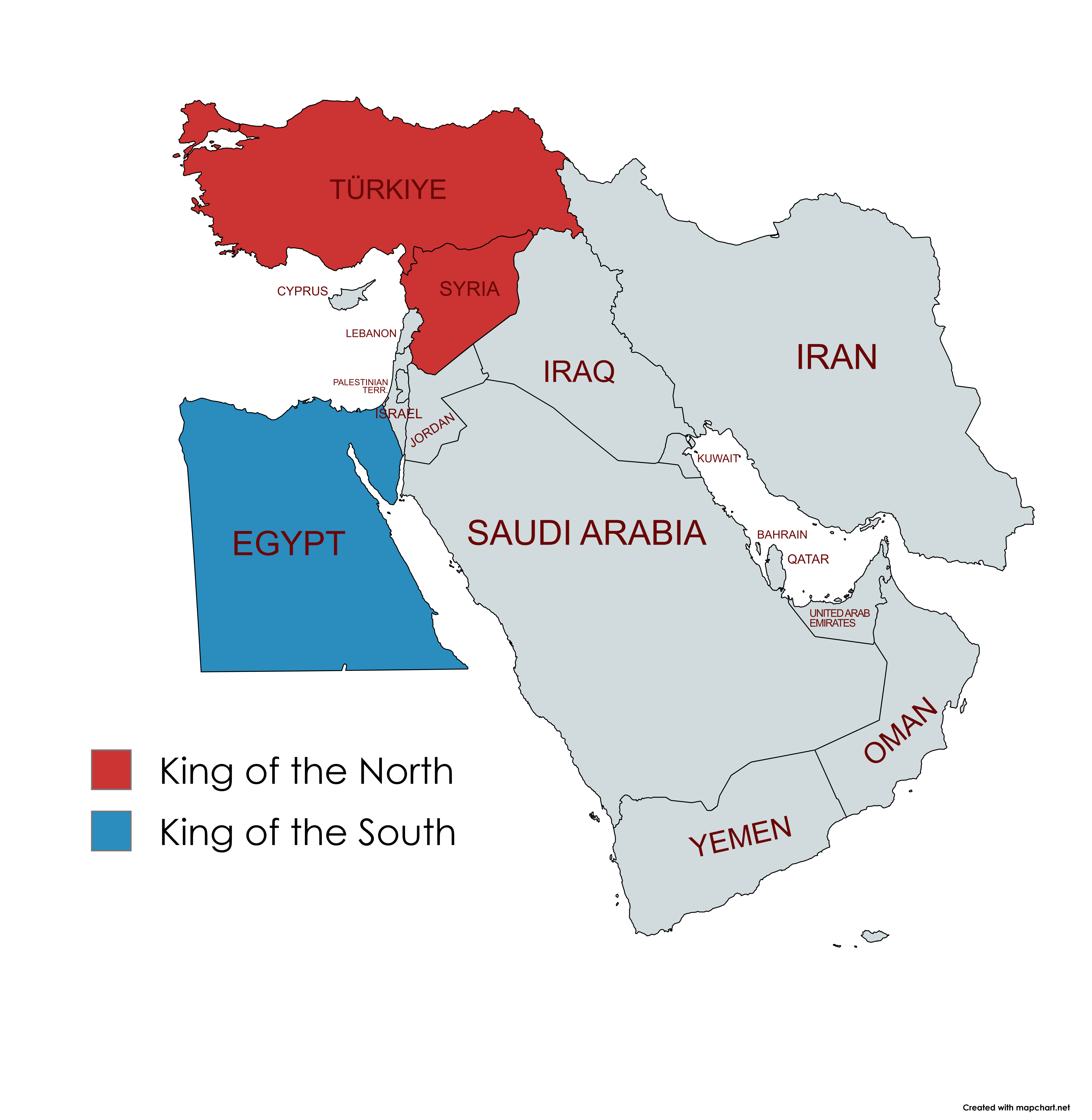
I will give reasons why I think the Antichrist mentioned in the preceding verses is not the king of the North, but is a third, more dominant, figure on the world stage.
Through the entirety of Daniel 11:36-39, “he/him/his” refers back to “the king.” (I have added labels in brackets to indicate who the individuals are, and if they are debated.)
36 “Then the king [ANTICHRIST] will do as he [ANTICHRIST] pleases, and he [ANTICHRIST] will exalt himself and boast against every god and will speak dreadful things against the God of gods; and he [ANTICHRIST] will be successful until the indignation is finished, because that which is determined will be done. 37 And he [ANTICHRIST] will show no regard for the gods of his [ANTICHRIST] fathers or for the desire of women, nor will he [ANTICHRIST] show regard for any other god; for he [ANTICHRIST] will boast against them all. 38 But instead he [ANTICHRIST] will honor a god of fortresses, a god whom his [ANTICHRIST] fathers did not know; he [ANTICHRIST] will honor him with gold, silver, precious stones, and treasures. 39 And he [ANTICHRIST] will take action against the strongest of fortresses with the help of a foreign god; he [ANTICHRIST] will give great honor to those who acknowledge him and will make them rulers over the many, and will parcel out land for a price.
Except for the debatable case in question (Daniel 11:40), all the pronouns in verses 41-45 also refer back to the Antichrist. He was introduced in verse 36 and is the main character until the end of verse 45.
40 “And at the end time the king of the South will wage war with him [ANTICHRIST], and the king of the North [DEBATED] will storm against him [DEBATED] with chariots, horsemen, and with many ships; and he [DEBATED] will enter countries, overflow them, and pass through. 41 He [ANTICHRIST] will also enter the Beautiful Land, and many countries will fall; but these will be rescued out of his [ANTICHRIST] hand: Edom, Moab, and the foremost of the sons of Ammon. 42 Then he [ANTICHRIST] will reach out with his [ANTICHRIST] hand against other countries, and the land of Egypt will not escape. 43 But he [ANTICHRIST] will gain control over the hidden treasures of gold and silver, and over all the precious things of Egypt; and Libyans and Ethiopians will follow at his [ANTICHRIST] heels. 44 But rumors from the East and from the North will terrify him [ANTICHRIST], and he [ANTICHRIST] will go out with great wrath to eliminate and annihilate many. 45 And he [ANTICHRIST] will pitch the tents of his royal pavilion between the seas and the beautiful Holy Mountain; yet he [ANTICHRIST] will come to his end, and no one will help him [ANTICHRIST].
Minority Third Position
It should be noted that a very small minority have defended the view that the passage starts off discussing Antichrist in 11:36-39, only to switch to a separate king of the north at verse 40. Then the passage sticks with that new king of the north for the remainder of the chapter.81
Yet this is not very likely as we will shortly see. This is due to how Daniel 11 usually behaves when putting the spotlight on a particular king. The whole narrative in 11:36-45 is consistent with Antichrist, not another person.
The real question, then, is if “the king of the north” is just another name for the Antichrist, or if it is a separate king from the Antichrist. Richardson believes king of the North is Antichrist, whereas I believe he is (probably) distinct from the Antichrist.82
Back and Forth Reading - The Counterattack
If we think that the willful king of 11:36-39 just is the “king of the North” in verse 40, the reading will look like this.
40 “And at the end time the king of the South will wage war with him [ANTICHRIST], and the king of the North [ANOTHER NAME FOR ANTICHRIST] will storm against him [KING OF THE SOUTH] with chariots, horsemen, and with many ships; and he [ANTICHRIST] will enter countries, overflow them, and pass through.
This reading would mean that there are only two main actors. The king of the South attacks the King of the North (Antichrist), and the King of the North makes an overwhelming counterattack.
The Single Subject Reading - The Pincer Attack
If we think that every “he/him/his” in the passage refers back to the willful king in Daniel 11:36, our reading will look like this:
40 “And at the end time the king of the South will wage war with him [ANTICHRIST], and the king of the North will storm against him [ANTICHRIST] with chariots, horsemen, and with many ships; and he [ANTICHRIST] will enter countries, overflow them, and pass through.
This reading would lead us to believe there are three actors here, not two. In this case “king of the South” would be Egypt (as it was historically) and “the king of the north” will be Syria/Turkey (as it was historically) who attack a more intimidating figure, “the king,” in the end times.
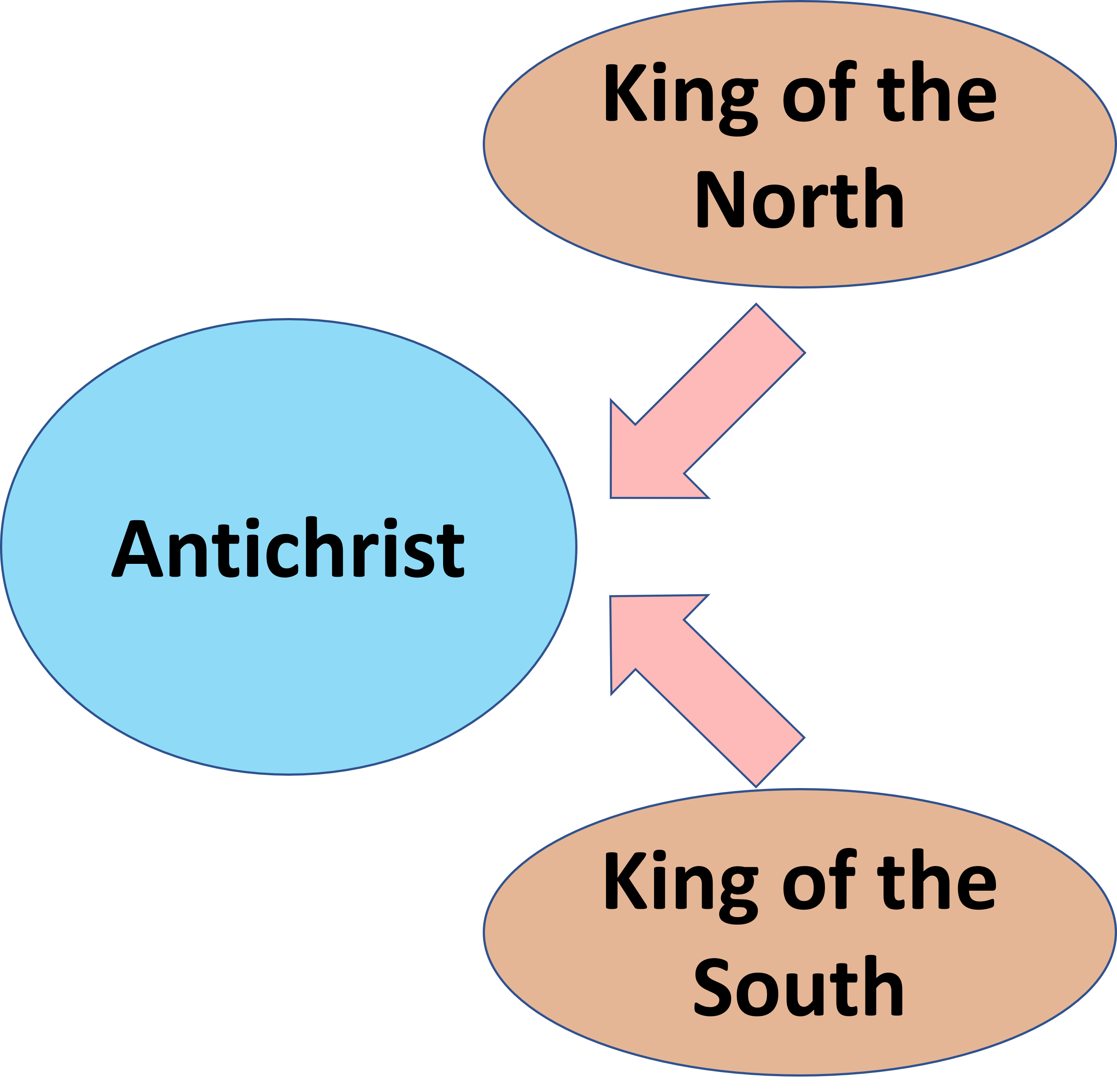
Precedent Throughout Daniel 11
The “king of the North,” the “king of the South” and other kings (i.e. Alexander the Great and Antiochus IV) are discussed throughout the previous verses in Daniel 11. Therefore, we should look at how those verses deal with pronouns and titles. Therefore, we must ask an important question: Based on how pronouns and titles are used throughout Daniel 11, which reading should we go with?
I do not know Hebrew. However, there doesn’t seem to be any grammatical rules that force a certain reading of who’s who in this passage. Nevertheless, as chaotic as the pronouns and titles appear to be, they do happen to have patterns.
Pronouns for Main Characters
When a person is introduced with a title, the pronouns usually stay with that person until it “resets” with a new person. For example, the “mighty king” (Alexander the Great), is the sole subject of the pronouns until a new person is introduced, even though other people are mentioned.
3 And a mighty king [ALEXANDER] will arise, and he [ALEXANDER] will rule with great authority and do as he [ALEXANDER] pleases. 4 But as soon as he [ALEXANDER] has arisen, his [ALEXANDER] kingdom will be broken up and parceled out toward the four points of the compass, though not to his [ALEXANDER] own descendants, nor according to his [ALEXANDER] authority which he [ALEXANDER] wielded, because his [ALEXANDER] sovereignty will be removed and given to others besides them. (Daniel 11:2-4)
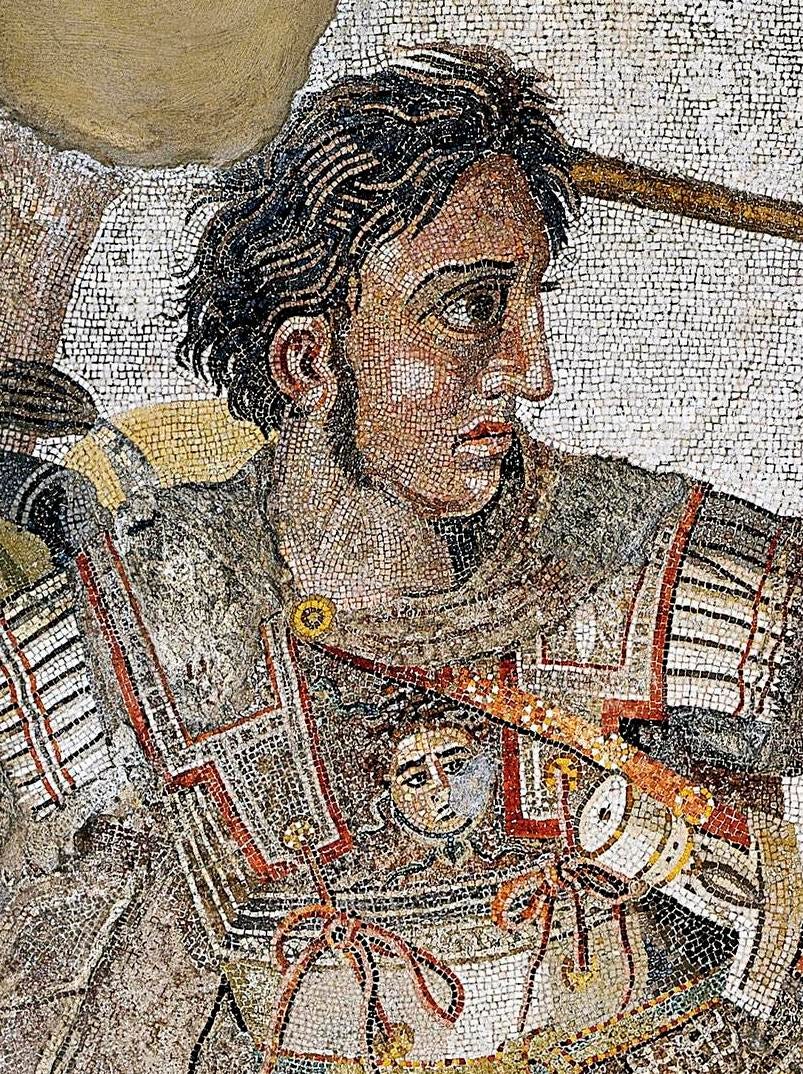
Daniel 11:21-35 does the same thing with Antiochus IV. Despite numerous other actors (sometimes even third parties), it usually uses “he/his/him” to talk about Antiochus IV.
Daniel 11:21-35 provides a good example of this precedent:
21 And in his place a despicable person [ANTIOCHUS IV] will arise, on whom the majesty of kingship has not been conferred; but he [ANTIOCHUS IV] will come in a time of tranquility and seize the kingdom by intrigue. 22 And the overflowing forces will be flooded away from him [ANTIOCHUS IV] and smashed, and also the prince of the covenant. 23 After an alliance is made with him [ANTIOCHUS IV] he [ANTIOCHUS IV] will practice deception, and he [ANTIOCHUS IV] will go up and gain power with a small force of people. 24 In a time of tranquility he [ANTIOCHUS IV] will enter the richest parts of the realm, and he [ANTIOCHUS IV] will accomplish what his [ANTIOCHUS IV] fathers did not, nor his [ANTIOCHUS IV] ancestors; he [ANTIOCHUS IV] will distribute plunder, spoils, and possessions among them, and he [ANTIOCHUS IV] will devise his [ANTIOCHUS IV] schemes against strongholds, but only for a time.
25 And he [ANTIOCHUS IV] will stir up his [ANTIOCHUS IV] strength and courage against the king of the South with a large army; so the king of the South will mobilize an extremely large and mighty army for war; but he [KING OF THE SOUTH] will not stand, because schemes will be devised against him [KING OF THE SOUTH]. 26 Those who eat his [KING OF THE SOUTH] choice food will destroy him [KING OF THE SOUTH], and his [KING OF THE SOUTH] army will overflow, but many will fall down slain. 27 As for both kings [ANTIOCHUS IV & KING OF THE SOUTH], their hearts will be intent on evil, and they will speak lies to each other at the same table; but it will not succeed, because the end is still to come at the appointed time. 28 Then he [ANTIOCHUS IV] will return to his [ANTIOCHUS IV] land with much plunder; but his [ANTIOCHUS IV] heart will be set against the holy covenant, and he [ANTIOCHUS IV]will take action and then return to his [ANTIOCHUS IV] own land.
29 “At the appointed time he [ANTIOCHUS IV] will return and come into the South, but this last time it will not turn out the way it did before. 30 For ships of Kittim will come against him [ANTIOCHUS IV]; therefore he [ANTIOCHUS IV] will withdraw in fear and will return and curse the holy covenant and take action; so he [ANTIOCHUS IV] will come back and pay attention to those who abandon the holy covenant. 31 Forces from him [ANTIOCHUS IV] will arise, desecrate the sanctuary fortress, and do away with the regular sacrifice. And they will set up the abomination of desolation. 32 And by smooth words he [ANTIOCHUS IV] will turn to godlessness those who act wickedly toward the covenant, but the people who know their God will be strong and take action. 33 And those who have insight among the people will give understanding to the many; yet they will fall by sword and by flame, by captivity and by plunder for many days. 34 Now when they fall they will be granted a little help, and many will join with them in hypocrisy. 35 And some of those who have insight will fall, to refine, purge, and cleanse them until the end time; because it is still to come at the appointed time.
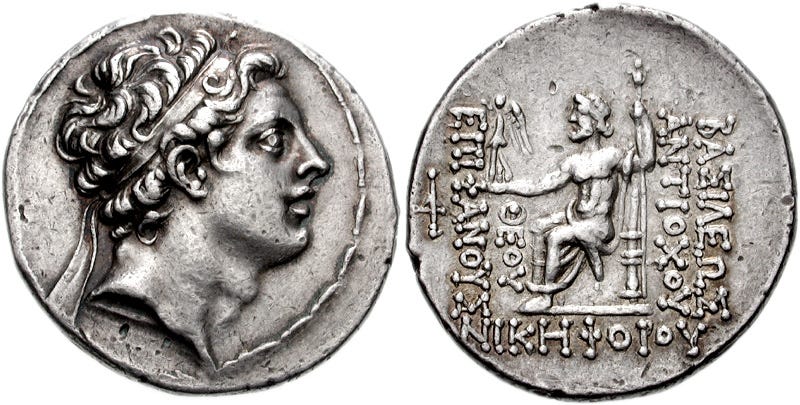
You will notice that the pronoun only changes when it brings up a new subject (the “king of the South in verse 25). But the pronouns reset back to Antiochus IV as a “default setting” when it is done talking about “both kings” in verse 30. Even though the subject is ambiguous, a bare pronoun refers back to the main subject of the entire section, not the King of the South.
This bolsters the case for the three-actor reading. When “he” is not explicitly announced, it usually refers back to the main character of the section.
Pronouns When Third Party Attackers Are Involved
Daniel 11:29-30 is a good test case of the pincer view, since it involves a third-party attacker.
29 “At the appointed time he [ANTIOCHUS IV] will return and come into the South, but this last time it will not turn out the way it did before. 30 For ships of Kittim [THIRD PARTY] will come against him [ANTIOCHUS IV]; therefore he [ANTIOCHUS IV] will withdraw in fear and will return and curse the holy covenant and take action; so he [ANTIOCHUS IV] will come back and pay attention to those who abandon the holy covenant.
In this case, the bare pronouns “he/him” after the third party consistently revert to Antiochus IV, not the ships of Kittim. This is of course true, since “ships of Kittim” is plural, and “he” is singular.
But what if we don’t have that additional helpful information? This is where Daniel 11:40 comes in:
40 “And at the end time the king of the South will wage war with him [ANTICHRIST], and the king of the North will storm against him [ANTICHRIST] with chariots, horsemen, and with many ships; and he [ANTICHRIST] will enter countries, overflow them, and pass through.
The precedent set by the text is that when new characters are introduced as attacking the main character, the pronouns default to the main character, not the newly introduced attacker. This would mean that the “king of the North” is a separate character from the main one, who is the Antichrist.
Alarming Rumors from the North
The most powerful argument that the Antichrist is distinct from the king of the North is found in the context of Daniel 11:44-45.
44 But rumors from the East and from the North will terrify him, and he will go out with great wrath to eliminate and annihilate many. 45 And he will pitch the tents of his royal pavilion between the seas and the beautiful Holy Mountain; yet he will come to his end, and no one will help him.
Here, the Antichrist is alarmed from rumors coming from “the East” and “the North.” If the Antichrist simply is the king of the North, then why is he alarmed by reports from his own domain?
One could respond by saying that the Antichrist is alarmed by reports east and north of himself, not north of Israel. On this view, when the Antichrist is in the process of dominating Egypt, he is alarmed by reports in Israel (north of himself) and reports east of himself.
Yet this is also problematic because directional names throughout the book of Daniel always refer to locations relative to Israel (“Beautiful Land”), not relative to the actor being spoken about. You can see how references to the North, the South, the West, and the East are used throughout Daniel by clicking on the respective links provided.
This is supported by the fact that the Euphrates River dries up for the “kings from the east,” so they can meet for war at Armageddon in Israel (Revelation 16:12-16). These are likely the rumors from the east which causes the Antichrist to panic and move back up into the holy land to fight.
Another possibility is that these northern rumors come from a different northern location than the king of the North’s power base. For example, Richardson speculates that the reports from the North could be from Russia, and those from the East could be China:
Then, sometime in the midst of the Antichrist’s conquests, “rumors” from both the North and the East upset him greatly. Exactly what these rumors are, we can only speculate. But we would assume that they refer to the movements of large armies, perhaps from Russia in the North and China in the East:83
Since Richardson believes that the “king of the North” is the same as the Antichrist, these reports have to be coming from a northern location other than Turkey and Syria. Otherwise, the Antichrist would be alarmed by rumors from his own domain. This would be very unlikely, since that’s the origin of his own power base on Richardson’s view.
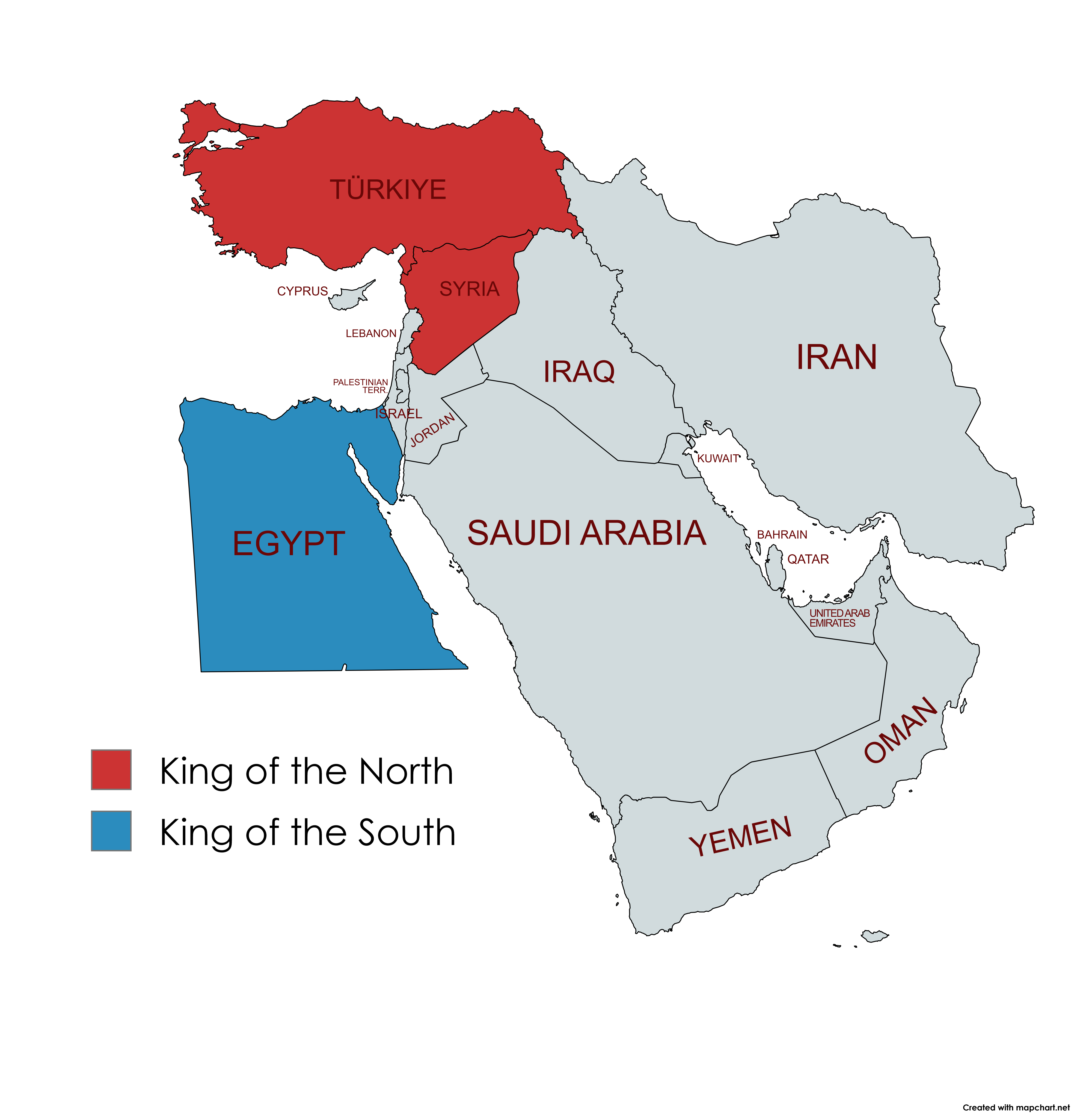
Yet this is an inconsistent use of the directional term. For example, the bare term “the South” is used in Daniel 11:29 to refer to forces from the same location as the “king of the South.” Namely, “the South” denotes the Ptolemaic (Egyptian) forces.
Therefore, consistency would have us think that “the North” is a reference to the area of the former Seleucid empire, namely, Turkey and Syria. This would mean the Antichrist is alarmed by internal problems from his own domain. Yet this is extremely unlikely, since the Antichrist’s power appears to be consolidated until Armageddon (Revelation 17:14).
The best explanation for this is that, while in Egypt, the Antichrist is alarmed by rumors from the area of the king of the North, who has since regrouped his armies after being defeated (Daniel 11:40). This causes the Antichrist to move back north into the holy land, to fight both the eastern and northern threats. On this view, there are three actors, not two.
Specific Kings vs Titles
Throughout the early part of the chapter, “king of the South” and “king of the North” are almost always explicitly introduced with those titles, unless a very specific person is in view (Daniel 11:5-19). In fact, these terms function more like regional placeholders in most cases, as these generally refer to dynasties. On the contrary, terms like “a mighty king” (Alexander) or “contemptible person” (Antiochus IV) or simply, “the king” (Antichrist) refer to specific individuals.84
For example, Antiochus IV Epiphanes is actually the king of the north, since he was a Seleucid king. Yet he is never called such in the Hebrew, because he is introduced as “a contemptible person.” In fact, the term “king of the North” is last used in verse 15 and doesn’t appear again until verse 40. This is true, despite the fact that those regional actors are still at play throughout Daniel 11.
As a result, the fact that the Antichrist is not introduced as “the king of the North,” but only as “the king” is very telling. In verse 40, the king of the north is reintroduced, despite being absent since verse 15. It usually refers to a dynastic placeholder, or a “regional officeholder” if you will. This is why it’s unusual that “the king” would be renamed to “the king of the north.”
This is especially the case, since his influence seems rather outsized compared to a mere regional actor. He will do as he pleases, just like Alexander the Great (Daniel 11:3). This points to the idea he is not limited to the area of one of these dynasties but has a bigger role to play. This would also explain why he is simply called “the king” in an unqualified sense.85
Types, Patterns, and Foreshadowing
The entire chapter of Daniel 11 mostly speaks of back-and-forth battles between a northern player and a southern player. Verses 11:36-45 involves the same two characters (king of the South and the King of the North) in the end times. Since the events of Daniel 11:21-35 foreshadow the end times, some argue that 11:36-45 must follow that same theological pattern as well.
Furthermore, one of those northern kings, Antiochus IV, is widely considered to be a forerunner and “type” of the Antichrist. In the same way King David foreshadows Jesus, Antiochus IV foreshadows Antichrist.86 I would agree. Though never explicitly called as such, Antiochus IV was the “king of the North,” since he was a Seleucid ruler.
Richardson seems to think that typology requires an exact duplication of geography. In particular, he implies that the Antichrist and Antiochus IV must come from the same region, since Antiochus prefigures Antichrist.87
This is problematic for a few reasons.
First, typology is not usually tied to geography. Granted, king David was born in Bethlehem, just like Jesus.88 However, there are numerous instances where types do not come from the same place. For example, Ezekiel 28 speaks of the king of Tyre as if he is Satan. We do not think that Satan is literally a man from the city of Tyre, even though the king of that city prefigures him. Furthermore, the descriptions of Satan in Ezekiel 28 actually contradict the king of Tyre, as the latter never lived in Eden (Ezekiel 28:13).
Furthermore, the abomination of desolation in the end times most certainly will not involve allegiance to Zeus, as it did in 167 B.C. Furthermore, just from the text, Daniel 11:36-45 involves character traits that were not true of Antiochus IV. For example, Antiochus IV did honor the gods of his ancestors, which Daniel 11:36-38 makes clear the Antichrist will not do. Furthermore, Antiochus did not die in the holy land, whereas the Antichrist will be defeated there (Daniel 11:44-45).89
Therefore, when cannot use typology to argue that there are only two actors in Daniel 11:36-45. Though they have notable similarities to what they are foreshadowing, types often have notable and uncanny differences from what they are foreshadowing as well.
Therefore, we cannot conclude that the Antichrist is a northern, Seleucid ruler, just due to typology. The mere presence of the king of the North and king of the South in the end times is a sufficient parallel to the past. The text does not require that we push the parallel beyond this.
The Antichrist’s Power Base Begins in Europe
Since the Antichrist is distinct from the king of the south and the king of the North, it bolsters the case that he and his ten kings will originate from mainland Europe.
Before the Antichrist rises to power, there exists a group of ten kings from the Roman Empire. After he consolidates power, he goes to war with someone south of Israel (Egypt) and someone north of Israel (Turkey/Syria).
But if the Antichrist goes to war with all these places, where is he attacking from? Where is his homebase from where he launches his military operations?
The only place left on the map of the old Roman Empire is western Europe.
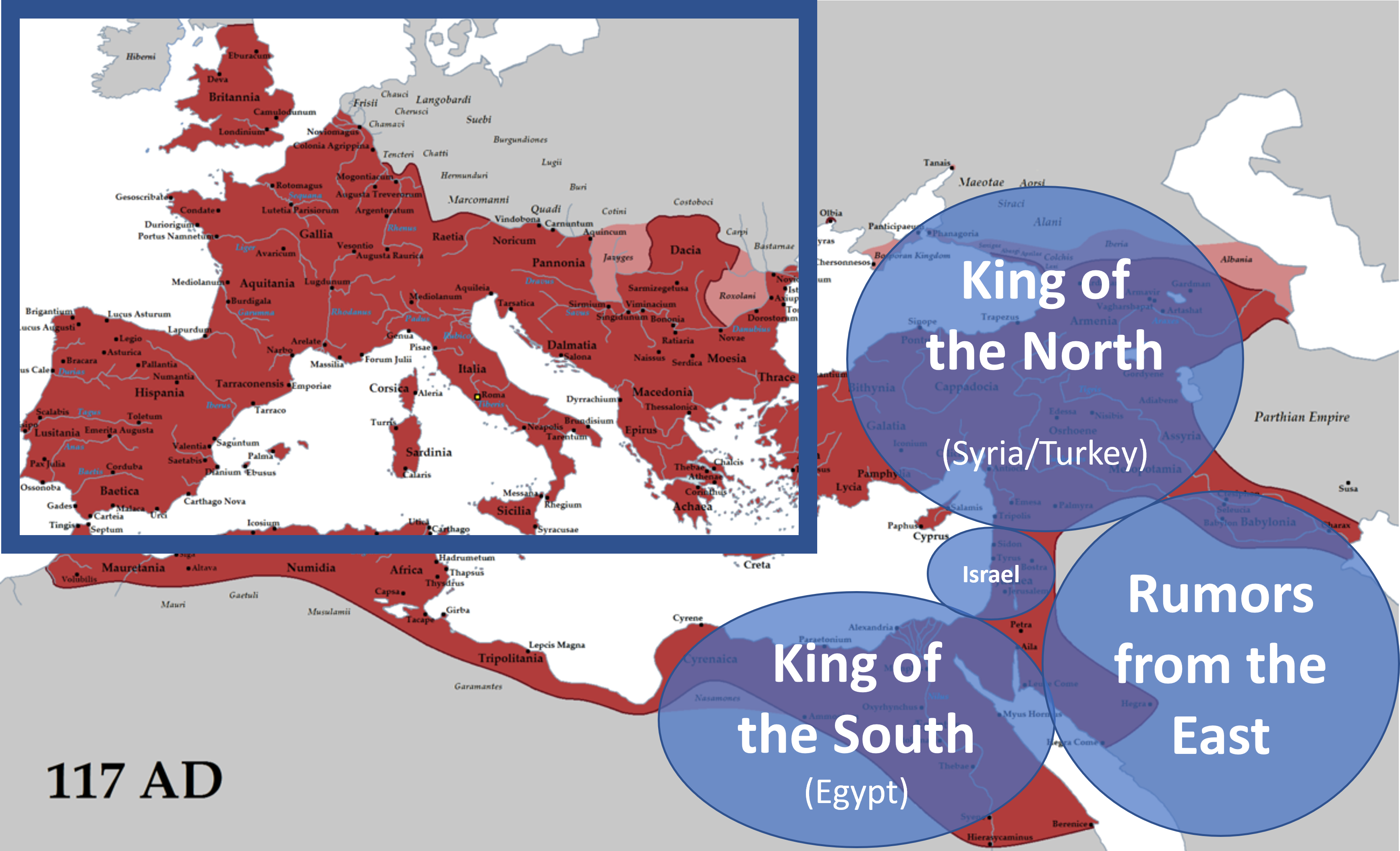
Both Views Work with a Roman Antichrist
It should be noted that neither of these actually undermines the revived Roman Empire view. The Roman Empire at its height encompassed large parts of Turkey and Syria. Therefore, the Antichrist could still be “Roman” and still come from the north. As J. Paul Tanner writes:
To be consistent with the chapter, the king of the north should be related to the countries that once composed the ancient Seleucid Empire (e.g., Syria, Iraq, Turkey... and even Israel). If this is true and the Antichrist is the “king of the north,” then this would need to be reconciled with Daniel 7:23-24 that somehow connects him with the Roman Empire. This is not necessarily a contradiction, since most of the countries that comprised the ancient Seleucid Empire were also a part of the Roman Empire.90
From the north would be totally appropriate designation in this case. As Tanner writes:
the use of the term “north” in reference to countries outside of Israel is a frequent expression of the prophets for Israel’s neighbors of the Middle East, either Babylon, Assyria, Medo-Persia or the Seleucid empire. The reason why eastern countries such as Babylon would be designated as being “from the north” is to be found in the explanation that an attack upon Israel by these foes always came from the north, whereby the major highways across the Fertile Crescent (along the Euphrates) would take one to the upper regions of Galilee in the northern part of the country. 91
In summary, part of the historical Roman Empire was in fact directly north of Israel. Furthermore, any ground invasion of Israel would come from the north, regardless of the fact that the bulk of the historical Roman Empire was not directly north of Israel. This is consistent with the fact that other northern invaders are treated as such in the Scriptures.
That being said, the way pronouns work throughout Daniel 11 technically allows for the two-king or the three-king view. Nevertheless, in my opinion, titles and pronoun usage in the previous parts of Daniel 11 moderately favors the three-king view. As a result, we can make a cumulative case to show that the king of the north is probably distinct from the Antichrist.
Summary
There are several reasons to believe the Antichrist will come from a revived Roman Empire. In contrast, there are many reasons to believe he will not be a Muslim from a revived Islamic Caliphate.
The Fourth Kingdom is the Roman Empire
We saw several reasons why the fourth kingdom of Daniel 2 & 7 is the Roman Empire, not the Ottoman Empire. First, we saw that the Roman Empire was the “fourth” empire in a series of sequential empires after Babylon. Second, the book of Daniel sets the precedent that the empire that conquered the previous is the next empire in the sequence. The Ottoman Empire did not come fourth in a sequence of successive empires after the Babylonian Empire. We saw how an appeal to prophetic gaps does not work here, as the word “fourth” does not imply a gap in an ordinal set, as demonstrated from Daniel 11:2-4.
The Roman Empire Meets the Description of the Fourth Kingdom
We saw how the Roman Empire was terrifying and violent, just like Daniel 2 & 7 describe. We saw how the Pax Romana (Roman Peace) existed because of its terrible violence. Scholarship on the Roman Empire supports this notion. Furthermore, we can find specific examples of its violence in the Punic Wars, Gallic Wars, Destruction of Corinth, and the Jewish Roman Wars. Whether the Ottoman Empire was more violent than Rome is a moot point, since the fourth empire in succession after Babylon (Rome) meets the criteria of violence just fine, without having to appeal to another candidate.
Furthermore, Rome dominated the entire Mediterranean Sea area, fitting the description that the beast comes up out of the “Great Sea.” Furthermore, Rome was one of the most brutal oppressors of the Jews and occupiers of the holy land. If Daniel mentions, indirectly, the activities of the Roman army in Daniel 9:26, as a very significant event in Israel’s history, we would find it quite odd that he would leave it out of the four-kingdom sequence in Daniel 2 & 7.
The People of the Prince Were the Romans
The people who destroyed the temple and Jerusalem in 70 A.D. were the Romans. Daniel 9:26 predicted this event, stating that the coming ruler (Antichrist) would be from the same people who did this. Richardson claims that “Romans” is too vague and cannot count due to the fact the word “people” allegedly refers only to an ethnic group. We saw that the word for people does not always refer to an ethnic group. In this context, it is best interpreted as being those politically affiliated with a certain leader.
The Antichrist Will Have World Domination at the Height of His Reign
We saw how the Antichrist will start off as a regional power. At the height of his reign, he will have world domination. This coheres well with the traditional futurist reading of the seven king/kingdom sequence in Revelation 17, where the Antichrist emerges from the revived Roman Empire to have a second reign that is much larger and powerful than before. We saw how this reading of the seven king/kingdom sequence fits with Daniel and the rest of Revelation 17. On the contrary, Richardson has to borrow Rome to make his sequence work. Furthermore, the long duration of the Islamic Caliphate does not fit well with the reign of the revived fourth kingdom for only “a little while.”
The Antichrist Will Be Self Deifying, Not Islamic
We saw how the Antichrist will most certainly claim to be God, through his actions and likely his words. This is clear due to Paul’s statement in 2 Thessalonians 2, which aligns with Daniel 11 and passages about the “abomination of desolation” as an idol in the temple. Richardson’s claim that the Greek word proskuneo does not mean worship is mistaken, since the Antichrist demands this allegiance on pain of death, causing those who submit to go to hell. Finally, the “god of fortresses” is best explained as the worship of military power and might in general, not a reference to Allah.
The Antichrist is Distinct from the Northern Foe
We saw how there does exist a northern foe in the end times. We saw how Richardson’s claims that these are the same as the Antichrist do not succeed, since there are many villains who are defeated at Armageddon, not just Antichrist. Finally, we saw how the “king of the North” likely refers to the Antichrist’s attacker, not the Antichrist himself. Appeals to pronouns in the passage are probabilistic at best, and typology does not force us to accept him to be the king of the North.
Conclusion
I hope you found this article to be interesting and thought provoking, even if you don’t agree. My primary goal in this article is not so much to “debunk” the Islamic Antichrist, but to show a positive case for why the Antichrist is from the revived Roman Empire instead. This way, we are not caught off guard when the Antichrist comes from the Euro-Mediterranean area.
Furthermore, as I said before, none of this is meant to be a personal attack on Joel’s character. If he has the time, I greatly look forward to and appreciate his response to my article.
Sitting in the background is the relationship of this debate to current events. In my next post, I hope to provide a summary of the revived Roman Empire interpretation’s relevance to the last few decades of world history. If you’d like to be notified when that comes out, feel free to subscribe here. Contrary to what it first appears; there is a lot more going on there than meets the eye.
Come Lord Jesus!
(NOTE: A small section was added on Dec. 4, 2025, to increase the strength of the argument. You can jump straight to the new section by clicking here. Furthermore, this article received minor updates for clarity and grammar on that same day).
Richardson, Joel. Mideast Beast: The Scriptural Case for an Islamic Antichrist (p. 83). Joel Richardson. Kindle Edition.
Richardson, Joel. Mideast Beast: The Scriptural Case for an Islamic Antichrist (p. 9). Joel Richardson. Kindle Edition.
Goldsworthy, Adrian Keith. Pax Romana: War, Peace and Conquest in the Roman World (p. 11). Yale University Press. Kindle Edition.
Goldsworthy, Adrian Keith. Pax Romana: War, Peace and Conquest in the Roman World (p. 13). Yale University Press. Kindle Edition.
Goldsworthy, Adrian Keith. Pax Romana: War, Peace and Conquest in the Roman World (p. 46). Yale University Press. Kindle Edition.
Goldsworthy, Adrian Keith. Pax Romana: War, Peace and Conquest in the Roman World (p. 46). Yale University Press. Kindle Edition.
Goldsworthy, Adrian Keith. Pax Romana: War, Peace and Conquest in the Roman World (p. 13). Yale University Press. Kindle Edition.
Goldsworthy, Adrian Keith. Pax Romana: War, Peace and Conquest in the Roman World (p. 412). Yale University Press. Kindle Edition.
Serrati J. Warfare and the state. In: Sabin P, van Wees H, Whitby M, eds. The Cambridge History of Greek and Roman Warfare. Cambridge University Press; 2007:461-497.
Serrati J. Warfare and the state. In: Sabin P, van Wees H, Whitby M, eds. The Cambridge History of Greek and Roman Warfare. Cambridge University Press; 2007:461-497.
Britannica Editors. “Punic Wars.” Encyclopedia Britannica, October 22, 2025. https://www.britannica.com/event/Punic-Wars.
Britannica Editors. “Lucius Mummius.” Encyclopedia Britannica, March 28, 2024. https://www.britannica.com/biography/Lucius-Mummius.
Britannica Editors. “Corinth.” Encyclopedia Britannica, April 5, 2025. https://www.britannica.com/place/Corinth-Greece.
Britannica Editors. “Spartacus.” Encyclopedia Britannica, September 12, 2025. https://www.britannica.com/biography/Spartacus-Roman-gladiator.
Goldsworthy, Adrian Keith. Pax Romana: War, Peace and Conquest in the Roman World (p. 49). Yale University Press. Kindle Edition.
Raaflaub, Kurt A. (2021) “Caesar and Genocide: Confronting the Dark Side of Caesar’s Gallic Wars,” New England Classical Journal: Vol. 48 : Iss. 1 , 54-80. https://doi.org/10.52284/NECJ/48.1/article/raaflaub
Richardson, Joel. Mideast Beast: The Scriptural Case for an Islamic Antichrist (p. 60). Joel Richardson. Kindle Edition.
Britannica Editors. “Mongol empire.” Encyclopedia Britannica, October 22, 2025. https://www.britannica.com/place/Mongol-empire.
Richardson, Joel. Mideast Beast: The Scriptural Case for an Islamic Antichrist (p. 40). Joel Richardson. Kindle Edition.
Richardson, Joel. Mideast Beast: The Scriptural Case for an Islamic Antichrist (p. 43). Joel Richardson. Kindle Edition.
Richardson, Joel. Mideast Beast: The Scriptural Case for an Islamic Antichrist (p. 6). Joel Richardson. Kindle Edition.
Miller, Stephen B.. Daniel: An Exegetical and Theological Exposition of Holy Scripture (The New American Commentary Book 18) (p. 205). B&H Publishing Group. Kindle Edition.
Richardson, Joel. Mideast Beast: The Scriptural Case for an Islamic Antichrist (p. 58). Joel Richardson. Kindle Edition.
Richardson, Joel. Mideast Beast: The Scriptural Case for an Islamic Antichrist (p. 58). Joel Richardson. Kindle Edition.
Richardson, Joel. Mideast Beast: The Scriptural Case for an Islamic Antichrist (p. 59). Joel Richardson. Kindle Edition.
Benware, Paul. Daniel: God’s Man with God’s Message (p. 177-179). Dispensational Publishing House. Kindle Edition.
Miller, Stephen B.. Daniel: An Exegetical and Theological Exposition of Holy Scripture (The New American Commentary Book 18) (p. 210). B&H Publishing Group. Kindle Edition.
Richardson, Joel. Mideast Beast: The Scriptural Case for an Islamic Antichrist (p. 152). Joel Richardson. Kindle Edition.
Richardson, Joel. Mideast Beast: The Scriptural Case for an Islamic Antichrist (p. 149). Joel Richardson. Kindle Edition.
Richardson, Joel. Mideast Beast: The Scriptural Case for an Islamic Antichrist (p. 154). Joel Richardson. Kindle Edition.
Richardson, Joel. Mideast Beast: The Scriptural Case for an Islamic Antichrist (p. 98). Joel Richardson. Kindle Edition.
Ludwig Koehler, Walter Baumgartner, M. E. J. Richardson, et al., The Hebrew and Aramaic Lexicon of the Old Testament (Leiden: E.J. Brill, 1994–2000), 838.
William Lee Holladay and Ludwig Köhler, A Concise Hebrew and Aramaic Lexicon of the Old Testament (Leiden: Brill, 2000), 226.
Pietersma, Albert., Wright, Benjamin G.. A New English Translation of the Septuagint. United Kingdom: Oxford University Press, USA, 2007. https://ccat.sas.upenn.edu/nets/edition/40-daniel-nets.pdf
Pietersma, Albert., Wright, Benjamin G.. A New English Translation of the Septuagint. United Kingdom: Oxford University Press, USA, 2007. https://ccat.sas.upenn.edu/nets/edition/40-daniel-nets.pdf
Richardson, Joel. Mideast Beast: The Scriptural Case for an Islamic Antichrist (p. 95). Joel Richardson. Kindle Edition.
Richardson, Joel. Mideast Beast: The Scriptural Case for an Islamic Antichrist (p. 100). Joel Richardson. Kindle Edition.
Richardson, Joel. Mideast Beast: The Scriptural Case for an Islamic Antichrist (p. 102). Joel Richardson. Kindle Edition.
Richardson, Joel. Mideast Beast: The Scriptural Case for an Islamic Antichrist (p. 99). Joel Richardson. Kindle Edition.
Richardson, Joel. Mideast Beast: The Scriptural Case for an Islamic Antichrist (p. 36). Joel Richardson. Kindle Edition.
Chapter IX The Revival Of Rome | Walvoord.com https://walvoord.com/article/300
Unreached Peoples | Desiring God https://www.desiringgod.org/articles/unreached-peoples#panta
17. The Destruction Of Ecclesiastical Babylon | Walvoord.com https://walvoord.com/article/275
Thomas, Robert L.. Revelation 8-22: An Exegetical Commentary. United States: Moody Press, 1995.
Paul M. Hoskins; Another Possible Interpretation of the Seven Heads of the Beast and the Eighth King (Revelation 17:9–11). Bulletin for Biblical Research 17 April 2020; 30 (1): 86–102. doi: https://doi.org/10.5325/bullbiblrese.30.1.0086
Paul M. Hoskins; Another Possible Interpretation of the Seven Heads of the Beast and the Eighth King (Revelation 17:9–11). Bulletin for Biblical Research 17 April 2020; 30 (1): 86–102. doi: https://doi.org/10.5325/bullbiblrese.30.1.0086
Thomas, Robert L.. Revelation 8-22: An Exegetical Commentary. United States: Moody Press, 1995.
Richardson, Joel. Mideast Beast: The Scriptural Case for an Islamic Antichrist (p. 155). Joel Richardson. Kindle Edition.
Richardson, Joel. Mideast Beast: The Scriptural Case for an Islamic Antichrist (p. 158). Joel Richardson. Kindle Edition.
Chapter 7 Daniel’s Vision Of Future World History | Walvoord.com https://walvoord.com/article/248
Hultberg, Alan . Three Views on the Rapture: Pretribulation, Prewrath, or Posttribulation (Counterpoints: Bible and Theology) (p. 38). Zondervan Academic. Kindle Edition.
Hultberg, Alan . Three Views on the Rapture: Pretribulation, Prewrath, or Posttribulation (Counterpoints: Bible and Theology) (p. 125). Zondervan Academic. Kindle Edition.
Hultberg, Alan . Three Views on the Rapture: Pretribulation, Prewrath, or Posttribulation (Counterpoints: Bible and Theology) (p. 213). Zondervan Academic. Kindle Edition.
Tanner, J P. 2020. Daniel: Evangelical Exegetical Commentary. (p.679) Edited by H W. House, and William D. Barrick. Bellingham, Washington: Logos Bible Software.
Richardson, Joel. Mideast Beast: The Scriptural Case for an Islamic Antichrist (p. 132). Joel Richardson. Kindle Edition.
Richardson, Joel. Mideast Beast: The Scriptural Case for an Islamic Antichrist (p. 133). Joel Richardson. Kindle Edition.
Richardson, Joel. Mideast Beast: The Scriptural Case for an Islamic Antichrist (p. 134). Joel Richardson. Kindle Edition.
Richardson, Joel. Mideast Beast: The Scriptural Case for an Islamic Antichrist (p. 134). Joel Richardson. Kindle Edition.
Richardson, Joel. Mideast Beast: The Scriptural Case for an Islamic Antichrist (p. 131). Joel Richardson. Kindle Edition.
Richardson, Joel. Mideast Beast: The Scriptural Case for an Islamic Antichrist (p. 131). Joel Richardson. Kindle Edition.
Richardson, Joel. Mideast Beast: The Scriptural Case for an Islamic Antichrist. (p. 113-125, 159-220, 235-246) Joel Richardson. Kindle Edition.
Richardson, Joel. Mideast Beast: The Scriptural Case for an Islamic Antichrist. (p. 159-220) Joel Richardson. Kindle Edition.
Richardson, Joel. Mideast Beast: The Scriptural Case for an Islamic Antichrist (p. 176). Joel Richardson. Kindle Edition.
Richardson, Joel. Mideast Beast: The Scriptural Case for an Islamic Antichrist (p. 176). Joel Richardson. Kindle Edition.
Richardson, Joel. Mideast Beast: The Scriptural Case for an Islamic Antichrist (p. 176). Joel Richardson. Kindle Edition.
Richardson, Joel. Mideast Beast: The Scriptural Case for an Islamic Antichrist (p. 179). Joel Richardson. Kindle Edition.
Richardson, Joel. Mideast Beast: The Scriptural Case for an Islamic Antichrist (p. 186-187). Joel Richardson. Kindle Edition.
Richardson, Joel. Mideast Beast: The Scriptural Case for an Islamic Antichrist. (p. 235-246) Joel Richardson. Kindle Edition.
Britannica Editors. “Assyria.” Encyclopedia Britannica, December 1, 2025. https://www.britannica.com/place/Assyria.
Richardson, Joel. Mideast Beast: The Scriptural Case for an Islamic Antichrist (p. 117). Joel Richardson. Kindle Edition.
“An Historical, Exegetical, and Theological Study of Daniel 11:2b–12:4” (ThD diss., Dallas Theological Seminary, 1987) 184-203. https://biblicalelearning.org/wp-content/uploads/2022/01/Harton-Dan11-GTJ.pdf
Richardson, Joel. Mideast Beast: The Scriptural Case for an Islamic Antichrist. (p. 113-125) Joel Richardson. Kindle Edition.
Richardson, Joel. Mideast Beast: The Scriptural Case for an Islamic Antichrist (p. 123). Joel Richardson. Kindle Edition.
Daniel 11:2-21 Historical Developments from Daniel’s Day until Antiochus IV Epiphanes https://paultanner.org/English%20Docs/Daniel/Dan%2011_Bib%20Text%20and%20Notes_J%20P%20Tanner_2nd%20ed.pdf
In this section, I heavily relied on ChatGPT to brainstorm title and pronoun patterns in the Hebrew text, since I do not know Hebrew.
COMMENTARY ON THE BOOK OF DANIEL (p. 83) https://paultanner.org/English%20Docs/Daniel/Commentary/Dan%20Comm%20for%20BEE_P%20Tanner_Ver%201.15_8.4.2017.pdf
Richardson, Joel. Mideast Beast: The Scriptural Case for an Islamic Antichrist (p. 112). Joel Richardson. Kindle Edition.
Where was King David born? | GotQuestions.org https://www.gotquestions.org/where-was-David-born.html
Volkmann, H. “Antiochus IV Epiphanes.” Encyclopedia Britannica, April 5, 2025. https://www.britannica.com/biography/Antiochus-IV-Epiphanes.
COMMENTARY ON THE BOOK OF DANIEL (p. 108) https://paultanner.org/English%20Docs/Daniel/Commentary/Dan%20Comm%20for%20BEE_P%20Tanner_Ver%201.15_8.4.2017.pdf
J. Paul Tanner, “Daniel’s ‘King of the North’: Do We Owe Russia An Apology?” JETS 35:3 (Sept 1992): 315-28. https://paultanner.org/English%20Docs/Daniel/Introductory/App%20N%20-%20Daniel%2011%20Article.pdf