


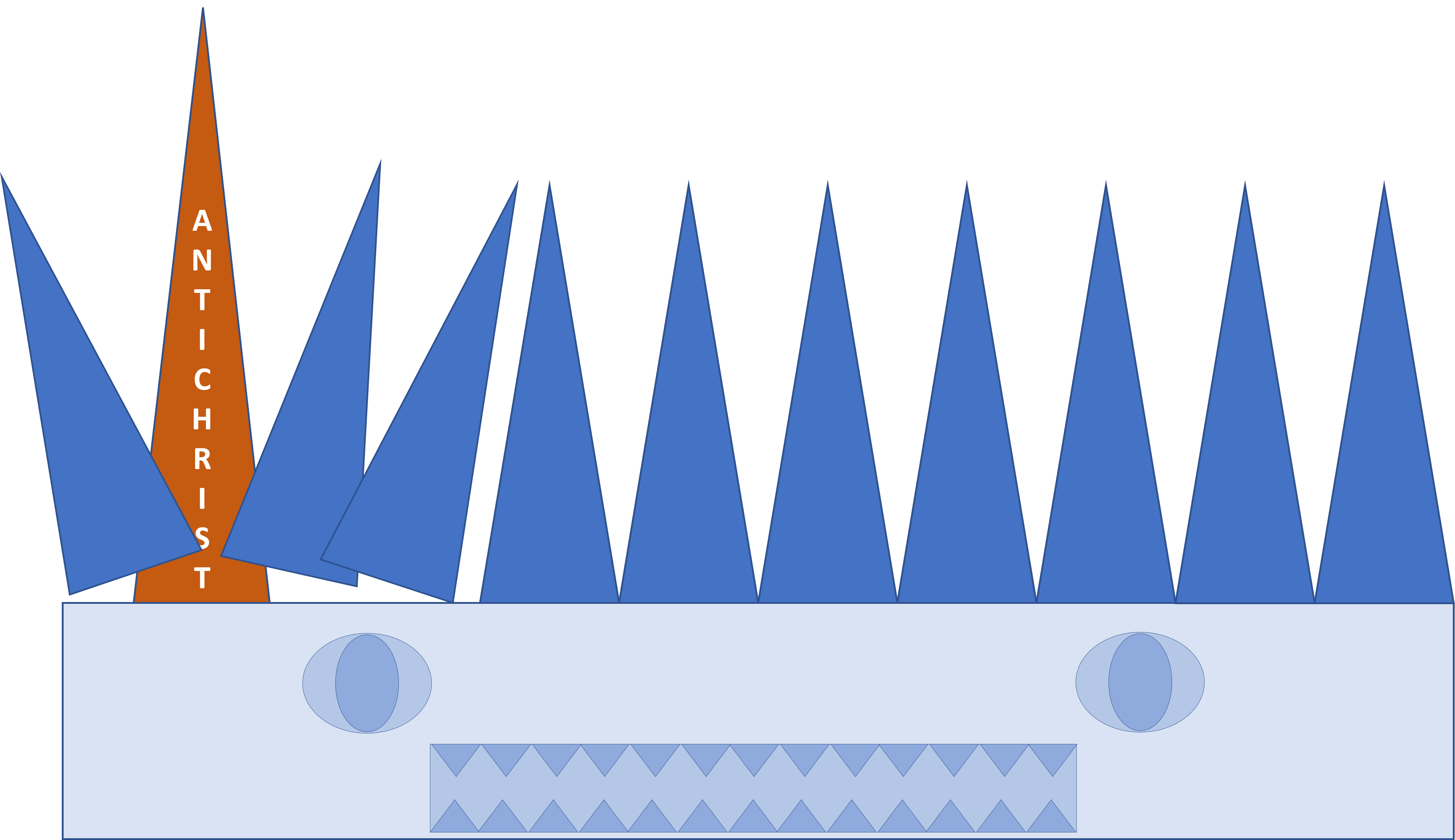
The Bible predicts that the Roman Empire will exist in the end times, just prior to the Second Coming of Christ. In Daniel 7, this “revived” Roman Empire is depicted as a beast with ten horns. The ten horns represent ten kings that will come out of the old Roman Empire.
It is in context of these ten kings that the Antichrist rises to power. When having the vision of the beast with ten horns, the prophet Daniel sees a little horn rising up among ten larger horns. This represents another king who arises after the ten kings are already in place.
I believe that Javier Solana has fulfilled this prophecy with remarkable accuracy, as I explained in a previous article.
Three of the Ten Horns Uprooted
When the little horn comes up, it uproots three of the original ten horns in the process.
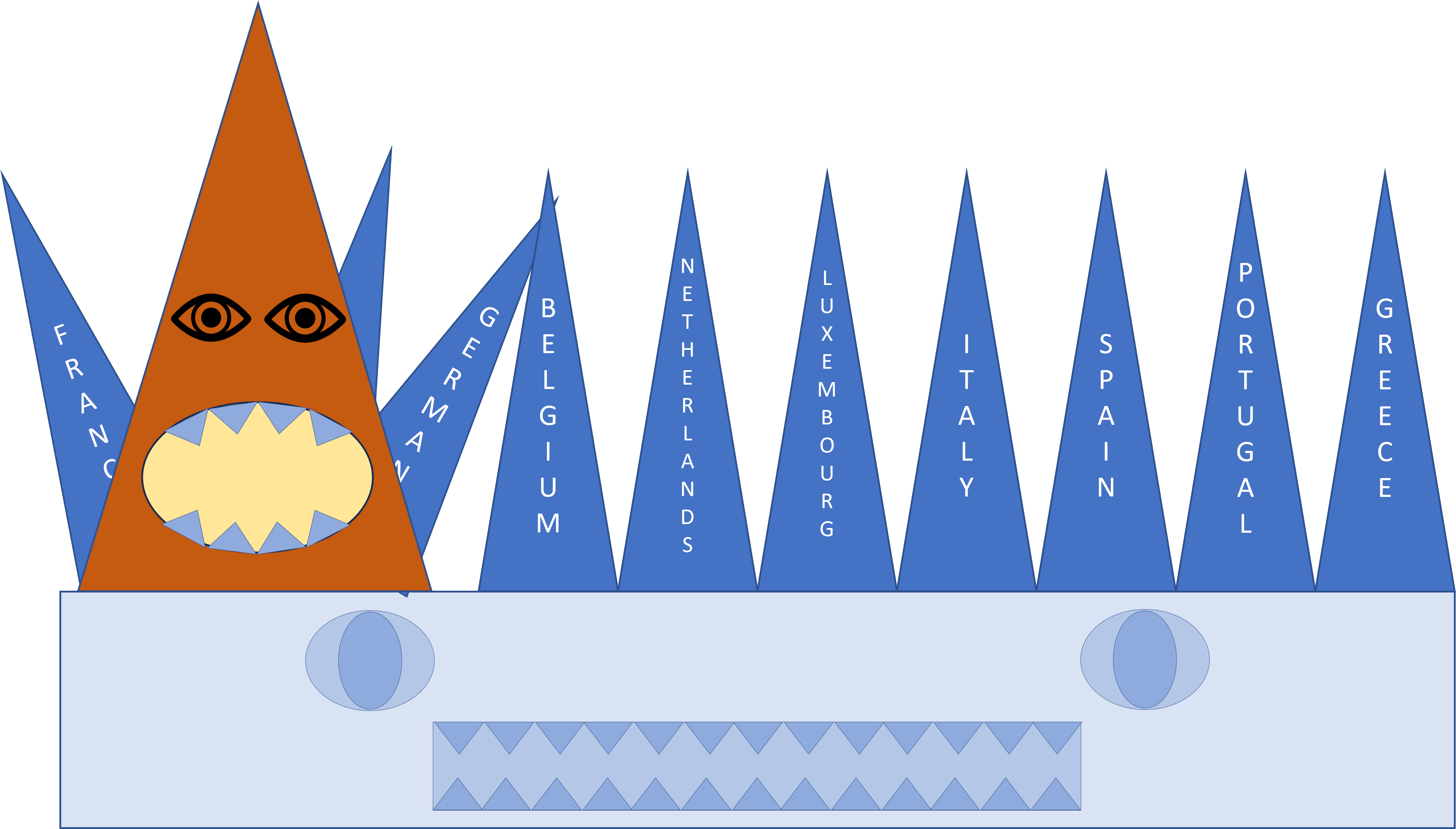
8 While I was thinking about the horns, behold, another horn, a little one, came up among them, and three of the previous horns were plucked out before it; and behold, this horn possessed eyes like human eyes, and a mouth uttering great boasts. (Daniel 7:8)123
When contemplating the horns, Daniel speaks of how the three horns “fell” due to the rise of the little horn. In his great curiosity, he wondered about the beast:
and the meaning of the ten horns that were on its head, and the other horn which came up, and before which three of the horns fell, namely, that horn which had eyes and a mouth uttering great boasts, and which was larger in appearance than its associates. (Daniel 7:20)
Later, the angel interprets this for Daniel, saying:
24 As for the ten horns, out of this kingdom ten kings will arise; and another will arise after them, and he will be different from the previous ones and will humble three kings. (Daniel 7:24)
What Does It Mean to Humble?
The Aramaic word for “humble” is shephel. A Concise Hebrew and Aramaic Lexicon of the Old Testament defines shephel in this way:
שׁפל: Heb. =: hafel: pf. 2. m. הַשְׁפֵּלְתְּ; impf. יְהַשְׁפִּֽל; inf. הַשְׁפָּלָה; pt. מַשְׁפִּֽיל: bring low, humble Dn 4:34; 5:19; 7:24; w. lebab humble onesf. 5:22. †4
Shephel occurs only four times in the Bible, all of which are in Daniel. In its 2020 update, the NASB translates every instance of shephel is translated as “humble” or “humbled.”5 6 The New American Standard Bible (NASB) is well-known as one of the most literal Bible translations available.
The NASB footnotes Daniel 7:24, saying that “humble” could also mean “humiliate.”7 This is consistent with the more detailed lexicon, called The Hebrew and Aramaic Lexicon of the Old Testament, which defines shephel in this way.8
However, a comparison of how the word is used elsewhere in Daniel gives us good reason to believe that the NASB correctly translated this as “humble.” It does not primarily refer to what happens to the three kings emotionally. For example, when describing Nebuchadnezzar’s political power, Daniel says:
Now because of the greatness which He granted him, all the peoples, nations, and populations of all languages trembled and feared in his presence; whomever he wished, he killed, and whomever he wished, he spared alive; and whomever he wished he elevated, and whomever he wished he humbled [8214]. (Daniel 5:19 - link to Aramaic in brackets)
Here, “humbled” is contrasted with “elevated.” This reinforces the idea found in another professional lexicon. The Enhanced Brown-Driver-Briggs Hebrew and English Lexicon: With an Appendix Containing the Biblical Aramaic defines shephel in this context as “to be low.”9 When someone does it to another person, it means to “bring low” or “put down.”
The New International Version is even more clear about the contrast, saying that Nebuchadnezzar “promoted” whoever he wanted and “humbled” whoever he wanted (Daniel 5:19 NIV). English Standard Version also carries the same nuance, saying that the king “raised up” whoever he wanted, in contrast to those he humbled (Daniel 5:19 ESV).
Many commentators believe this involves conquering the kings by force. Others say this involves removing them from office by toppling or displacing them. As we will see later, this fits the imagery of the little horn uprooting three horns. However, we cannot infer this from the angel’s interpretation alone.
Three Kings Deposed?
Interestingly, the author does not choose the word for “depose” or “removing” a king here. This is especially significant, given that Daniel doesn’t hesitate to use that word elsewhere for deposing kings or removing someone’s kingdom. A Concise Hebrew and Aramaic Lexicon of the Old Testament defines the word and gives examples here:
יְהַעְדּוֹן; pt. מְהַעְדֵּה: take away Dn 5:20; 7:12, 26, remove 2:21. †10
For example, Daniel 2:21 says:
It is He who changes the times and the periods;
He removes [5709] kings and appoints kings;
He gives wisdom to wise men,
And knowledge to people of understanding. (Daniel 2:21)
NIV is more explicit, saying that God “deposes” kings. This is exactly what the BDB Lexicon says this means in that context.11
In fact, the word for removing a king or a kingdom is used twice in Daniel 7…but not in verse 24.
As for the rest of the beasts, their dominion was taken away [5709], but an extension of life was granted to them for an appointed period of time. (Daniel 7:12)
Just two verses after it says the little horn humbles the three kings, it goes on to say that the Antichrist’s kingdom will be taken away.
24 As for the ten horns, out of this kingdom ten kings will arise; and another will arise after them, and he will be different from the previous ones and will humble [8214] three kings. 25 And he will speak against the Most High and wear down the saints of the Highest One, and he will intend to make alterations in times and in law; and they will be handed over to him for a time, times, and half a time. 26 But the court will convene for judgment, and his dominion will be taken away [5709], annihilated and destroyed forever. (Daniel 7:24-26)
The fact that Daniel used “taken away” in Daniel 7:26 but not in Daniel 7:24 shows that the meanings are different.
Ten Kings at the End
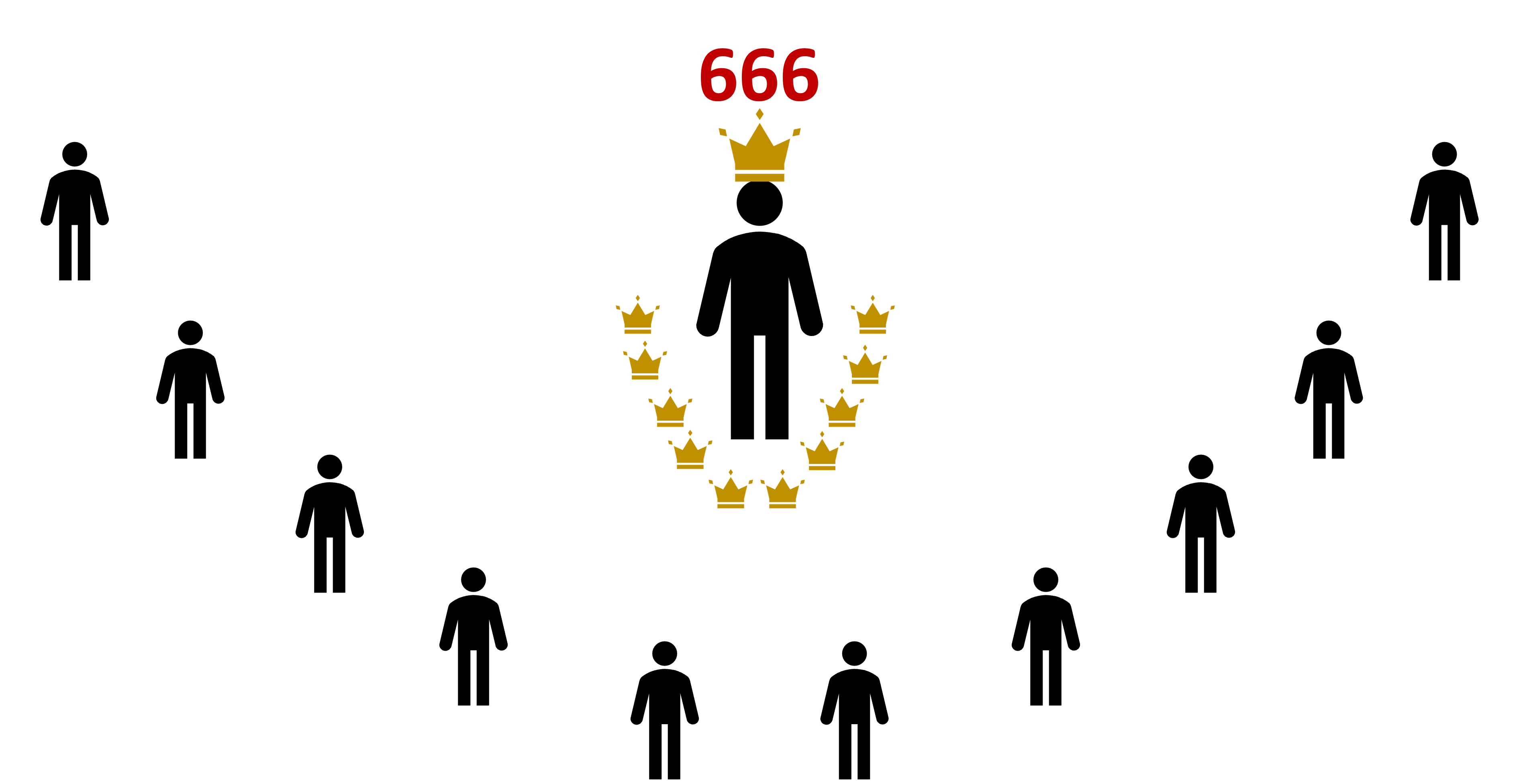
By reading the imagery of the horns in Daniel 7, you would think that the Antichrist removes 3 of his 10 colleagues, leaving himself and 7 other subordinates remaining. However, Revelation 17 paints a different picture. There, the ten kings give up their sovereignty to the Antichrist.
12 The ten horns which you saw are ten kings who have not yet received a kingdom, but they receive authority as kings with the beast for one hour. 13 These have one purpose, and they give their power and authority to the beast. (Revelation 17:12-13)
Furthermore, all ten kings wage war with the lamb, not just 7 of them.
14 These will wage war against the Lamb, and the Lamb will overcome them because He is Lord of lords and King of kings; and those who are with Him are the called and chosen and faithful.” (Revelation 17:14)
In addition, the ten horns (not just seven) are united in giving their kingdom to the beast in order to destroy the great city known as Babylon the Great.
16 And the ten horns which you saw, and the beast, these will hate the prostitute and will make her desolate and naked, and will eat her flesh and will burn her up with fire. 17 For God has put it in their hearts to execute His purpose by having a common purpose, and by giving their kingdom to the beast, until the words of God will be fulfilled. 18 The woman whom you saw is the great city, which reigns over the kings of the earth.” (Revelation 17:16-18)
Therefore, the 3 kings are not killed. Yet they are certainly made subordinate to the beast.
Javier Solana Humbles the E3
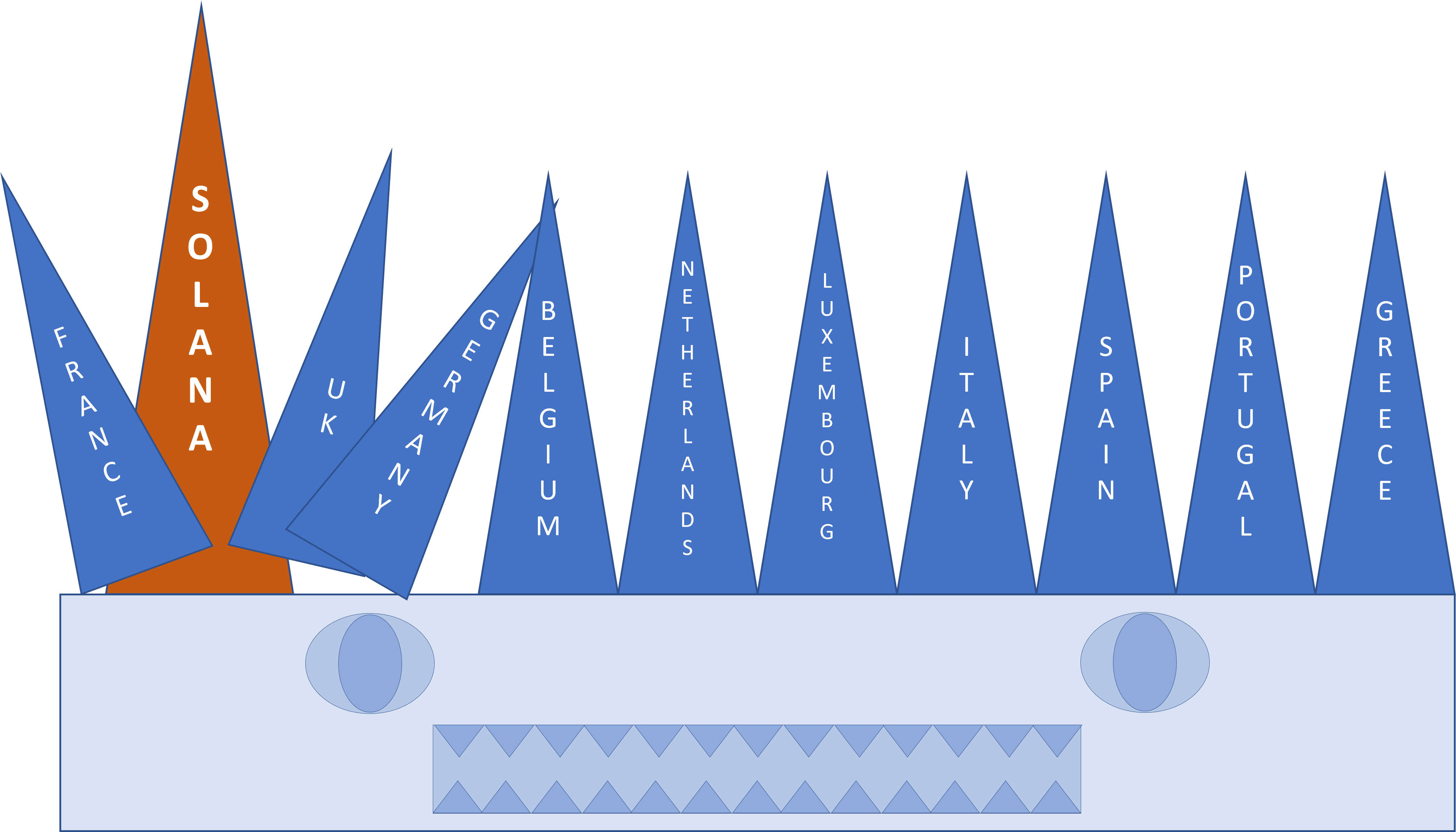
Javier Solana’s emergence and rise to power in the EU matches the description of the angel’s interpretation. Starting off as a “little” horn, he had less power than the other ten Western European Union nations.
In the early 2000’s, the E3 group, composed of France, the UK, and Germany, represented the EU in its negotiations over Iran’s nuclear program.12
The leaders of these countries were even accused of a power grab when they held a special meeting to decide the EU’s future.13
Nevertheless, the smaller EU countries naturally felt left out. As a result of their complaints, High Representative Javier Solana was included in the negotiations.14
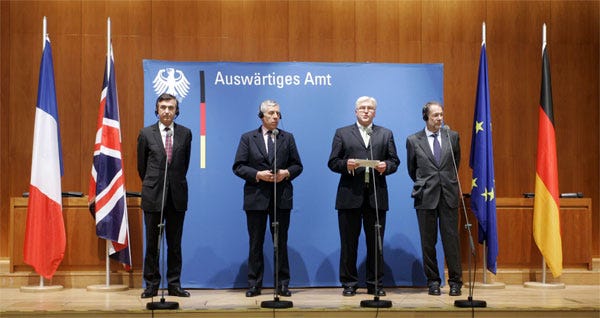
On 06/06/06, Javier Solana emerged before the world as leader of the group. Despite rarely being in the news, on this day he was seen across major news outlets. He was shown presenting a deal that the Iranians could potentially accept. Since he was the one presenting the deal, it was now Solana who was in the driver’s seat.15
New York Times also writes on the same day:
The European Union’s foreign policy director, Javier Solana, arrived in Tehran on Monday night with incentives intended to resolve the nuclear crisis with Iran,[...]16
A few months later, Reuters wrote an article, stating that he was the leader of the negotiations. Ahead of another meeting with Iran, Reuters writes:
Solana, who has headed Western negotiating efforts with Iran on the nuclear issue, [...] 17
As the EU’s External Action Service website summarizes:
Since 2006, the EU High Representative has led diplomatic efforts between the E3/EU+3 (China, France, Germany, Russia, the United Kingdom and the United States) and Iran, which led to the conclusion of the Joint Comprehensive Plan of Action on Iran’s nuclear program (JCPOA) in Vienna on 14 July 2015.18
Speaking with One Voice
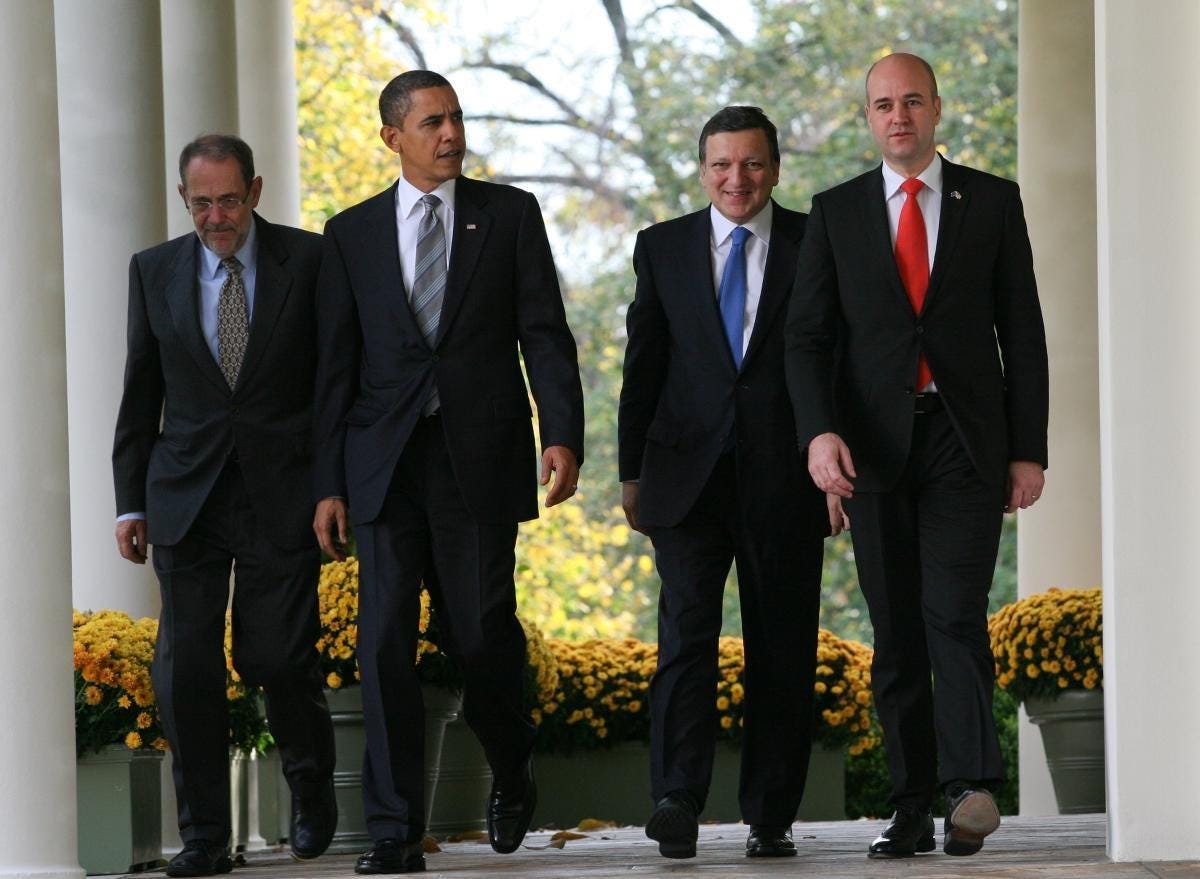
This change in who led European foreign policy was an important development for the European Union on the world stage. A major German newspaper, Der Spiegel, puts it quite accurately:
During his time in office, Solana established himself as a key negotiator and speaker for the EU on the subject of Iran’s nuclear capabilities. He also worked on raising the status of Europe internationally. Reflecting on his achievements, he said “We have given Europe its current world standing.”19
EUObserver also writes, summarizing his achievement in this area:
It took him some time to get himself established as one of the negotiators and speaker for the EU on the Iran nuclear issue, a topic where Britain, France and Germany took the lead.20
In another article, EUObserver also notes how this created a “rare success story” for EU foreign policy:
The “big three plus Solana” construction used by the EU in the Iran dispute is seen by many experts and diplomats as having produced a rare success story for EU foreign policy.
Not only has the EU so far largely spoken with one voice on Iran – as opposed to for example on the Middle East – but the bloc has also taken up a leading international role on the issue, with UN veto powers, the US, Russia and China, allowing Mr Solana to talk to Tehran on their behalf.21
Solana gradually replaced the E3 as the main speaker for the entire EU on the Iran nuclear issue. This is very consistent with the description of the horns, where the little horn gradually displaces the three larger horns.
One book on EU foreign policy summarizes his career quite well:
Dr. Solana also became, together with the Big Three states of France, the United Kingdom, and Germany, a major mediator in Europe’s relations with Iran since 2004. He presented the following three advantages. Internally to the EU, he represented all EU states and not just the Big Three. This was a major issue for small states, which asked for the inclusion of the High Representative in the negotiations (Sauer 2007, 10). In Iran itself, he was seen as a neutral actor as opposed to a negative actor such as the United States (Chubin 2006, 66).22
All this lines up quite well with how the little horn has “eyes like human eyes, and a mouth uttering great boasts” (Daniel 7:8b). The word “boasts” is not in the original text.23 However, the interpretation in Daniel 7:24 supports this interpretation.
Perhaps Solana becoming leader of the E3, especially with regard to who “speaks” for the EU, is a preliminary fulfillment of how the little horn will speak “great things” (Dan. 7:8 ESV).
Did Solana Really Fulfill the Prophecy?
Did Javier Solana “humble” the three kings as Daniel 7:24 says? Yes and no. I believe that Solana becoming the leader of the E3 was a preliminary fulfillment of the prophecy. As we will see below, it will be fulfilled more exhaustively in the future.
Prophecies often focus on political outcomes, not the messy processes it took to get there. For example, prophecies that have since been fulfilled in history about Antiochus IV “Epiphanes” show an interesting pattern. They often show “initial” instances of the fulfillment of prophecy that escalate over time until they are completely fulfilled.
Preliminary fulfillments and their historical precedent will be discussed in a forthcoming article. But for now, check out this section of my article on interpreting Daniel.
What Do the Theologians Think?
Theologians vary in their opinion of how the three kings are humbled. Some theologians believe that the humbling of the three kings is a violent event associated with military conquest or intimidation. Others take a non-violent view, seeing these three as merely deposed or even just outmaneuvered politically. Others do not specify exactly how this is done.
Nevertheless, a common theme among commentators is that:
the Antichrist will displace or replace three of the ten in some way
the Antichrist will gain sovereignty over these kings, violently or non-violently
The word “humble” is broad enough to include lowering someone’s rank. Yet the imagery of the little horn uprooting three kings is much stronger than merely politically demoting someone. This seems to greatly inform how Bible scholars interpret the passage.
We will have a look at their opinions and how they square with what happened in the past…and what might happen in the near future.
Political Maneuvering Instead of Violence
These theologians seem to take less non-violent interpretation:
“This little horn will be able to displace three of the other horns and usurp their power and prestige”
-Charles Feinberg, 198124
“What this means is that the Antichrist moves in and replaces three of the nations by some sort of political subterfuge and somehow maneuvers them until he arrogates their power to himself.”
David Jeremiah, 201925
Leon Wood gives a similar picture, saying the little horn:
“…is able to displace three of them shows that he becomes leader of the others.”
Leon Wood, 197326
Elsewhere, Wood argues that the displacement is a gradual process:
“This must signify that, when this king comes to power, he takes over control of the kingdoms of three of his predecessors. The word for “uprooted” (ʿqar) connotes a gradual process, where new growth pushes out old. The new king will not take control of all three areas at once, then, but over a period of time.”
-Leon Wood, 197327
Three Kings Removed from Office
Some theologians use slightly stronger language, implying the little horn will “topple” or “overthrow” the three kings. At the very least, this implies they get deposed or lose their jobs.
According to Charles Woodbridge, the little horn:
“…will seize power by toppling three other rulers…”
Charles Woodbridge, 196728
Elsewhere, Renald Showers states:
“Therefore, as he would be rising to power, he would overthrow three of the ten kings, thereby making himself more powerful than any of the other seven.”
-Renald Showers, 198229
Gleason Archer has an interesting proposal which compares this future event to the events of World War II. He says that the three kings will be directly ruled by Antichrist, whereas the other seven will be vassals.
24 The interpreting angel turned from the historic Roman Empire to its ultimate ten-horn phase (corresponding to the ten toes in Nebuchadnezzar’s dream-image [2:41–43]) and the emergence of the final world-dictator. He arises after ten horns have been set up and subdues three of these ten to his own direct rule. He will then subject the other seven states to vassalage, somewhat as Hitler subjected Norway, Holland, Hungary, and the Balkan countries to a leader of their local Nazi party. In theory they were separate nations, but in practice they were subservient to Hitler. There is apparently to be a strong personality cult attached to this empire of the little horn (cf. the quasi-deification of Hitler).
-Gleason Archer, 198530

Three Kings Violently Conquered
Others use much stronger language, saying that the little horn “conquers” three of the ten kings or nations. For example, John Walvoord says that:
The ten-horn stage and the ruler who will conquer three and then all ten of the kingdoms has not yet been fulfilled.
John Walvoord, 199131
Elsewhere, Stephen Miller writes:
The uprooting of three horns symbolizes that three kings or kingdoms (nations) will be conquered by the new ruler. Being “uprooted” denotes a violent overthrow and does not imply that an individual will merely succeed a previous king (or kings) to the throne, nor does it mean that the king will simply displace other rivals for his position of leadership. These “uprooted” rulers are not contenders to the throne but are in fact kings themselves. By force this king (the little horn) will subjugate other kings (and their kingdoms) who resist his quest to rule over them (or to incorporate them into his empire). When they capitulate, the empire symbolized by the ten horns comes under the aggressive king’s full control (cf. 7:24).
-Stephen Miller, 199432
J. Paul Tanner has the most detailed discussion of this event. In his commentary on Daniel, he makes the following remarks on the little horn:
“As he arises, three of the horns among the ten are ‘uprooted from it.’ This imagery of ‘uprooting’ denotes violent militaristic overthrow.”
J. Paul Tanner, 202033
Tanner explains this at length in another part of the book:
“According to Dan 7:24, the “little horn” (the antichrist) will “humble three kings.” As explained in the translation notes to this verse, the word translated “humble” (יְהַשְׁפִּל, yᵉhašpil) can have the idea of bringing low or overthrowing militarily. This suggests that there is some type of action on his part to assert his military power and subdue them. The text does not tell us the circumstances that lead to this action, but it is not difficult to piece together the parts of the puzzle. What we can discern from a study of Daniel and Rev 13–17 is that at some future point, ten rulers come together by treaty to form a confederacy. This could be by force or for some mutually advantageous reason (such as economic gain or military defense).”
-J. Paul Tanner, 202034
A few sentences later, Tanner says:
“Then, in light of Dan 7:24, we are told that the antichrist will humble three of the ten kings, a hostile action of a military nature. He apparently does not destroy these three, because Rev 17:16–17 indicates that the ten horns join league with the beast and unite with him in a “common purpose.” Yet his action against the three probably has the effect of compelling the remaining seven kings to submit to his demands and sovereignty. They probably realize that they cannot match him militarily, so they join forces with him.”
-J. Paul Tanner, 202035
In the above paragraphs, it seems Tanner is attempting to reconcile these two ideas:
Antichrist will humble three of the ten through a “hostile action of a military nature”
All ten kings form a confederacy where they voluntarily give their power to the Antichrist
Yet in his commentary on Revelation, Tanner seems to slightly soften his stance on the military aspect of the humbling of the three kings. Writing a couple years later, Tanner states:
“The fact that the antichrist subdues three of the ten kings implies that they rule at the same time. Whether he defeats them in battle or gains power over them in some other way is not clear, but apparently he does not destroy them. The result of this is that the ten-king confederacy is forced into submission to the antichrist. They continue to exist as ten kings, but now their authority is yielded to the antichrist.”
J. Paul Tanner, 202236
Evaluating the Different Views
When considering all these positions, the upshot here is that the little horn doesn’t stay “little” forever. He goes on to become the leader of the entire group. When contemplating the horns, Daniel says:
20 and the meaning of the ten horns that were on its head, and the other horn which came up, and before which three of the horns fell, namely, that horn which had eyes and a mouth uttering great boasts, and which was larger in appearance than its associates. (Daniel 7:20)
This is clear from the final description of the king:
The last king of the restored Roman empire, the Antichrist, will become the leading king of that time, having displaced three kings and gaining leadership thereby over the rest.
-Leon Wood, 197337
The Roman beast, ruler of the end time, will arise from the midst of the ten-nation confederacy and command the whole coalition.
Charles Feinberg, 198138
Renald Showers puts this quite explicitly, saying the little horn starts off with less power, but later gets more power.
Just as the eleventh horn originally was smaller than the other ten, because it rose up after they were already present, so the eleventh king initially would have less power than the ten kings, because he would begin his rise to power after they would be established in their positions of rule. Just as the eleventh horn became larger in appearance than the other ten, so the eleventh king would become more powerful than the ten kings. It is apparent, then, that the future Revived Roman Empire will become dominated by the rule of one man.
-Renald Showers, 198239
These theologians have great insights into the meaning of the humbling process. Of all the views described, I myself prefer Tanner’s updated view in his Revelation commentary. Yet, in light of these theologians’ interpretations, Solana’s past role, and current developments, we can make some educated guesses. We can consider what would need to happen in the near future for this prophecy to be completely fulfilled, rather than merely initially fulfilled.

What Could Happen Soon?
(The following sections will be updated and/or modified as current events progress.)
The Solana-era E3 group of France, UK, Germany had been dormant since 2016. This was due to the UK’s decision to leave the European Union in June of that same year.40 However, they have recently made a comeback due to the events in Iran and Ukraine.41
The E3 exists as an autonomous group. Though active as an elder statesman, Javier Solana (83) does not hold political office at the time of writing. Therefore, Solana’s actions in June 2006 remain an initial fulfillment. They do not represent the exhaustive fulfillment of all the details of this prophecy. For that to happen, the E3 would have to totally lose sovereignty to Javier Solana in such a way that he would overshadow the E3 group in dominance.
Interestingly, the little horn in Daniel 7 is not said to “grow” (Daniel 7:8). This is in strong contrast to Daniel 8, where the little horn there (Antiochus IV Epiphanes) “grew” in power in various directions (Daniel 8:9-10). This leaves open the possibility that Solana’s rise is not gradual as some theologians say. Rather, he moves from less power than the other ten (2006) and abruptly becomes “larger in appearance” than his colleagues upon reappointment to political office (2026?).
This is not as implausible as it sounds on the surface. In recent weeks there has been lots of talk of appointing an envoy on behalf of Europe to give them a “seat at the table” when it comes to ceasefire negotiations over Ukraine.42
At the height of all this talk, Solana gave a very relevant speech in European Parliament, where he was the recipient of a major award.43 Using caution but direct implication, he did not say the word “Ukraine.” Nevertheless, he was very explicit that the EU needed a seat at the table with the big powers, as it had been in the past during his tenure.44
EU leaders are split as to have a single envoy do negotiations, a group of nations, or some other format.45 However, as of today, there are rumors that the old E3 group intends to sit down at the negotiating table with Ukraine and Russia.46 This would make them the speaker for the EU on this subject.
Interestingly, the leaders of the E3 countries have some of the lowest approval ratings in all of Europe. Below are the approval ratings for each E3 leader as of April 2026.47
Friedrich Merz (Germany) - 19%
Emmanuel Macron (France) - 18%
Keir Starmer (UK) - 27%
However, if Solana is the little horn, then it would be him that would need to be speaker for Europe, not the E3. If Solana were to be reappointed to a high-ranking European position, he could potentially come in conflict with the E3 over who speaks for Europe.



President of Europe?
Particularly interesting in this regard is a European Parliament amendment in 2022, stating:
Amendment 3 a. Underlines the need to reduce the EU's institutional complexity, in particular the EU's external representation; proposes in this regard to merge the function of President of the European Council and President of the European Commission and create a single Presidency of the EU to enhance the visibility, efficiency and consistency of EU external action; calls to make the relevant treaty provisions more explicit in this regard;
Document reference PE736.669v01-0048
This amendment was introduced during the process leading up to the European Parliament resolution on amending the EU’s treaties.49 Though the document has no legal force, other prominent figures have called for a single EU president in recent history.50
If Solana were to eventually take such a role, it would have enormous implications for prophecy. The creation of a single EU president would make Solana the sole speaker for the EU on everything from Ukraine to Iran. In this case, he would most certainly be “larger in appearance” than his colleagues.
Perhaps the creation of such a role would put him directly at odds with the E3. Furthermore, Solana’s rise could cause such controversy regarding national sovereignty that the E3 leaders have to resign, or their governing coalitions are toppled, or generally forced out of office.
Time will tell. Come Lord Jesus.
All Scripture quotations are from the New American Standard Bible. 2020 ed. La Habra, CA: The Lockman Foundation, 2020.
“In the NASB, italics are used to communicate to the reader words that are not found in the original language but are implied in the original language or are needed for a complete thought in English” https://www.lockman.org/new-american-standard-bible-nasb/about-nasb-2020/
Unless otherwise noted, all bolded text within quotations reflects my own emphasis and does not appear in the original source.
William Lee Holladay and Ludwig Köhler, A Concise Hebrew and Aramaic Lexicon of the Old Testament (Leiden: Brill, 2000), 424.
Ludwig Koehler et al., The Hebrew and Aramaic Lexicon of the Old Testament: Aramaic, The Hebrew and Aramaic Lexicon of the Old Testament (Leiden; New York: E.J. Brill, 1994–2000), 2001.
William Lee Holladay and Ludwig Köhler, A Concise Hebrew and Aramaic Lexicon of the Old Testament (Leiden: Brill, 2000), 424.
“In the NASB, italics are used to communicate to the reader words that are not found in the original language but are implied in the original language or are needed for a complete thought in English” https://www.lockman.org/new-american-standard-bible-nasb/about-nasb-2020/
Feinberg, Charles L. 1981. Daniel: The Kingdom of the Lord. Winona Lake, Indiana: BMH Books. (p. 93)
Jeremiah, David, and C C. Carlson. 2019. The Handwriting on the Wall: Secrets from the Prophecies of Daniel. Nashville, Tennessee: W Publishing Group. (p. 147)
Wood, Leon J. The Bible and Future Events: An Introductory Survey of Last-Day Events. Grand Rapids, MI: Zondervan, 1973. (p. 99)
Wood, Leon J. 1973. A Commentary on Daniel. Eugene, Oregon: Wipf and Stock Publishers. (p. 188)
Woodbridge, Charles J. Phd. 1967. Bible Prophecy. 2nd ed. Chicago: Moody Bible Institute. (p. 40)
Renald E. Showers, The Most High God: Commentary on the Book of Daniel (Bellmawr, NJ: Friends of Israel Gospel Ministry, Inc., 1982), Da 7:15–27.
Archer, Gleason L. Jr. 1985. The Expositor’s Bible Commentary, Volume 7. Edited by Frank E. Gabelein. Grand Rapids, Michigan: Zondervan Publishing House. (p.93)
Walvoord, John F. Major Bible Prophecies: 37 Crucial Prophecies That Affect You Today. Grand Rapids, MI: Zondervan, 1991. (p. 314)
Miller, Stephen B.. Daniel: An Exegetical and Theological Exposition of Holy Scripture (The New American Commentary Book 18) (p. 206). B&H Publishing Group. Kindle Edition.
Tanner, J P. 2020. Daniel: Evangelical Exegetical Commentary. Edited by H W. House, and William D. Barrick. Bellingham, Washington: Logos Bible Software. (p. 412-413)
Tanner, J P. 2020. Daniel: Evangelical Exegetical Commentary. Edited by H W. House, and William D. Barrick. Bellingham, Washington: Logos Bible Software. (p. 457)
Tanner, J P. 2020. Daniel: Evangelical Exegetical Commentary. Edited by H W. House, and William D. Barrick. Bellingham, Washington: Logos Bible Software. (p. 457)
Tanner, J. Paul. The Book of Revelation: The Return of Christ to Reign Victoriously. Independently published, 2022. (p.136)
Wood, Leon J. 1973. A Commentary on Daniel. Eugene, Oregon: Wipf and Stock Publishers. (p. 198)
Feinberg, Charles L. 1981. Daniel: The Kingdom of the Lord. Winona Lake, Indiana: BMH Books. (p. 93)
Renald E. Showers, The Most High God: Commentary on the Book of Daniel (Bellmawr, NJ: Friends of Israel Gospel Ministry, Inc., 1982), Da 7:15–27.